


Page 6 - Demo
P. 6
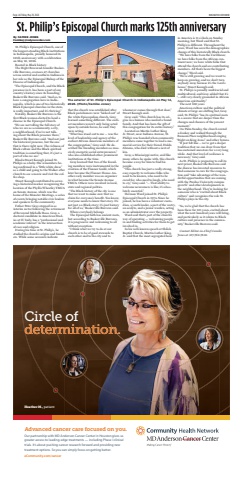
Page A6 Friday, May 29, 2026 INDIANAPOLIS RECORDERCircle ofdetermination.Heather M., patientOur partnership with MD Anderson Cancer Center in Houston gives us greater access to leading-edge treatments %u2014 including Phase I clinical trials. It%u2019s about pushing cancer research forward and providing new treatment options. So you can simply focus on getting better.eCommunity.com/cancerAdvanced cancer care focused on you.By CAMIKE JONES Camikej@indyrecorder.com St. Philip%u2019s Episcopal Church, one of the longest-standing Black institutions in Indianapolis, proudly honored its 125th anniversary with a celebration on May 10, 2026. Rooted in Black history The Right Reverend Jennifer Baskerville Burrows, oversees 47 churches across central and southern Indiana in her role as the Episcopal Bishop of the Diocese of Indianapolis. %u201cThe Episcopal Church, and the Black presence in it, has been a part of our country%u2019s history since its founding,%u201d Baskerville Burrows said. %u201cAnd so, to have a congregation here in Indianapolis, which is one of two historically Black Episcopal churches in the state, is really important, and it%u2019s thriving.%u201d Notably, Baskerville Burrows is the first Black woman elected to head a diocese in the Episcopal Church. %u201cWe are not telling the full story of who we are as a community, a city, a neighborhood, if we%u2019re not talking about the Black presence there,%u201d Baskerville Burrows said. %u201cAnd not just the historical presence, but the one that is there right now. The richness of Black culture and the Black spiritual tradition is something that, it%u2019s just a part of who we are.%u201d Rhoda Stuart Keough joined St. Philip%u2019s as a baby. She remembers being confirmed in a %u201clittle white dress%u201d as a child and going to the Walker after church to see a movie and visit the coffee shop. Stuart Keough contributed to securing a historical marker recognizing the location of the Phyllis Wheatley YMCA on Senate Avenue, which was the home of the Monster Meetings, a series of events bringing notable civic leaders and speakers to the community. Father Peter Gray stepped in as interim rector following the retirement of Reverend Michelle Roos. Gray, a doctoral candidate in American Studies at IU Indy, has a %u201cprofessional and academic interest%u201d in the intersection of race and religion. During his time at St. Philip%u2019s, he studied the church%u2019s origins and founders. While some accounts indicate that the church was established after Black parishioners were %u201ckicked out%u201d of the white Episcopalian church, Gray learned something different. The earliest members weren%u2019t only being acted upon by outside forces, he said; they were acting. %u201cWhat has stood out to me ... was the level of leadership and agency of the earliest African American members of the congregation,%u201d Gray said. He described the founding members as massively energetic social entrepreneurs,%u201d who also established other prominent institutions at the time. Gray learned that two of the founding members were instrumental in the creation of the Flanner Guild, which later became the Flanner House. Another early member was an organizer in what became the Senate Avenue YMCA. Others were involved in local, state and regional politics. %u201cThe Black history of the city is one that we want to make sure that we claim for everyone%u2019s benefit. You know, everyone needs to know that story. It%u2019s not just a a Black story; it%u2019s just history for all of us,%u201d Baskerville Burrows said. Where everybody belongs The Episcopal faith has ancient roots, but according to Baskerville Burrows, it is progressive and welcoming to all without exception. %u201cI think what we try to do at our church is to be of good stewards to each other and to the city and to whomever comes through that door,%u201d Stuart Keough said. Gray said, %u201cThis church has its origins in a human who needed a found family. And that has been the gift of this congregation for its entire history.%u201d Located on Martin Luther King Jr. Street, near Indiana Avenue, St. Philip%u2019s was founded when community members came together to lead a memorial service for their friend, Hulda Abrams, who died without a next of kin. Gray, a Mississippi native, said like many others he spoke with, this church became a way for him to find his people. %u201cThis church has just a really strong, easy capacity to welcome folks who need to be known, who need to be cared for, who need to laugh, who need to cry,%u201d Gray said. %u201c... That ability to welcome newcomers is like, it%u2019s absolutely essential.%u201d Herman Ward joined St. Philip%u2019s Episcopal Church in 1974. Since he joined, he has been a volunteer custodian, a youth leader, a part of the vestry, an acolyte, and a junior warden, acting as an administrator over the property. Ward said that%u2019s part of the church%u2019s way of operating %u2014 welcoming people in and finding activities for them to get involved in. In his well-known speech at Shiloh Baptist Church, Martin Luther King, Jr. said that the most segregated hour in America is 11 o%u2019clock on Sunday morning, but Ward said that St. Philip%u2019s is different. Throughout the years, Ward has seen the demographics change of this historically Black church. %u201cWe have folks from the Caribbean; we have folks from the African continent now; we have white folks that attend the church and are contributing members. All that%u2019s been the biggest change,%u201d Ward said. %u201cWe%u2019re still growing and we want to keep on growing, and we don%u2019t turn anybody away because it%u2019s the Lord%u2019s house,%u201d Stuart Keough said. St. Philip%u2019s is proudly multiracial and multicultural, and Gray added that it%u2019s %u201c... still very clearly grounded in African American spirituality.%u201d The next 100 years American culture and the political climate at large are shifting but, Gray said, St. Philip%u2019s %u201chas its spiritual roots in a source that are deeper than the changes and chances of the present moment.%u201d On Palm Sunday, the church rented a donkey and walked through the Ransom Place neighborhood singing %u201cRight on King Jesus%u201d and other hymns. %u201cIt just felt like ... we%u2019ve got a deeper tradition that we can draw from that has sustained ancestors for a very long while. And that level of resilience is necessary,%u201d Gray said. As St. Philip%u2019s is preparing to call its next priest, Baskerville Burrows said the diocese has invested resources to find someone to care for the congregation and %u201ctake advantage of the wonderful opportunities that are coming with the Purdue University campus growth%u201d and other developments in the neighborhood. They%u2019re looking for someone who is %u201cexcited about Black culture%u201d and recognizes the role St. Philip%u2019s plays in the city. %u201cSo, we%u2019re glad that the church has been there for 125 years, excited about what the next hundred years will bring, and particularly as it relates to Black culture and presence in the community,%u201d Baskerville Burrows said. Contact Editor-in-Chief Camike Jones at 317-762-7850. St. Philip%u2019s Episcopal Church marks 125th anniversaryThe exterior of St. Philip%u2019s Episcopal Church in Indianapolis on May 14, 2026. (Photo/Camike Jones)


