


Page 16 - Demo
P. 16
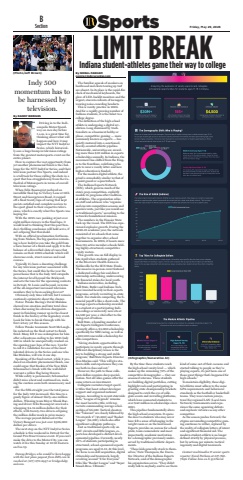
Friday, May 29, 2026B Section SportsBy NORAL PARHAMnoralp@indyrecorder.comThe familiar squeak of sneakers on hardwood and cleats tearing up turf are absent. In its place is the rapid-fire clack of mechanical keyboards, the glow of LED-backlit monitors and the urgent, staccato callouts of teenagers wearing noise-canceling headsets.This is varsity practice in 2026. And for a rapidly growing number of Indiana students, it is the ticket to a college degree.The definition of the high school athlete is undergoing a digital revolution. Long dismissed by traditionalists as a basement hobby or phase, competitive gaming %u2014 more commonly known as esports %u2014 has quietly matured into a sanctioned, heavily-scouted athletic pipeline. Nationwide, universities are awarding more than $30 million in esports scholarships annually. In Indiana, the movement has shifted from the fringes to the frontlines, redefining who gets to wear a varsity letter and how higher education is funded.For the modern digital athlete, the grind is remarkably similar to that of a point guard or a quarterback.The Indiana Esports Network (IEN), which governs much of the state%u2019s prep competition, explicitly models its programs after traditional athletics. The organization relies on staff and advisors who %u201corganize and execute competition seasons and special events, just like you would see in traditional sports,%u201d according to the network%u2019s foundational mission.The numbers in the Hoosier State back up the visual. The IEN has experienced explosive growth. During the 2020-21 academic year, the network consisted of 45 schools that came together to organize after-school tournaments. In 2026, it boasts more than 185 active member schools fielding highly-structured, competitive varsity rosters.This growth was on full display in late April when students gathered at the Riverview Health Arena in Noblesville for the IEN State Finals. The massive in-person event featured a dedicated college fair and direct internship networking, underscoring the financial stakes for local youth.Indiana universities, including Ball State, Butler and Indiana Tech, have invested heavily in their esports programs, actively recruiting in-state talent. For students competing, the financial payoff is like a cheat code. The average esports scholarship awarded to a student at a participating Indiana college or university now sits at $4,500 per year, a vital offset to the rising cost of tuition.Ball State, a founding member of the Esports Collegiate Conference, currently offers a $5,000 scholarship specifically for SIM racing, as well as a $12,500 renewable scholarship for elite competitors.%u201cGiving students opportunities to participate in varsity esports through different disciplinary lenses is the key to building a strong and stable program,%u201d Ball State Esports Director Dan Marino said. %u201cThis will give students skills and experiences they can use both in class and out.%u201dHowever, the path to those collegiate dollars requires deep specialization. Not all video games offer the same return on investment.Collegiate recruiters target specific titles that boast robust developer support and organized national leagues. According to recent statewide data, %u201cLeague of Legends%u201d remains the most lucrative title, with top recruits commanding average scholarships of $6,500. Tactical shooters like %u201cValorant%u201d are closely followed by %u201cOverwatch 2%u201d ($5,200) and %u201cRocket League%u201d ($4,100), which also offer significant collegiate pathways.Just as traditional sports rely on AAU circuits and little leagues, esports has developed a distinct developmental pipeline. Currently, nearly 30% of students participating in structured, school-sponsored esports programs are aged 11-13. At this level, the focus is on skill acquisition, digital citizenship and teamwork, largely revolving around %u201cE for Everyone%u201d titles like %u201cRocket League%u201d and %u201cSuper Smash Bros. Ultimate.%u201dBy the time these students reach the high school varsity level %u2014 which makes up the remaining 70% of the competitive demographic %u2014 they are seasoned veterans. These students are building digital portfolios, cutting highlight reels and participating in grueling state championship brackets designed to catch the eye of collegiate scouts and recruiting platforms, which have connected students to over $40 million in scholarships since 2021.This pipeline fundamentally alters the high school ecosystem. It opens the door to students who may never have felt a sense of belonging in the weight room or on the hardwood. Esports provides an avenue for school pride, team camaraderie and most importantly, academic motivation for a demographic previously underserved by traditional athletic departments.%u201cThese kids generally stuck to themselves,%u201d Nate Thompson, the Executive Director of the Indiana Esports Network, said of the demographic his organization serves. %u201cThey didn%u2019t really talk to anybody, and to see them kind of come out of their cocoons and started talking to people as they%u2019re playing esports, it%u2019s just been one of those great things that%u2019s happened for high schools.%u201dTo maintain eligibility, these digital athletes must adhere to the same GPA requirements and behavioral standards as the football or basketball teams. They wear custom jerseys, travel for regional LAN (Local Area Network) tournaments and experience the same agonizing defeats and euphoric victories as any other competitor.As the season pushes forward, the stigma surrounding competitive gaming continues to wither, replaced by the reality of collegiate letters of intent and significant financial aid. The modern student-athlete is no longer defined strictly by physical prowess, but by actions per minute, tactical ingenuity and digital teamwork.Contact multimedia & senior sports reporter Noral Parham at 317-762-7846. Follow him on X @3Noral.LIMIT BREAK Indiana student-athletes game their way to collegeIndy 500 momentum has to be harnessed by television.By DANNY BRIDGES%u00a0Driving in to the Indianapolis Motor Speedway on race day before 5 a.m. is a great time for thinking about what will happen and how it may impact the NTT IndyCar Series, which historically sees a huge bump in television ratings from the greatest motorsports event on the entire planet.How to capture the vast opportunity from yet another phenomenal finish is the challenge for the NTT IndyCar Series, and their television partner Fox Sports, and indeed is a tall task for those calling the shots in a sport that has struggled%u00a0away from the Cathedral of Motorsports in terms of overall television ratings.When Felix Rosenqvist parlayed an incredible final lap to Victory Lane at 16th Street and Georgetown Road, it capped off a final twenty laps of racing that kept purists satisfied and complete novices to the sport glued to their respective televisions, which is exactly what Fox Sports was hoping for.With the 2025 race peaking at just over eight million viewers in the final laps, it would lend to thinking that this past Sunday%u2019s thrilling conclusion will hold serve, if not eclipsing that threshold.%u00a0With an official proclamation forthcoming from Nielsen, the big question remaining is how IndyCar can take the gold from a barn burner of a finish and apply it to the balance of a diversified slate of races that remain on their 2026 schedule which will showcase ovals, street courses and road courses.Typically it%u2019s been a daunting challenge for any television partner associated with the Series, but could this be the year the powerhouse that is the Indy 500 catapults the interest level beyond the Brickyard, and sets the tone for the upcoming contests in Detroit, St. Louis and beyond, in terms of the all-important increased television numbers they%u2019re been seeking forever?Obviously only time will tell, but I remain cautiously optimistic about the chance.Notes: Penske Racing%u2019s David Malukas showed raw emotion and later total class when discussing his obvious disappointment in finishing runner up in the closest finish in the history of the legendary event. Look for him to break through with his first victory yet this season.%u00a0Fellow Penske teammate Scott McLaughlin rocketed on the final restart to finish third. Many felt it was redemption for him after a disastrous ending to his 2025 Indy 500 in which he unexpectedly crashed on the opening pace laps of the%u00a0race. I prefer to call it a validation for one of the most talented drivers in the Series and one who like Malukas, will win it one day.Speaking of the final restart, while it produced an absolute phenomenal finish, one could argue that Rookie of the Year Mick Schumacher%u2019s brush with the wall didn%u2019t warrant a yellow flag being thrown.While safety is paramount, Schumacher didn%u2019t miss a beat and continued on, making the caution seem both unnecessary and odd.For the fifth straight year the total purse for the Indy 500 increased, this time to a gaudy figure of almost thirty-one million dollars. Winning team Meyer Shank Racing and driver Felix Rosenqvist received a whopping $4.34 million dollars for their efforts, with twenty-two drivers eclipsing the million dollar mark in prize money.%u00a0The average payout%u00a0disbursed at the Victory Banquet was just over $936,000 dollars per driver.%u00a0The next stop on the NTT IndyCar Series schedule is this weekend in Detroit for the Grand Prix Street Course event. If you can%u2019t make the drive to the Motor City, you can watch it live this Sunday at 12:30 Eastern on Fox 59.Danny Bridges, who would%u2019ve been happy with the last place payout from IMS,%u00a0can be reached at (317) 370-8447 or bridgeshd@aol.com.(Photo/Jefi Brown)(Infographic/Generative AI)


