



He is known by name names: Santa Claus (or simply Santa), St. Nicholas (or simply St. Nick), Father Christmas, Kris Kringle, Sinterklaas. But what is Santa’s “backstory’? Where is he from? Is he a myth, a legend, or an actual historical figure?
When the vast majority of Americans think about Santa Claus, the Middle East is likely the furthest thing from their minds. However, the story of the real man – St. Nicholas – who ultimately became “Santa” begins in the seaside town of Patara, Lycia – which we now know as Turkey.
This makes sense because Turkey is often considered to be a type of literal and philosophical bridge between East and West. Traditions and stories from the Middle East (or Ancient Near East) often spread to Europe via Turkey.
This leads us to the man who would become Santa Claus. Born circa 280 A.D., Nicholas was a deeply religious man who was also known for his generosity. He is said to have been born into wealth and was orphaned when he was young. For whatever reason, Nicholas spent his life giving away his fortune. He was eventually elected Bishop of Myra (now Demre). In honor of his piety and selflessness, hundreds of churches have been dedicated to St. Nicholas.
Still, having lived during the Roman Empire, Nicholas was subject to the vicissitudes and whims of its leaders. In particular, Diocletian was known for persecuting Christians. In fact, he imprisoned Nicholas because of his faith. Fortunately, Diocletian’s successor was Constantine, who freed Nicholas and other Christians via his Edict of Milan in 313 A.D. This allowed Nicholas to attend the First Council of Nicaea in 325 A.D.
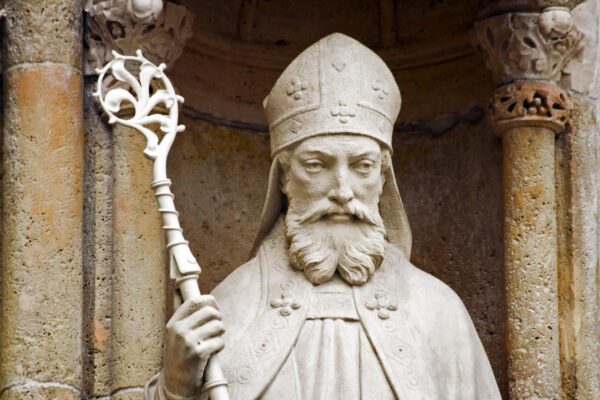
The boundary between myth and history is often winding and hazy. That is certainly true in the case of St. Nicholas, who is venerated both in Catholic and in Greek Orthodox traditions. Perhaps the best-known story about Nicholas is that he gave three indigent sisters a dowry – money that prevented them from having to be sold into slavery or forced into prostitution.
Some stories are, well, less certain. Nicholas is said to have been able to fly and even to raise people from the dead. I’m not saying whether those accounts are true or untrue, but I’d have to see them to believe them.
Despite Nicholas’ immense popularity, the Protestant Reformation of the 16th century almost achieved what Diocletian had failed to do: Erase St. Nicolas from history.
Led by Martin Luther, the Reformation was initially intended merely to rebuke and to correct the Catholic Church for certain beliefs, policies, and practices (e.g., simony, indulgences, nepotism). One major point of contention was the veneration of saints, of which Nicholas was one. Most of the “reformers” considered such reverence to be idolatrous, though some retained the practice, albeit in a toned-down manner.
One thing that casual observers might not realize is that St. Nicholas’ wardrobe changed dramatically over time. For example, he was initially pictured in the canonical robes and hats of a bishop. He was also much thinner in centuries past and often wasn’t even depicted with a beard. However, as the syncretic impulse caused various national traditions to compress, the religious garb of St. Nick gave way to the jolly, chubby, Cherubim-faced elf dressed in red that we all recognize today. (That’s due in no small part to Coca-Cola.)
St. Nicholas died on Dec. 6, 343. For hundreds of years, this was a “Feast Day” that was celebrated in Nicholas’ honor. It is also the day on which his followers gave small tokens or gifts to each other, mostly inexpensive ones. What we now know as “Christmas” evolved from this early tradition, with many interesting twists and turns along the way. (This includes some X-rated celebrations a few hundred years ago.)
As billions of people around the world await “Jolly Old Saint Nick” this year, let us remember that the world’s best-known gift-giver was a real person who we can all emulate. Generosity should not be measured by how much you give; it should be measured by how much you give up in service to others.
Contact community leader Larry Smith at larry@leaf-llc.com.





, St. Nicholas (or simply St. Nick), Father Christmas, Kris Kringle, Sinterklaas. But what is Santa’s “backstory’?)