Shortly before Martin Luther King Jr. was assassinated, a Harris Poll found that 75% of Americans disapproved of him. Yes, three out of four. White Americans’ disgust with King was driven by his unflinching commitment to racial equality and his staunch opposition to the Vietnam War. He spoke of “three evils” that are inextricably linked: racism, militarism, and poverty.
King had increasingly made known his pessimism about America, doubting whether his movement was truly dismantling racism at its roots. While he recognized the Civil Rights Act and the Voting Rights Act as historic victories, King understood that those laws had not sufficiently addressed socioeconomic discrimination. Poverty seemed to be an intractable maze from which millions of Blacks — and whites — could not escape.
Moreover, as King’s geographic aperture expanded, he found even greater opposition to racial integration in the North than he had experienced in the South. By his own account, King’s most vicious crowds were in Chicago — “America’s most segregated city.” Northern whites, who had often championed King’s movement when it was below the Mason-Dixon line, suddenly changed their tune.
Regarding the Vietnam War, King’s stance caused an irreparable rift between him and President Lyndon Johnson. Tragically, the war was still popular among most white Americans during King’s life.
Further, while whites disdained King much more than Blacks did, his standing had fallen precipitously among them as well. But their reasoning was completely different. Young Black activists, who were frustrated with what they felt was King’s too slow and insufficiently radical approach, derisively labeled him “De Lawd.”
In short, King had become persona non grata for being perceived by whites as doing too much and by Blacks for doing too little. For whites, opposition to King was hate; for Blacks it was hurt. Truly, King was caught between Scylla and Charybdis — a rock and a hard place.
And then he was killed.
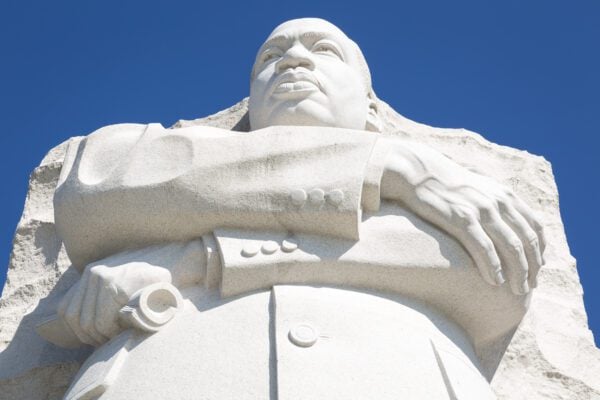
Everything changed. King’s murder made him a martyr. He went from being a pariah to being an icon. However, as I have written numerous times, this seismic shift came at a cost. Namely, King became sanitized. Commodified. Neutered. A couple of years ago I wrote:
“The court of public opinion has confined King to a virtual jail cell. He has been imprisoned by one phrase, in one sentence, in one paragraph, in one speech. I am referring to King’s plea that his children would ‘one day live in a nation where they will not be judged by the color of their skin but by the content of their character’. That phrase has been bastardized to transform King into a one-dimensional character (or caricature) as opposed to the incredibly complex 3-D human being he was. In short, King’s most famous quote is very frequently taken out of context and cynically used by people whose views on racial equality are the exact opposite of his. This is a fact that his children and those who were closest to him have made abundantly clear.”
“The bottom line is that the people who complain about DEI and ‘wokeness’ today are the direct ideological descendants of the very people and powers against which King fought until his final breath.”
The bottom line is that the people who complain about DEI and “wokeness” today are the direct ideological descendants of the very people and powers against which King fought until his final breath.
Today, the final insults to King come in two forms. One is the larceny of King’s legacy by comparing him to Charlie Kirk. Indeed, many of Kirk’s followers are attempting to meld King and the slain provocateur into a dynamic duo. However, it is impossible to imagine that King and Kirk would have embraced each other, especially given that Kirk tirelessly fought against racial equality.
Fortunately, we don’t have to employ our imaginations. We should let Kirk speak for himself when it comes to King: “Actually, MLK was awful. Ok? He’s not a good person.” There is no ambiguity in Kirk’s statement. I take him at his word.
Ironically, the other insult regarding King is a return to some of the criticisms that he faced during his life. For example, one popular line of argument is that King was a communist, despite his constantly preaching against that system. In the view of many Americans, then and now, there is no greater sin that being a communist.
Of course, if we don’t take King’s words to heart, the results of the FBI’s years-long surveillance of him should prevail. The Senate’s Church Committee, which oversaw the intelligence operation against King, wrote: “The FBI has stated that at no time did it have any evidence that Dr. King himself was a communist or connected with the Communist Party.” Facts don’t care about our feelings, or the lies that we tell.
So here we are. Those of us who do more than simply pay lip service to King now have the double duty of trying to extricate him from both the prison of his Disneyfied image and from the obscene Orwellian delusion that sets him up as Charlie Kirk’s muse.
It is arguably better to loathe King for what he was rather than to laud him for what he wasn’t.
Contact community leader Larry Smith at larry@leaf-llc.com.