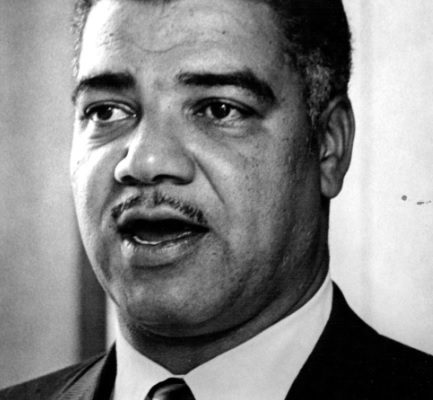

This column was published in the Indianapolis Recorder on April 13, 1968, the week after the assassination of Martin Luther King, Jr.
Dr. Martin Luther King, Jr. was a fighter for equality and racial justice — but he lived in a nation in which racism is rampant. And so he became still another martyr to racism and hate.
We will all cherish our memories of this great man. I recall marching with him in Selma and in Mississippi, and I worked closely with him for years. Most of us will always keep the memory of his “I Have a Dream” speech at the 1963 March on Washington.
He had a dream of a democratic society in which white people and Negroes worked together for peace and justice. He had a dream of hope and beauty, and he had a vision of what we could all become when we free ourselves from hate.
But our society is too sick to share that dream, and he was brutally struck down by an assassin.
We weep for him and for his family. But the pain that eats away at us should not obscure the message he left us.
He preached non-violence. It was his creed, and he was its symbol. It would be a tragic betrayal to turn our backs on this philosophy today. His death brought anger and disgust to the hearts of all men of good will, but these emotions must be repressed and channeled into other avenues.

If we do otherwise, he will have died in vain. Non-violence gave his life its meaning, and we’ve got to resist those among us who wish to get down to the level of his murderer. He lived by words and actions of peace, and we can’t betray his memory by worshiping the gods of vengeance and hatred.
We must instead, rededicate ourselves to the ideals for which he fought. We who believe with him in non-violence have been dealt a mortal blow, but we’ve got to redouble our efforts to prove that it can work.
The day after his assassination I saw the hurt and the shock on the faces of people in the streets. Whites and Negroes were united that day in pain and in a sense of personal loss. There were others too — those who used his death to loot and to vent their anger in the streets. Their actions were committed in his name, but were acts against his memory.
But he must not have died in vain. We — Negroes and whites — must create a living memorial to his memory. We have to stamp out the racism that took his life.
I fear for this nation. It is divided; it is racist; it lives by the gun and the bullet. A Civil Rights Bill is held up in Congress. A Riot Commission Report pointing to white racism and the terrible economic and social deprivation faced by Negroes as being the cause of our domestic crisis is ignored. Nothing has happened to change things.
A white reporter tried to assure me the night of the murder that the vast majority of whites bear no ill-will for Negroes. But I told him that that wasn’t the problem. The problem is that they have no will. They do nothing. They just watch while Negroes are beaten, killed, and exploited.
Dr. King will not have died in vain if his tragic death moves Americans from seeing race relations as a spectator sport to becoming involved in the fight for justice. They’ve got to fight for the things Dr. King fought for — open housing, anti-poverty measures, a national rededication and reconstruction and, as his death so tragically demonstrated the need, federal protection for civil rights workers.
His death must be given a meaning. We can’t allow it to become just another example of the results of the senseless and sick racism that permeates our society. The man who pulled the trigger committed an insane act, but he functioned in a society whose racism implicitly condoned and fostered it.
His death must be the occasion for a great upsurge of immediate and continued action by all Americans. The decent people can’t remain silent. A great void has been created. The moral and spiritual leader of this nation is dead, and while no single man can take Dr. King’s place, a resurgence of national morality and a rededication to his principles can help to fill the void.
Whitney M. Young Jr. (July 31, 1921 – Mar. 11, 1971) was an American civil rights leader.