
Like most Americans, I have had seemingly endless discussions in the wake of the murders of Renee Nicole Good and Alex Jeffrey Pretti at the hands of ICE agents in Minneapolis. Yes, I understand that “murder” is a legal distinction that must be determined in a court. However, what I have seen dozens of times, from multiple angles, leaves no doubt as to the moral question of the nature of Mrs. Good’s and Mr. Pretti’s deaths.
It will come as no surprise that most of my discussions have taken place among people with whom I generally agree. Humans naturally gravitate towards those who share their worldview. This notwithstanding, I have always found it important to engage in sincere dialogue with those who have different perspectives than I do. Doing so is crucial for one’s intellectual, moral and emotional growth.
I have learned that, even if I don’t change my thoughts, I have sometimes changed how I think. Still, some of my viewpoints are immutable (barring a literal act of God). Those views are based on my sense of morality. On occasion this gives rise to tension between morality and the law.
“… there are times when morality unmasks certain laws as unjust and even unjustifiable.”
To be clear, it is fair to refer to me as a “law and order” person. I’ve never been incarcerated. I’ve never even been arrested. I’ve instructed my children to obey the law. Yet, there are times when morality unmasks certain laws as unjust and even unjustifiable. And then there are occasions when moral laws are applied for immoral purposes.
Such is the case regarding the situation in Minneapolis. Our nation’s immigration laws, as currently constituted, are not inherently racist (as compared to, say, the Chinese Exclusion Act). However, President Trump and his key policy advisor, Stephen Miller, have repeatedly used racist language regarding immigration, both illegal and legal.
For example, Miller was revealed to have sent several hundred email messages to Breitbart News that encouraged the publication to push Great Replacement Theory and other white nationalist tropes. Further, researchers at American Oversight have repeatedly uncovered overtly racist anti-immigration communications between Miller and Trump officials. (American Oversight is a nonpartisan, nonprofit organization that strongly advocates for citizens’ right to review government records.)
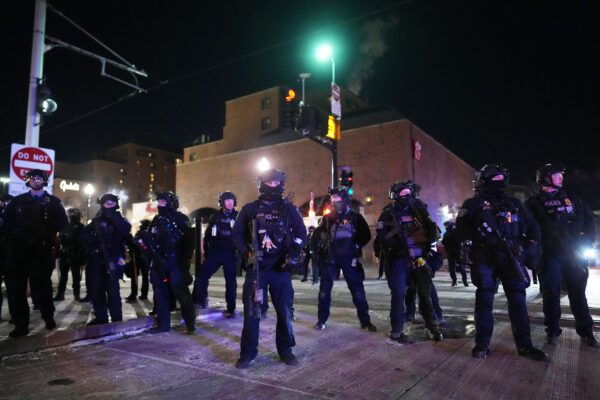
Thus, it is not at all a stretch to view the administration’s extreme actions in Minneapolis as not being motivated by a concern for removing “dangerous criminals” from our midst. Rather, their words in public and private lead to the unmistakable conclusion that Mr. Trump’s vision of a “greater” America means a “whiter” America.
Consider, for example, the all-Aryan version of America that has been pictorially promoted by the Department of Labor. Then there is the Department of Homeland Security’s New Year’s Eve’s post on X, which featured a photo of an empty beach (replete with palm trees) and a classic car. There were two captions on the post:
“America after 100 million deportations,” and “The peace of a nation no longer besieged by the third world.” (Note: There are only 50 million or so foreign-born Americans. Total.)
“For me, these warning signs have been clear since Donald Trump made racist stereotypes of Mexicans a cornerstone of his first campaign.”
For me, these warning signs have been clear since Donald Trump made racist stereotypes of Mexicans a cornerstone of his first campaign. Millions of Americans openly embraced his language, relieved that he had given legitimacy to their xenophobic concerns. Millions more dismissed such rhetoric as hyperbole, choosing instead to focus on economic concerns. We’ll call these people “moderates.”
Today, the inimitable words that Martin Luther King expressed in his “Letter from a Birmingham Jail” ring with frightening prescience:
“I must make two honest confessions to you, my Christian and Jewish brothers. First, I must confess that over the past few years I have been gravely disappointed with the white moderate. I have almost reached the regrettable conclusion that the Negro’s great stumbling block in his stride toward freedom is not the White Citizen’s Councilor or the Ku Klux Klanner, but the white moderate, who is more devoted to ‘order’ than to justice; who prefers a negative peace which is the absence of tension to a positive peace which is the presence of justice; who constantly says: ‘I agree with you in the goal you seek, but I cannot agree with your methods of direct action;’ who paternalistically believes he can set the timetable for another man’s freedom; who lives by a mythical concept of time and who constantly advises the Negro to wait for a ‘more convenient season.’”
King continued:
“Shallow understanding from people of good will is more frustrating than absolute misunderstanding from people of ill will. Lukewarm acceptance is much more bewildering than outright rejection.”
Those moderates who continue to make excuses for the Trump administration are the ideological descendants of those to whom King was referring. They are “law and order” people who must come to understand that some actions are legal even though they are immoral, and that some actions are illegal even though they are moral.
It is better to die on your feet than it is to live on your knees.
Contact community leader Larry Smith at larry@leaf-llc.com.