
The numbers tell a striking story: Per Brookings Institution, Black Americans are now more likely to consider starting a business than a decade ago.
Yet something happens at the intersection of intention and action. The barriers aren’t simply about capital — though that remains significant. They’re about networks, knowledge transfer and the courage to step out when the systems weren’t designed for them to succeed.
Across Indianapolis and beyond, Black entrepreneurs are rewriting that narrative. They’re leaving corporate America in droves and building businesses on their own terms.
The corporate exit: ‘It takes courage to be an entrepreneur.’
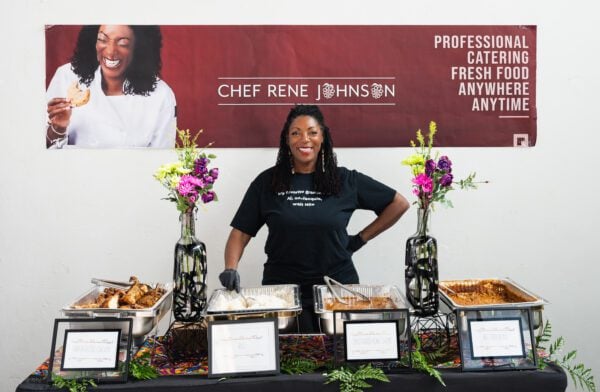
For Chef Rene Johnson, the journey began not in a commercial kitchen but in the mortgage industry. In this field, she had no degree, no experience and every reason to doubt herself.
“I was going through a divorce and my mother had said to me, ‘Just go back to your husband,'” Johnson told the Indianapolis Recorder. Instead, she spotted a newspaper ad for a loan officer position, called on a Thursday, and started work Monday.
Within months, she was walking into her boss’ office with 30 loans, needing a mail cart to carry them all.
That inner voice — the one that carried Johnson through a successful mortgage career — would eventually power BlackBerry Soul Catering, one of the Bay Area’s most requested catering companies, and now Link and Thrive, a platform teaching entrepreneurs the difference between networking and referrals.
“It takes courage to be an entrepreneur,” Johnson said. “It takes courage to have enough faith to step out there and know you’re going to have enough customers, that you’re going to be able to feed your children or pay your bills.”
That courage is being tested daily as corporations roll back diversity initiatives. Apple recently saw the departure of Lisa Jackson, its highest-ranking Black executive. Tractor Supply Company faces backlash from the National Black Farmers Association after eliminating all its DEI roles. Target faced similar fallout after rolling back its DEI initiatives.
For Black entrepreneurs, the message is clear: if you want a seat at the table, sometimes you have to build your own.
The knowledge gap: ‘We don’t talk about this at dinner time.’
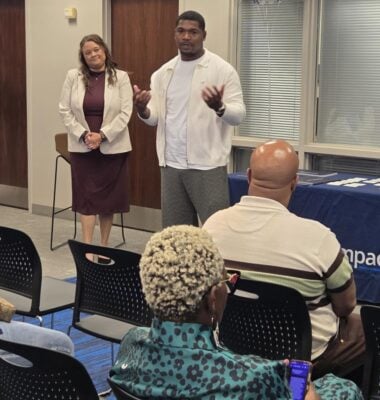
When Curtis Collins entered Chase’s Coaching for Impact program, he was in his 20s and hungry for information that wasn’t available in his immediate circle.
“I didn’t really have access to information that would help my dreams, Collins aid. “Others were born into a lot of the information and access. We didn’t know much about credit, we didn’t know much about business, we didn’t know about loans and LLCs and things like that.”
That knowledge gap is generational. Research shows that Black entrepreneurs have fewer opportunities than white entrepreneurs to gain pre-business experience through family businesses.
Alejandra Amezcua, who runs a multicultural distribution business with her husband, Uvaldo Mondragon, puts it bluntly: “Financial literacy in our communities is definitely not something that we talk about at dinner time. We’re mostly focused on the survival of the day-to-day.”
Mondragon spent 20 years in the industry before realizing what he didn’t know.
“I know the profit, I know how much I have to put in, but I didn’t know what the heck an LLC was,” Mondragon said. “If I didn’t have the experience I have now and I started, I would have failed in six months.”
That’s where programs like Coaching for Impact come in. Shellie Vernon, a Chase business consultant, works with entrepreneurs on five key areas: capital access, cash flow management, building teams of trusted advisers, marketing and cybersecurity foundations.
“The answers are out there on how to get approved for funding, how to pivot and put yourself in the right positioning, how to create processes,” Vernon said. “We just don’t know where to get them.”
Community over competition: The new Black Wall Street

The modern Black Wall Street movement, founded in 2015 by Martell Matthews and Frank Perkins, operates on a simple premise: collaboration over competition. By connecting Black business owners across the diaspora through a digital ecosystem, the movement has helped thousands of entrepreneurs scale.
That ethos echoes what Johnson teaches through Link and Thrive. Her distinction between networking and referrals is sharp: networking is saying hello; referrals mean someone leaves with money in their pocket.
“When you hand out a business card, you are handing out money,” Johnson said. “If you receive a business card, know you can give some money back.”
She recalls a recent encounter with a loan officer who missed the point entirely. Johnson mentioned she had a stalled loan, and the officer handed over his card but didn’t ask for hers.
“I said, ‘Did you not hear me just say I have a referral? You didn’t ask me for my card, and you lost some money.’”
AI and the future: ‘We have to be at the table’

For Camille Walker, the entrepreneurship journey intersects with one of the most consequential technologies of our time. Through Lamira AI, she trains artificial intelligence systems to be more ethical — and trains people of color to get involved in AI development.
“If our community, especially Black and brown communities, are not a part of this early stage of developing AI, we’re going to be left out,” Walker said. “And you’re going to have situations where we’re not represented in this technology, because we’re afraid of it.”
That fear may feel justified when data centers — the physical infrastructure powering AI — are disproportionately proposed for low-income neighborhoods like Martindale-Brightwood. Walker attended community meetings about a proposed data center near Sherman Drive in Indianapolis, listening as elders and stakeholders pushed back against yet another industrial project in a historically Black area.
“The tone needs to switch,” Walker said. “Instead of trying to convince the community members, we need to be convincing the data companies: here are our conditions. If you want the support of the community members, these are the demands we’re requesting that you meet.”
Walker sees AI as a tool — neither savior nor destroyer — that requires community investment to become benevolent.
“If we’re not investing, if we’re not being invested in, we’re going to be left out,” Walker said.
The path forward: ‘Don’t be scared.’

For entrepreneurs considering the leap, the advice from those who’ve done it is consistent.
“Where do you see yourself in 10 years?” Collins asked. “If you can’t give me an answer, it’s probably not for you. You’ve got to have some type of direction where you want to go.”
Mondragon’s more direct: “Just go do it. Don’t be scared. Nothing will happen if you don’t have faith.”
Amezcua thinks about the next generation — their children growing up alongside the business. She wants to build something that outlasts them, inspired by the women business owners she used to see while working for a food distributor.
“I definitely want to bring exposure to the women that I’ve met who were the owners,” Amezcua said. “That really inspired me to do it myself.”
Johnson, now preparing to hand BlackBerry Soul to her team so she can focus on Link and Thrive full-time, offers this simple wisdom:
“Just don’t be scared. Make sure that when you hand out that business card, you’re handing it out for money — not coffee.”
Contact Multimedia Reporter Noral Parham at 317-762-7846. Follow him on X @3Noral. For more news, visit indianapolisrecorder.com.

Noral Parham is the multi-media reporter for the Indianapolis Recorder, one of the oldest Black publications in the country. Prior to joining the Recorder, Parham served as the community advocate of the MLK Center in Indianapolis and senior copywriter for an e-commerce and marketing firm in Denver.