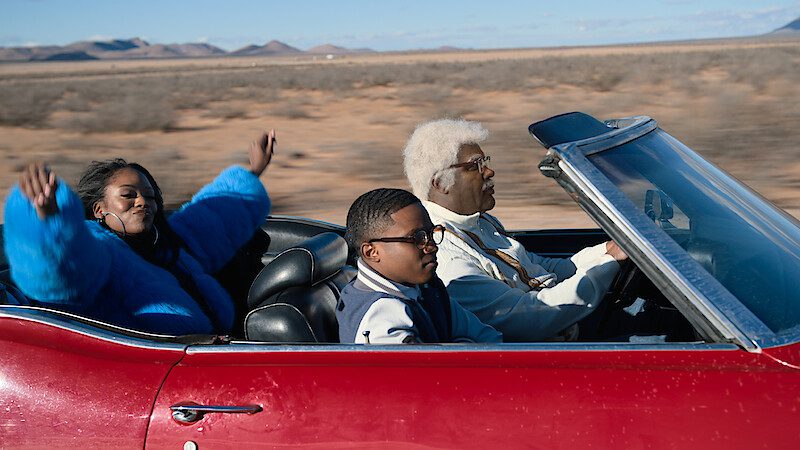
For decades, the Tyler Perry cinematic universe has operated within a very specific, often polarized, frequency. We knew the formula: the slapstick chaos of Madea, the high-octane melodrama of the ‘wronged woman,’ and the eventual Sunday-morning sermon that tied every loose thread into a neat, faith-based bow. However, with his latest offering, “Joe’s College Road Trip,” Perry hasn’t just broken the mold — he’s melted it down and recast it into something far more grounded, philosophical and unapologetically pro-Black.
In this film, Perry finally stops playing the gallery of stereotypes he once helped curate. Instead, he leans into a narrative that feels like a direct rebuttal to the post-racial delusions currently being fed to Generation Alpha and Gen Z.
From slapstick to substance
The most immediate shift is in the protagonist himself. For the first time, it feels as though Perry is tired of the wig and the pearls. In playing Joe for a full-length feature, Perry seems liberated. Joe has always been the family’s resident truth-teller — crude, yes, but anchored in a reality that doesn’t care about making non-Black audiences comfortable.
This shift mirrors the film’s technical execution. The cinematography is refined, the pacing is deliberate and the subplots that often cluttered Perry’s previous work are gone. In their place is an in-your-face exploration of Black history that demands appreciation over appropriation.
There is no run-of-the-mill sermon here; there is only the stark, uncomfortable reality of what it means to be Black in a country that is actively trying to edit you out of its textbooks. (Bring in the white Pharaohs.)
The myth of the level playing field
The heart of the film lies in the friction between BJ (played with a poignant naivety by Jermaine Harris) and his white peers. When BJ’s friends dismiss the necessity of Historically Black Colleges and Universities (HBCUs) under the guise that racism is dead and gone, Perry doesn’t just argue with them — he exposes the danger of their ignorance.
As a philosopher by vocation, I found this particularly striking. The film tackles the ‘we are not our ancestors’ rhetoric — a phrase often weaponized by those who have never felt the weight of a deck stacked against them from the womb. Perry brilliantly illustrates that for Black and brown Americans, the past is never truly past; it is a lived, ongoing disruption. The film serves as a newsflash to a younger generation: racism hasn’t disappeared; it has simply become more conscious, more systemic and more insidious.
A roadmap of blood and misery
This film is, quite simply, for us. The humor isn’t translated for a general audience; it is rooted in the specific, sometimes painful, cultural shorthand of the Black experience — ranging from the cotton fields to the complex pimps and jezebel archetypes that have been etched into our collective psyche.
The turning point of the movie occurs when Joe takes BJ on a tour of landmarks that offer no fun, only memories.
Misery.
The Lorraine Motel. Money, Mississippi. Birmingham. Joe’s message is clear: the next generation is intentionally underinformed. They are being taught that progress is a straight line, ignoring the fact that HBCUs and the National Pan-Hellenic Council (NPHC) weren’t born out of a desire for separation, but out of a necessity created by exclusion.
We built our own because we were told we didn’t belong in theirs.
The verdict: A legacy reclaimed
“Joe’s College Road Trip” is a hilarious, yet heartbreaking reminder of who we are and the heavy lifting our ancestors did to ensure we could even stand on the starting line — even if that line is still several steps behind our white counterparts.
Released just in time for Black History Month, the film feels like a reclamation of Perry’s own legacy. It is a call to keep fighting — professionally, mentally and emotionally. It tells us that while the world may want us to forget our slave-based lineage and the scars of our journey, our survival depends on our recollection.
Tyler Perry has finally stopped preaching at us and started riding with us. And the view from this road trip is exactly what everyone needed to see.
Contact Multimedia Reporter Noral Parham at 317-762-7846. Follow him on X@3Noral. For more, visit indianapolisrecorder.com.

Noral Parham is the multi-media reporter for the Indianapolis Recorder, one of the oldest Black publications in the country. Prior to joining the Recorder, Parham served as the community advocate of the MLK Center in Indianapolis and senior copywriter for an e-commerce and marketing firm in Denver.