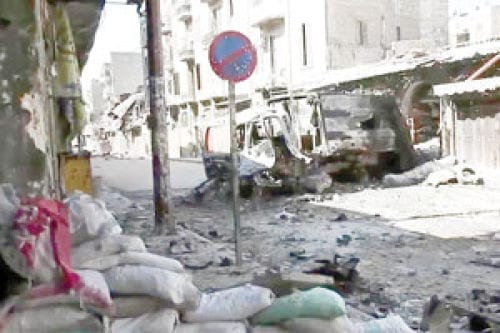

As the United States gears up for a possible air strike against Syria, Christian leaders around the world, nationally and locally are expressing their concerns.
Syria is currently engaged in a civil war between forces loyal to dictator Bashar Al-Assad, and those who want an end to his family’s iron fisted 43-year rule.
After it was reported that Assad’s forces had used chemical weapons on civilians, U.S. President Barack Obama announced that a limited armed strike (without the use of ground forces) might be needed to cripple Syria’s ability to use such weapons.
As Congress considers whether it will support military intervention against Syria, Christian leaders are weighing in on the matter.
In Rome, Pope Francis urged the world’s Catholics to unite in prayer and ask for “God’s great gift of peace upon the beloved nation of Syria.”
Pope Francis strongly condemned the Syrian regime’s use of chemical weapons, saying that the terrible images from recent days “are burned” into his mind and heart. Still, he took a stand consistent with all of his modern predecessors, opposing the use of military force against Syria as a solution.
“Never has the use of violence brought peace in its wake,” he stated. “War begets war, violence begets violence.”
In a view supported firmly by the Catholic Archdiocese of Indianapolis, Pope Francis encouraged all parties in the conflict to “follow the path of encounter and negotiation,” and added that the ultimate arbiter of justice of Assad’s forces is a higher power.
“A judgment of God and a judgment of history upon our actions are inescapable,” he said.
Civil rights leader and ordained Baptist minister, Rev. Jesse Jackson, also rebuked Assad’s use of chemical weapons against “his own people – against innocent civilians, including hundreds of children.”
He added, “Using chemical weapons in warfare is morally unjustified, unacceptable as a military strategy or tactic and in violation of international law.”
Jackson made international headlines in 1984 when he visited Syria to successfully negotiate the release of captured U.S. Navy pilot Bobby Goodman. He supports the use of military intervention if it has a wide range of domestic and international support.
In a statement this week, Jackson acknowledged that President Obama is in a “tough position” with “limited and no good options” when it comes to deciding how to handle Assad. He supports the president’s decision to call on Congress to debate whether or not a strike should be ordered against Syria.
“It’s clearly better to have 535 ayes and voices looking and speaking on the issues than just the president’s and his administration,” Jackson said. “Such congressional activity and authority would broaden the shared responsibility for whatever actions he finally decides to take or not take.”
Jackson also encourages the president to insist on a vote about the strike in the United Nations, seek support from international and regional groups such as NATO and the Arab League and to make a strong, clear legal case for a strike to the American people.
Although Syria is a predominantly Muslim country, Christian leaders believe that the believers of their faith also have a stake in its welfare.
Christians mostly affiliated with Eastern Orthodoxy account for over 10 percent of Syria’s population, and Syria joins Israel, Egypt and Lebanon as the countries that have the highest numbers of Christians in the Middle East.
By law, the president of Syria has to be a Muslim, but the country does not express a state religion, and some American Christians even say that the religiously moderate Assad regime has protected most Christians in the country from Islamic extremists.
Like most Christian minorities in the Middle East countries, Syrian Christians often protect themselves by striking deals with the government, according to research by the Human Rights Watch Advocacy.
U.S. Sen. Rand Paul, R-Ky., raised controversy this week after breaking ranks with many of his fellow Republicans in opposing military intervention in Syria, saying an overthrow of Assad could lead to a new Syrian regime that is even more hostile to the United States and Christians.
“I think the Islamic rebels winning is a bad idea for the Christians. All of a sudden we’ll have another Islamic state where Christians are persecuted,” said Paul, who was elected with significant support from conservative evangelicals.
More than 1.3 million Syrians have fled their war-torn country since its civil war began in 2011, according to the Untied Nations High Commissioner for Refugees. The conflict is often associated with the so-called Arab Spring, a movement across the Middle East to bring down autocratic governments.
In Indianapolis, Pastor Michael Jones of Progressive Baptist Church believes the actions of the Syrian government are appalling and unjustified, and agrees that the president is taking the correct course of action.
However, he added that overall, negotiated settlements are always preferable to violence, which can spawn a cycle that is hard to end.
“When we see violence, the causes are usually related to fear,” Jones said. “First John 4:18 says, ‘There is no fear in love, but perfect love drives out fear.’ We have to go back to valuing human life and loving each other.”