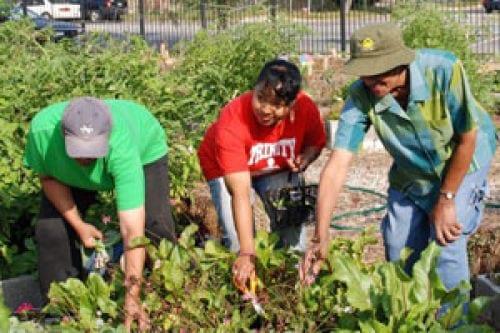

At Trinity United Church of Christ in Chicago, members and neighbors buy fruits and vegetables from a Black farmers market and work in an organic garden named after botanist George Washington Carver.
They recycle their church bulletins, plan to renovate their building with a “green” roof and have purchased 27 acres for a community project that will include an urban farm.
“By any greens necessary,” Rev. Otis Moss III, the church’s pastor, likes to say.
When it comes to African-American churches and a focus on the environment, Moss and his congregation is the exception rather than the rule.
Moss said many of his Black clergy colleagues are less interested in conservation and tell him: “That’s your thing.”
Black congregations have tended to focus on their members’ basic needs – getting jobs, rearing children, pursuing higher education.
Environmental matters have been a lower priority, said Rev. Dianne Glave, author of Rooted in the Earth: Reclaiming the African-American Environmental Heritage.
But although often reluctant to get on board, African-American churches are being encouraged to be advocates for conservation and environmental policy. And some have already answered the call. At a White House event recently, three Black clergy spoke at panel discussions on environmental justice and climate action.
Rev. Lennox Yearwood, CEO of the Hip-Hop Caucus, which works to engage young minorities on policy issues, took part in marches on the birthday of Rev. Martin Luther King Jr. that challenged the fossil fuel industry. As churches were once urged to stop divesting in businesses supporting apartheid in South Africa, he encourages congregations to divest from oil, gas and coal industries and invest in clean energy instead. This month, he’s the speaker at a Washington church event linking climate change and civil rights.
“There’s always many African-American leaders who are vocal,” he said. “I think the question is how we get the base of the congregations as vocal.”
He and other experts – many who are in the younger generation that have followed civil rights veterans – say they are working to bridge a gap between environmentalists and African-American churchgoers. They counter notions about lack of money and time to deal with seemingly esoteric issues by emphasizing how attention to the environment can reduce energy costs and lead to healthier eating habits in neighborhoods with no grocery stores.
Rev. Ambrose Carroll introduced a 10-minute video on Black churches and environmental issues at his Berkeley, Calif., church in February. It linked climate change to adverse affects on the Black community, such as children with asthma. A fellow of Green For All, which fosters diverse networks to support green industries, Carroll hopes the video will be a tool to reach out to denominational leaders and seminarians.
He also plans to connect with environmental groups that have successfully brought white churches on board with their efforts.
“They haven’t really been able to translate that message to why it’s important to people of color,” said Carroll.
That’s why GreenFaith, a national organization that builds environmental leadership through congregations, drafted Yearwood to lead a Black History Month webinar to discuss “eco-leadership and divestment” with African-American churches.
“We have found that the best ways to engage African-American congregations on these issues is through the lens of financial stewardship and health,” said Rev. Fletch Harper, executive director of GreenFaith. His organization recently enlisted an AME congregation in New Jersey that it expects will be the first Black church to complete its certification process, which includes making the buildings, worship and programs more environmentally friendly.
Since 2008, Rev. Michael McClain, a National Baptist Convention, USA, minister, has worked in five Southeastern states, building Black congregations’ awareness of climate change and its adverse effects on poor people and people of color. As the regional field coordinator of Creation Justice Ministries, a spinoff from the National Council of Churches, he’s organized trips to Capitol Hill so clergy can lobby for cleaner air and a reduction in carbon pollution.
At local, regional and national gatherings of Black churches, he has sounded this warning: “An unhealthy congregation would soon be no congregation.”
Moss, the pastor at Trinity United Church of Christ, said some are beginning to listen when he talks about the economic payoffs from connecting with farmers and reducing the costs of operating a church building.
Last year, the megachurch cut down on thousands of bulletins it prints for Sunday services by getting congregants to start using a mobile app instead.
“We’re trying to make all the connections,” Moss said. “Green is an act of social justice.”
Source: Religion News Service