
Few people know of the great African-American intellectual Dr. Howard Thurman, a man who had a great influence on Dr. Martin Luther King Jr. It was in 1935 that Thurman personally met Mohandas Gandhi in India, bringing back to America Gandhi’s message of non-violence. Gandhi noted, “It may be through the Negroes that the unadulterated message of nonviolence will be delivered to the world.” It may be important to note that King never met Gandhi the person; instead, through Thurman, King met Gandhi’s words, which put him on a pathway of non-violence as a means of guiding African-Americans to their destiny of freedom, justice and equality.
During this same time period, another pathway was being designed by Mr. W.D. Fard-Muhammad for African-Americans to tread in pursuit of their human and civil rights. Fard, a foreigner from India (modern-day Pakistan), deposited into Mr. Elijah Poole a new religion, “Islam,” and gave Elijah a new surname, “Muhammad.”
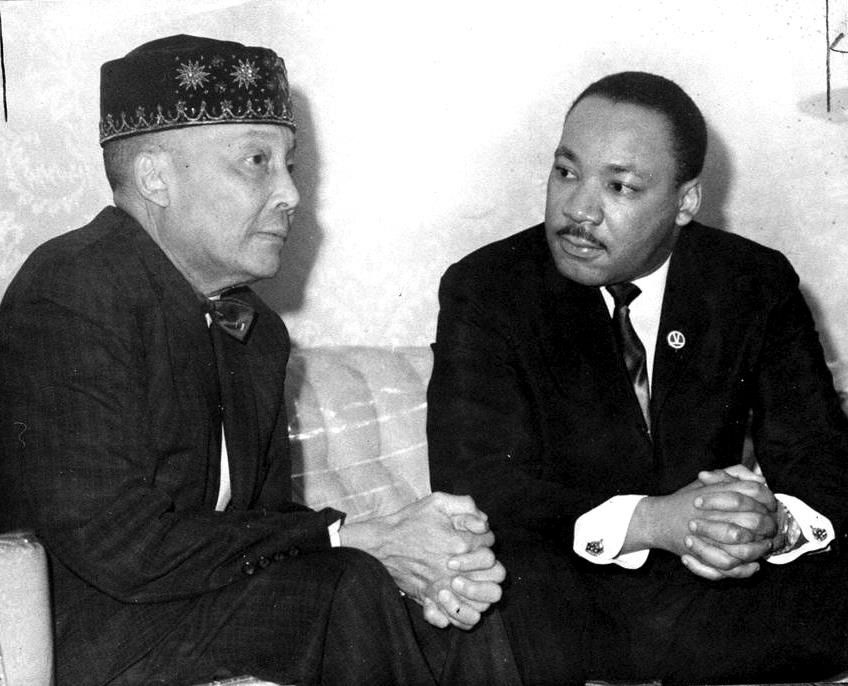
These two pathways — one calling for non-violence and integration, while the other called for racial separation and “do for self” — on the surface seemed to be at odds with one another. You may say the two methodologies seemed to be polar opposites; however, history reviewed is showing something quite different. When the leaders of these two pathways met in 1966, King, noting their place of birth, joked with Muhammad that they both “were Georgia boys.”
An important note to reiterate is that King and Muhammad both owed the birth of their missions to intellect from India. Fard and Gandhi, both of whom suffered under the oppression of Great Britain, had connected with the suffering souls of the Africans in America, and both “foreigners” had found a home within America via the African-American struggle toward one destiny.
Slavery’s dismantling of the African-ness in the orphans from Africa created a new people on earth in a new land and under unusual circumstances, yet still a people yearning to be free to chart their own destiny of human excellence.
Often the media presented the two movements as being at odds with each other, but frequently the pathway led by Muhammad intersected with the pathway of King; at times, they publicly and privately were working together. In 1968, Muhammad, via Julian Bond, gave many thousands of dollars to civil rights movement members who could not afford to attend the Democratic National Convention in Chicago. As King’s movement moved northward to address the Negro’s problem north of the Mason-Dixon Line, the two leaders worked in unison toward the destiny of human excellence for African-Americans.
Today, there are many lessons of unity that can be learned from these two great men. King and Muhammad left great legacies and influence not only upon African-Americans, but also upon the world. They were two “Georgia boys” who collectively led millions of people to the mountaintop of freedom, justice and equality without begging another race or ethnic group for anything.
King rightfully declared, “No document can do this for us. Not even an Emancipation Proclamation can do this for us. Nor can a Johnsonian Civil Rights Bill do this for us … if the Negro is to be free, he must move down into the inner resources of his own soul and sign with a pen and ink of self-assertive manhood his own Emancipation Proclamation.”
Muhammad’s final Savior’s Day address spoke a similar message. “I say that the Black man of North America have nobody to blame but himself. If he respects himself and do for himself, his once-slave master will come and respect him and help him to do something for self … I don’t believe in us, now in this modern time, laying down on the white man, looking for him to give us something to go for. He gave you something when he gave you freedom. That’s all you wanted. To be free to do something for self.”
We thank our Creator for blessing us with these two great leaders who represent divergent pathways to one great destiny of human excellence.
Michael Saahir is the imam at Nur-Allah Islamic Center. He can be reached at nur-allah@att.net.