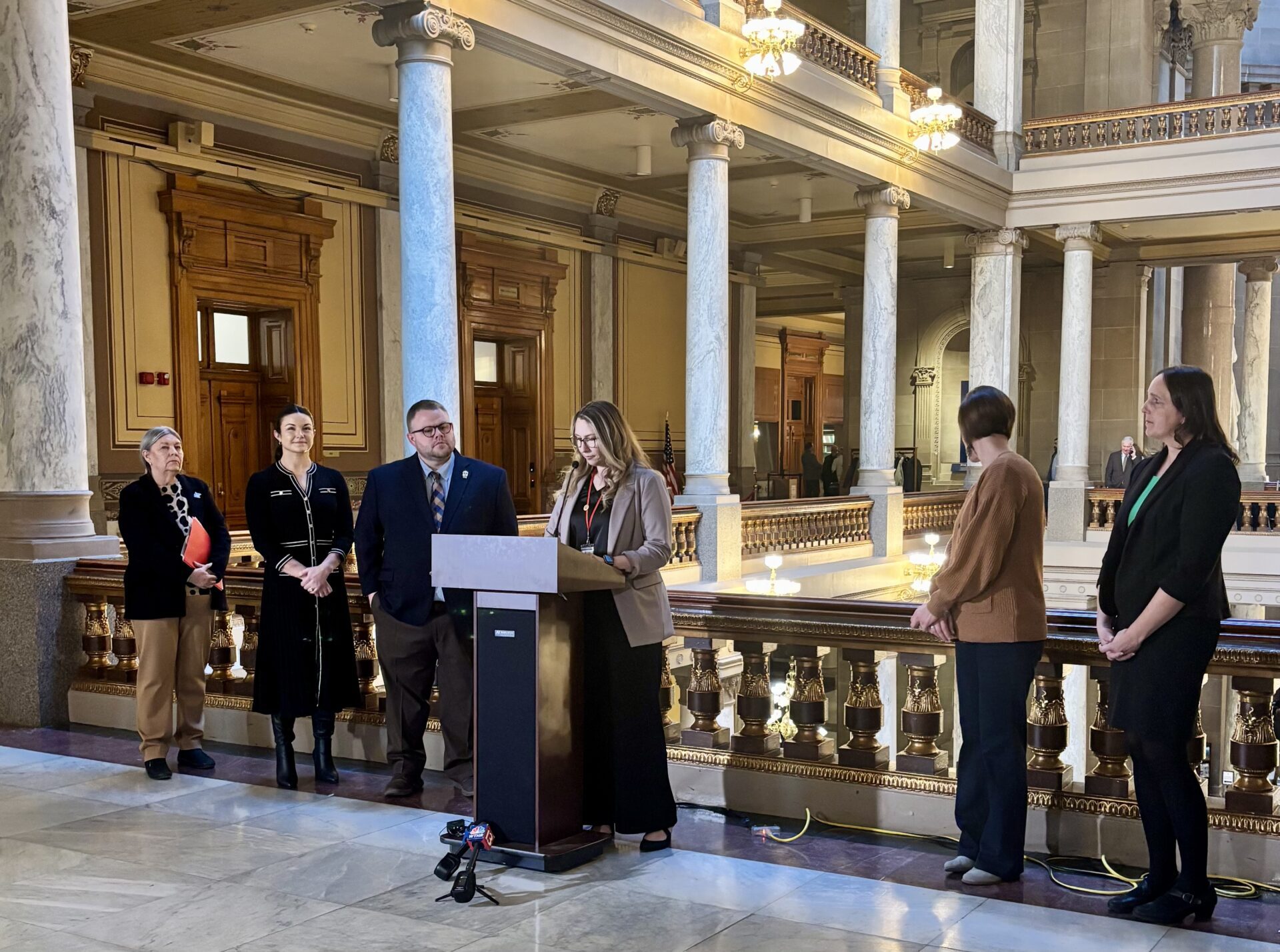
Local organizations are joining forces, urging lawmakers to consider bills to protect Hoosiers from the “harmful impacts” of medical debt.
Representatives from a bipartisan coalition of more than 25 organizations, including the American Cancer Society – Cancer Action Network (ACS CAN), Blood Cancer United, United Way of Central Indiana, Indiana Community Action Poverty Institute (ICAPI) and The Little Red Door Cancer Agency, gathered on the third floor of the Indiana Statehouse to urge legislators to pass SB 85 and SB 197. Joined by breast cancer survivor Christine Yoder, their message was clear: medical debt is affecting Hoosiers’ ability to meet basic needs.
“I would like our legislators to understand that this medical debt is not a chosen debt,” Yoder said. “It’s not a group of Hoosiers that have decided they’re going to run up a $30,000 credit card bill and they need help. It’s a debt you have to do to survive, and I think it’s a policy decision.”
Approximately 18% of Indiana residents have medical debt in collections, representing an estimated $2.2 billion statewide, according to ICAPI data. Medical debt, which doesn’t discriminate between the insured and uninsured, is one of the leading causes of financial instability in Indiana, and is often associated with complex issues beyond credit damage — such as delayed or foregone care, skipped housing payments and a decline in mental health.
READ MORE: Sekhem Institute creates space for healing rooted in Black history and heritage
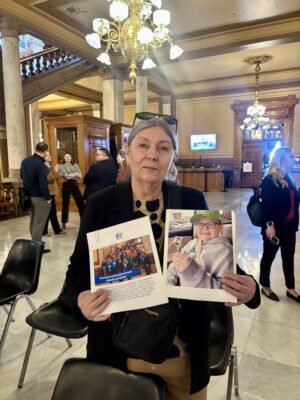
When families spend too much time worrying about how to pay medical bills, they stop doing or paying for things like car or house payments, putting food on the table, attending their kids’ soccer games or even receiving life-saving treatments, Yoder said. Yoder’s own daughter has been “so traumatized by medical debt” after her 13-year-old son’s battle with cancer and subsequent recovery, that she “won’t spend anything” out of fear of another bill or debt.
“We’re saying, change the policy so that when families are struggling so deeply with all of the medical stuff going on, they don’t have to also worry about, ‘Am I going to lose my house? Are they going to garnish my wages? How am I going to pay this bill?’” Yoder added.
One of the ways the coalition hopes to help prevent Hoosiers from incurring crippling medical debt or collections practices is by urging legislators to pass Senate Bill 85 and Senate Bill 197, which they emphasize as being “vital” to reducing health care costs in Indiana.
Authored by Sen. Ed Charbonneau (R-District 5), SB 85 is designed to protect Indiana residents from “harmful medical debt collection practices,” in addition to improving transparency surrounding hospital financial assistance and making affordable payment plans available, according to a press release.
The Recorder reached out to Sen. Charbonneau, but he declined to comment.
Co-authored by Sen. Greg Walker (R-District 41) and Sen. Kyle Walker (R-District 31), SB 197 deals with wage garnishment and would update Indiana’s exemption laws, which are intended to “help working Hoosiers maintain their jobs and housing while paying overdue bills,” according to a press release.
Sen. Greg Walker told the Recorder that SB 197 makes “no distinction as to the nature of the debt that led to the garnishment judgment against wages or deposit accounts.”
“By being a general debtor protection, it would certainly include judgments due to medical debt. I would say our policy to protect those most negatively affected by garnishments should not discriminate between medical debt and general obligations,” Sen. Greg Walker said in a statement. “I will be supportive of both approaches to allow the debtor to live and remain working, rather than being burdened to the extent where one might lose heart and quit working or hop job to job in order to evade the wage garnishment.”
An individual living with cancer may spend, on average, approximately $16,000 each year in health care expenses, and that number is only expected to increase, a spokesperson from Little Red Door Cancer Society said. Surgery and treatment are expensive, regardless of whether the patient has insurance. Long-term side effects are often life-changing, and for some, “there is not bouncing back,” she said.
“We were noticing that more and more patients were incurring medical debt as they went through their treatment and through their cancer journey,” Allie Kast Gregg, Indiana Government relations director for ACS CAN, said. “It became highly important to us as an organization that while working hand in hand with our other policies, that … Hoosiers had access to their cancer treatment without incurring major medical debt, and if they did incur medical debt, finding a pathway out of that that was realistic, safe and stable.”
Yoder’s twin brother passed away two years ago after a long battle with polycystic kidney disease. He was a truck driver and worked hard to provide for his family, she said, but eventually he became too ill to work, and lost his insurance when he lost his job.
The medical bills didn’t stop, though, Yoder said. Her brother continued to get dialysis at the ER as he waited for a kidney transplant for as long as he was able. However, by the time one became available, it was too late.
“The death certificate says it was cardiac,” Yoder said. “I’m telling you, he died because he couldn’t afford any more medical debt, and people were refusing to treat him.”
ACS CAN projects approximately 45,000 new cancer diagnoses in the state, Kast Gregg said. In the 2024 ACS survivor views survey, 47% of survey participants who are cancer patients reported having medical debt of at least $5,000 at that time. From this data, Kast Gregg said they can expect about half of those who will receive a cancer diagnosis in 2026 to go into some form of medical debt.
“I am here fighting. I can’t save my brother, but maybe I can save somebody else’s brother,” Yoder said. “We’re not asking for our debt to be wiped away. We’re asking for a fair opportunity to be able to repay it, like give us a fair repayment plan. Tell us you have charity care if you have it, and don’t hide that under 60 pages of documents you hand us when we leave.”
Contact Arts & Culture Reporter Chloe McGowan at 317-762-7848. Follow her on X @chloe_mcgowanxx.

Chloe McGowan is the Arts & Culture Reporter for the Indianapolis Recorder Newspaper. Originally from Columbus, OH, Chloe has a bachelor's in journalism from The Ohio State University. She is a former IndyStar Pulliam Fellow, and has previously worked for Indy Maven, The Lantern, and CityScene Media Group. In her free time, Chloe enjoys live theatre, reading, baking and keeping her plants alive.