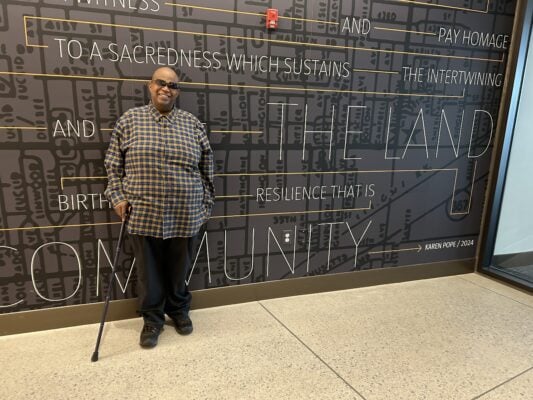
Ricky Woodard didn’t know he was living with diabetes until a devastating moment forced everything to stop. What began as unexplained headaches and long work hours in his mid-20s ended in a car accident that would ultimately change the course of his life.
Now a regular participant in the Eskenazi Health Diabetes Education Program, Woodard has transformed his experience into purpose — sharing his story, supporting others and advocating for healthier lifestyles. He spoke with the Recorder about his diagnosis, the challenges of managing diabetes and how education helped him take control of his health.
Responses have been edited for clarity and brevity.
When were you first diagnosed with diabetes, and what was that moment like for you?
Ricky Woodard: It was totally shocking to me. Mid-20s, had an accident in a car, working a lot, thought it was headaches, trying to make that money. I blacked out at the wheel, tore my car up, and had been having headaches, but I was working and working and working, and didn’t realize that I had diabetes until after that accident. I went home, wound up in the ER about three or four days. It was a life-changing situation for me.
What were some of the biggest challenges you faced after your diagnosis?
Woodard: Not knowing what to expect. I had relatives who had diabetes, but to me, it was just a total shock. Because I was a workaholic, just trying to make that money to survive. It threw me into depression, which I didn’t know. I had to change my eating habits and deal with the different things that diabetes does to your body. But it really was no hands-on services available now besides what the health department had. You had your nurses and your doctors that you’ve seen for your checkups, but really, there wasn’t that much support besides the classes we had at the health department.
How did you get connected to the Eskenazi Health Diabetes Education Program?
Woodard: I had to find a place closer to me that would provide more education about it. I wound up going to Blackburn on Martin Luther King. But we really didn’t have many education classes like they have today, because I was just lost besides what my family, who has diabetes, was telling me. Take your pills, take your shots and hope for the best.
What changes have made the biggest impact on your health?
Woodard: Looking at the labels more, learning what your pancreas and stuff do, and what your liver does with what you eat, and you are what you eat. I learned to read labels more, stop eating a lot of bread, stop eating a lot of processed foods, stop frying a lot of food, start eating more baked foods, and watch my intake of sugary drinks. And eat more fresh vegetables if you can. If not, if you have to eat canned vegetables, make sure you rinse them off and try to eat healthy.
Why has education and programming like this been so important for you?
Woodard: It was nothing there when I was diagnosed with diabetes back in the late 80s, early 90s. It was not education like it is today, besides going to a few classes. Now you’ve got more people who are dealing with diabetes in your classes, and you listen to other people and how they deal with it. Diabetes affects you from your head to your toes, and you have to change your lifestyle. Sometimes you just can’t move, and you get depressed. I was depressed for a while, still going through it, because I’m living with this disease, but I’m getting better, eating better and I’m feeling better, but I do have bad days.
You now help others who are going through similar experiences. What does that look like?
Woodard: I explain to them how I found out I had it and how it’s easy to talk to someone who has diabetes. Once you learn about the nutrition part of food in your body, you have to watch out for yourself. The doctors and the nurses and the nutritionists, they’re there to help you make better choices of what you put in your body, because if you don’t take care of it, diabetes is a silent killer, it destroys you from the inside out. I tell people, don’t get upset with yourself for not having certain things. You can have them, but limit them, and make sure you stay on your medication.
How has being a DJ influenced the way you connect with others about diabetes?
Woodard: When I’m on air at the radio station, people used to call in, and we would talk about it. I tell them to go to the doctor — men, women, even children, because diabetes affects anybody. If I knew what I know now, instead of going to Long’s Donuts and getting a dozen, only to have them be gone by the time I get home, I would have done things differently. I tell everybody, check with your doctors and have somebody you can talk to, because they’re there to help you cope with this.
What would you say to someone who has just been diagnosed and feels overwhelmed?
Woodard: Talk to your nurse or your doctor and see if there’s a group you can go to help you deal with people who have diabetes. You don’t have to talk in the classes, go and listen. Listen to people and how they are dealing with it, because it affects everybody differently. You have to change your lifestyle because, at the end of the day, it’s up to you. If you don’t do it, things are going to happen, and it’s not going to be nice.
For more information about the Eskenazi Health Diabetes Education Program, visit: eskenazihealth.edu/health-services/diabetes.
This reporting is made possible by a grant from the Indianapolis African-American Quality of Life Initiative, empowering our community with essential health insights. https://iaaqli.org/
Contact Health & Environmental Reporter Hanna Rauworth at 317-762-7854 or follow her on Instagram at @hanna.rauworth.
Hanna Rauworth is the Health & Environmental Reporter for the Indianapolis Recorder Newspaper, where she covers topics at the intersection of public health, environmental issues, and community impact. With a commitment to storytelling that informs and empowers, she strives to highlight the challenges and solutions shaping the well-being of Indianapolis residents.