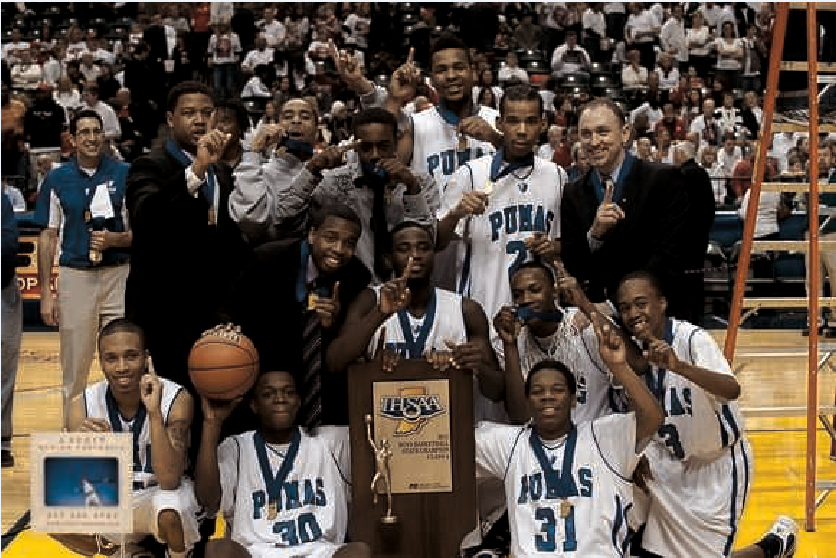
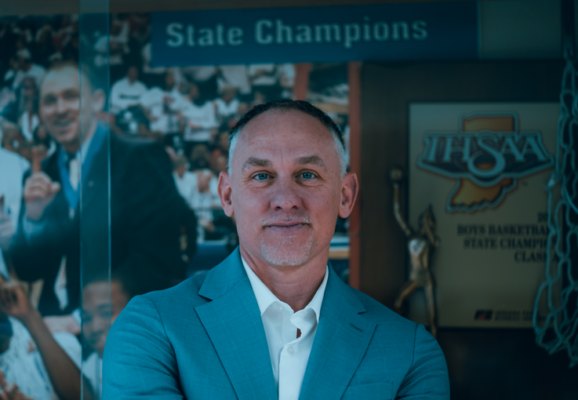
In high school sports, coaches often repeat the age-old mantra that no single player is ever bigger than the program. Former Indianapolis Metropolitan High School (Indy Met) head basketball coach Nick Reich has spent more than a decade challenging that philosophy, arguing that the system exists solely to serve the human beings inside of it.
His newly released book, “Every Player Is Bigger Than the Program,” turns conventional athletic thinking on its head. Drawing directly from his tenure leading the Indy Met Pumas to the 2011 IHSAA Class A state championship and the devastating personal grief that followed, Reich lays out a blueprint for leadership rooted entirely in putting people first.
“We didn’t have a program,” Reich said of his early years at Indy Met. “We existed to serve the kids. I continue to believe that in the work that I do now with leader development and working with organizations of all shapes and sizes, we still act like the people on the team, the players, the people in our organizations are there to serve the brand. But I believe the brand is there to serve the people. We don’t exist as a team without those kids.”
Reich, who has not coached a single basketball game since walking off the floor as a state champion in 2011, noted that prioritizing individual athletes does not mean abandoning discipline or lowering expectations.
“One of the parts of the playbook is excellence,” Reich said. “It’s about having high expectations and high accountability. That’s an extremely important part of it. I had to push kids and raise my voice. But they also knew that I cared. They knew that I had their back, and we knew that they had each other’s back. So often it becomes this ‘one, two, three, family’ talk. But it really comes down to the actions. Are you showing up? Are you doing what you say you will do? If you’re going through a tough time and I’m not right there with you, then is it really a family?”
That human-centered approach guided an unlikely group of young men to one of the most memorable championship runs in Indiana basketball history. In just the fourth year of the charter school’s existence, the underdog Pumas rebounded from losing five of their first six games to capture the 2011 Class A state title.
“Our goal was not to win a championship,” Reich said. “Our goal really wasn’t even to win a sectional. Our goal was to get kids prepared to graduate high school and go to college. It’s a very different perspective. The best way to do that within a team is to really focus on that growth of our people, because individual growth leads to collective growth.”
The season turned around in mid-December with a buzzer-beating victory over rival, Charles A. Tindley Accelerated School. Weeks later, the Pumas secured a double-digit road win over Guerin Catholic. By the regional tournament, the team was creating national headlines when guard Jerrbryon Graves sank an iconic, one-handed heave from the opposite free-throw line at the final horn, securing a win that landed at the top of ESPN’s SportsCenter Top 10 plays.
At the center of that historic team was Raymond “Boosie” Green, a powerhouse player whom Reich describes as the unquestioned heartbeat of the program.
“He was just a big old kid,” Reich said. “He just had this infectious laugh and smile, and always a huge grin on his face. He was that heartbeat. He was our leading scorer. We used to joke that he couldn’t dribble with his left hand and he couldn’t shoot a jump shot, and somehow he averaged 14 points a game. Every time he touched the ball, everybody in the stands and on the opposing bench was screaming, ‘He’s going right, he’s going right!’ And still, you couldn’t guard him.”
Green’s athletic dominance helped put the school on the map, leading to the construction of a brand-new campus gymnasium that Reich notably said would never have existed without him.
But away from the hardwood, Green faced severe structural obstacles. In May 2011, Green learned that he had not passed his end-of-course assessments and would not graduate with his class. Heartbroken, he walked out of the building and never returned to complete summer courses, despite Reich’s desperate efforts to track him down.
“Especially with Raymond and where he was living and where he grew up, I was in a tug-of-war for the four years that I knew him,” Reich said. “The day he walked out of the school and did not pass his assessments was the day I lost. There were days that I was winning that side of the war, and he was in school, and he was going to go to college and play basketball. And then there were days I was losing that side of the war, and he was being pulled hard back to the streets. That day when he wasn’t going to graduate is the day that I lost.”
Five months later, in October 2011, Green was shot and killed on the city’s east side at age 19.
“When I got that call in October that he had been killed, to this day it is probably the worst day of my life,” Reich said.
The traumatic loss cast a long shadow over the 2011 championship, leaving Reich unable to openly celebrate the milestone for well over a decade.
“For 15 years, there were a lot of times I was really unable to talk about the good things and really enjoy talking about the state championship season, because it was all connected to the memory of Raymond,” Reich said. “Sitting down to write that chapter was cathartic. I was able to reclaim the story of what we were able to accomplish, but also reclaim the memory of Raymond and not have it hurt quite so much.”
To navigate that enduring grief, Reich had a starfish tattooed on his shoulder, drawing inspiration from the parable of a boy throwing beached starfish back into the sea.
“A guy walks up and asks the boy what he’s doing, saying there are too many and he’ll never make a difference,” Reich said. “The kid picks up another starfish, throws it into the water, and says, ‘I made a difference to that one.’ For a very long time, I felt like if getting that close to someone could turn into that much pain, I didn’t want to do direct service anymore. But that tattoo is a reminder that the things we do matter. While it wasn’t the outcome that I or his family wanted, the things we did together with Raymond still mattered.”
Now, Reich travels the country delivering leadership keynotes to corporate executives and educational administrators, urging them to prioritize internal clarity before trying to manage teams.
“It starts with your purpose as a leader,” Reich said. “If you can’t articulate your purpose, your why, your core values, and your non-negotiables, you can’t turn those into daily leadership practices. If you don’t know yourself, you can’t lead yourself. And if you can’t lead yourself, you can’t lead others. You have to get crystal clear on who you are and live in purpose, on purpose.”
“Every Player Is Bigger Than the Program” is available now through major online retailers, including Amazon and Barnes & Noble, as well as local independent bookstores.
Contact multimedia & senior sports reporter Noral Parham at 317-762-7846. Follow him on X @3Noral. For more, visit indianapolisrecorder.com.

Noral Parham is the multi-media reporter for the Indianapolis Recorder, one of the oldest Black publications in the country. Prior to joining the Recorder, Parham served as the community advocate of the MLK Center in Indianapolis and senior copywriter for an e-commerce and marketing firm in Denver.