
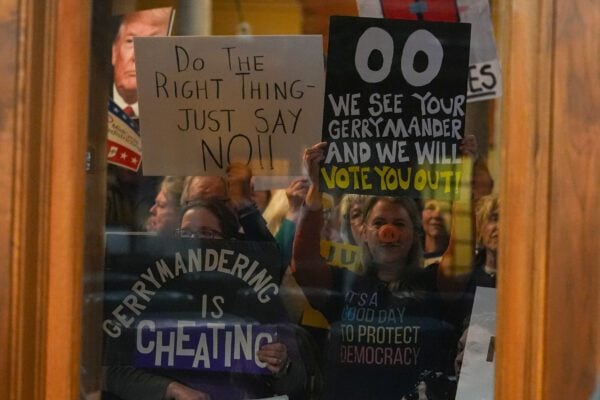
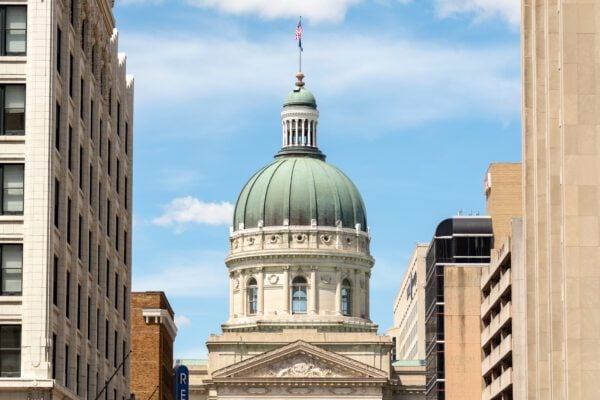
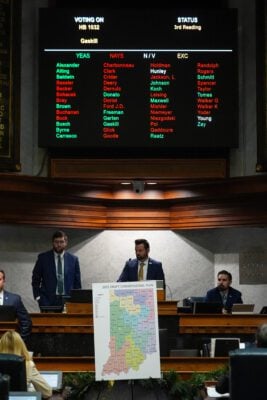
The Indiana Senate on Dec. 11 voted down House Bill 1032, ending months of debate over a proposed mid-decade redraw of the state’s congressional districts.
The proposal, advanced by House Republicans in the fall, would have reshaped several districts, including those currently represented by Democratic Reps. André Carson and Frank Mrvan. Critics argued the maps weakened minority representation and shifted political power for partisan gain, while supporters said the state had an opportunity to increase its influence in Congress.
The measure failed 31-19 after bipartisan opposition and weeks of public testimony.
Indianapolis Mayor Joe Hogsett praised the bill’s defeat.
“I am grateful for the bipartisan support in the Indiana General Assembly to preserve fair representation for the residents of Indianapolis at the federal level,” Hogsett said.
He then went on to say Indianapolis has “a distinct set of needs and opportunities that deserve to be recognized at the ballot box and in Washington.”

In the weeks leading up to the vote, lawmakers heard hours of testimony at the Statehouse, with opponents arguing the proposal was rushed and lacked transparency. Many community groups said redrawing maps only four years after the last redistricting cycle undermined public trust. Some Republican senators ultimately echoed those concerns.
Opposition from within the Republican caucus was central to the bill’s failure.
“Today, I joined the majority of my colleagues in voting against redistricting,” said Sen. Linda Rogers (R-Granger). Rogers said she heard from thousands of constituents who opposed the plan.
Other Republicans expressed broader concerns about precedent. Sen. Kyle Walker (R-Lawrence) said redrawing maps outside the normal 10-year census cycle sets a standard that could be exploited by future majorities.
Walker said, “I simply could not support an effort to redraw legislative districts in the middle of a decade solely for political purposes,” adding that his constituents stressed the need for “predictability, transparency and public trust.”
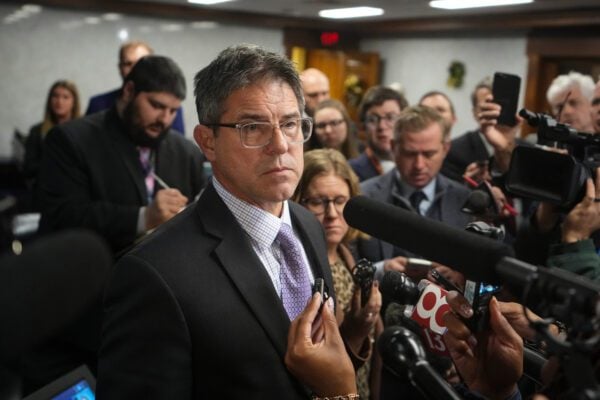
Senate leadership also acknowledged divisions within the caucus. Senate President Pro Tem Rodric Bray (R-Martinsville) said many lawmakers doubted whether the plan would achieve its intended political outcome, saying “many of my caucus members don’t think redrawing our Congressional map mid-cycle is a guaranteed way for Indiana – or our country – to achieve that outcome.” Bray said it is “time to turn the page” and refocus on state-level issues.
Supporters of the plan expressed frustration.
Sen. Gary Byrne (R-Byrneville) said he believed the legislature had an opportunity to strengthen Indiana’s Republican representation in Washington.
“I am disappointed that the Senate failed to pass House Bill 1032,” Byrne said, arguing it would have ensured “our conservative voice is heard in Washington, D.C.”
Democrats, meanwhile, said the defeat prevented a rushed process from weakening representation for urban and minority communities.
“Hoosiers’ voices were heard today, and communities were kept together,” said Rep. Mike Andrade (D-Munster).
Andrade said he hopes lawmakers now shift their attention toward affordability and healthcare issues.
Rep. Cherrish Pryor (D-Indianapolis) said the vote reinforces that residents want to choose their representatives, not the other way around. She called the outcome “a win for all Hoosiers,” saying it was made possible because people “showed up from across the state to advocate against mid-decade gerrymandering.”
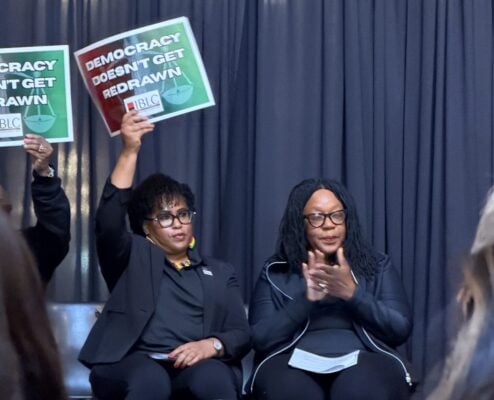
The Indiana Black Legislative Caucus said the months-long debate distracted from pressing economic concerns.
Rep. Earl Harris Jr. (D-East Chicago) said, “Now that the issue of redistricting is finally behind us, it’s time to move on and fight for Hoosiers.”
Harris said utility rates, child care access and cost of living remain priority issues heading into the next session.
Advocacy organizations that opposed HB 1032 said the vote signals lawmakers recognize the public’s demand for transparency. Megan Robertson, executive director of Indiana Conservation Voters, said, “Today is a win for Hoosiers, and a win for our democracy.” She said the proposal was “unnecessary and deeply unpopular” across the state.
Planned Parenthood Alliance Advocates said the bill was part of a broader effort by Indiana’s Republican supermajority to consolidate political power. Haley Bougher, the group’s Indiana state director, said, “Hoosiers won an important victory today.” She said protecting democratic participation and reproductive freedom “go hand in hand.”
A separate statement from the Black Panther Movement said lawmakers “chose independence over intimidation, fairness over fear and democracy over authoritarianism and tyranny,” emphasizing the broader implications the group saw in the debate.
With HB 1032 defeated, Indiana’s congressional map will remain unchanged for the 2026 midterm elections. Lawmakers return to the Statehouse in January, where affordability, public safety and health care are expected to dominate the agenda.
Contact Health & Environmental Reporter Hanna Rauworth at 317-762-7854 or follow her on Instagram at @hanna.rauworth.

Hanna Rauworth is the Health & Environmental Reporter for the Indianapolis Recorder Newspaper, where she covers topics at the intersection of public health, environmental issues, and community impact. With a commitment to storytelling that informs and empowers, she strives to highlight the challenges and solutions shaping the well-being of Indianapolis residents.