We talk a lot about timeliness in theater.
We — artists, art-enjoyers and art critics alike — also talk about how theater is a safe space to tackle difficult topics. We talk a lot about discomfort, catharsis and connection when we talk about live theater, and I think “English” couldn’t have come at a better time.
Written by Sanaz Toossi, “English” is a 2023 Pulitzer Prize-winning play set in Karaj, Iran, in 2008, and follows a group of four adult students and their teacher in an “English-Only” language class. Directed by Azar Kazemi, “English” is running on the Janet Allen stage at the Indiana Repertory Theatre (IRT) now through April 4.
As long as I’ve been attending shows in Indianapolis, I’d say the IRT has had its finger on the pulse of bringing powerful stories designed to inspire empathy and build community. “English” is no different; in fact, the timing is almost ironic given current events.
“English” was written in response to the 2017 travel ban, Toossi said in a 2025 interview with Playbill around the time when the play debuted on Broadway. However, in a time where the United States is actively dropping bombs on Iran and ICE agents continue to terrorize and steal our neighbors from their homes, schools and places of worship, a play delving into the struggles of identity, language, resilience and humanity helps put some of the chaos into devastating perspective.
READ MORE: ‘The Wiz’ North American tour stops in Indy during 50-year anniversary
It’s a beautiful play; don’t get me wrong. It’s funny and challenging and so very tender, but you can feel the anger, the urgency and the frustration of not being understood. And what could be more deserving of empathy than that?
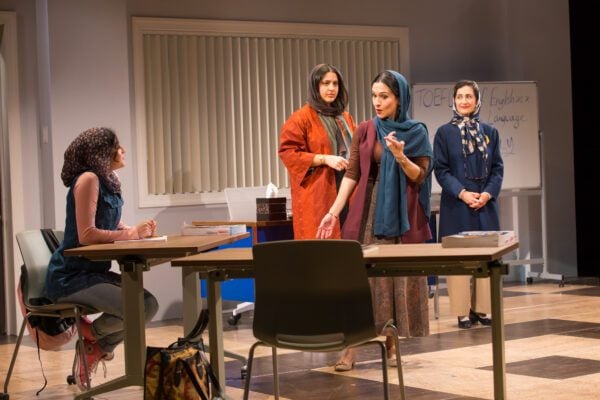
The story is revealed to the audience as the students — Elham (Natasha Behnam), Roya (Leyla Modirzadeh), Goli (Emelia Maryam Mosay) and Omid (Revon Yousif) — complete a six-week English course under the instruction of an advanced English teacher, Marjan (Naegheen Homaifar).
“English” is full of short, intimate scenes interspersed with textbooks, vocabulary exercises and show-and-tells that showcase each student’s reasons and desires to master a language that would grant them more opportunities through emigration. It’s a moving story that never seems to slow down. The more we learn about each character, the higher the stakes become.
As characters continue to navigate the language through speaking, listening, reading, and writing activities in preparation for the Test of English as a Foreign Language (TOEFL), they also face newfound challenges, not just in being understood but in being seen and heard.
Language, culture and identity go hand in hand, and each character’s individual struggle to express themselves in class only further highlights the personal and political implications of learning a foreign language. For Elham, an aspiring gastroenterologist, the opportunity to study abroad is at stake; for Roya, a relationship with her English-speaking granddaughter and the chance to move to Canada rely on fluency.
For Omid, the only male student in the course, mastery of English is about reconnecting with a part of his childhood, and for 18-year-old Goli, English represents empowerment.
For a play about language, it was the moments of silence that spoke volumes, as arguments break out, frustrations are released, and a mutual connection is eventually made. “English” couldn’t be more immersive: from the classroom set-up, tiled floor and fluorescent lights to a whiteboard that keeps tally of how many times Farsi is spoken.
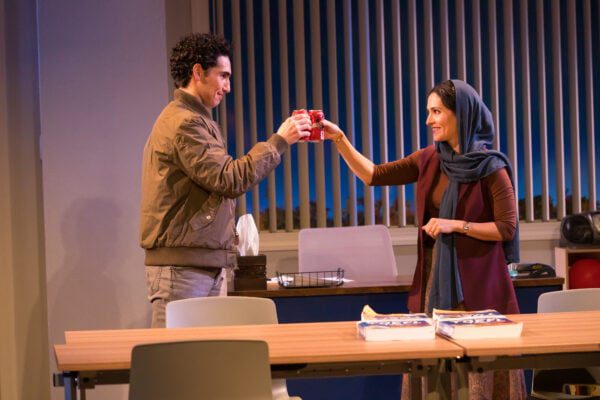
Subtle details in the costuming bring the audience into the reality on stage. Western style meets Iranian culture in a wash of vibrant fabrics. There’s a lot of layering, a handful of denim pieces, and head coverings for the women. Even the bags each student carries are reflective of their characters.
The classroom is the set, and the placement of the four desks and the subtle changes in lighting are really the only things signaling the passage of time.
Almost the entire play is in English. When the actors speak fluid, non-accented English, it represents the characters speaking Farsi, and when they speak English with an accent, it represents the characters truly speaking English. Until the very end, where Marjan and Elham meet again after the test and share an untranslated conversation in Farsi.
It’s a powerful performance, put on by a brilliantly talented cast, and I think Hoosiers could gain a lot from seeing it.
“English” features profanity alongside complex themes of cultural identity and immigration struggles, and is recommended for audiences 9th grade and up.
“English” is onstage at the IRT March 10-April 4. Tickets start at $27. The show is approximately 90 minutes with no intermission. For more information, supplemental programming or showtimes, visit irtlive.com.
Contact Arts & Culture Reporter Chloe McGowan at 317-762-7848. Follow her on X @chloe_mcgowanxx.

Chloe McGowan is the Arts & Culture Reporter for the Indianapolis Recorder Newspaper. Originally from Columbus, OH, Chloe has a bachelor's in journalism from The Ohio State University. She is a former IndyStar Pulliam Fellow, and has previously worked for Indy Maven, The Lantern, and CityScene Media Group. In her free time, Chloe enjoys live theatre, reading, baking and keeping her plants alive.