
“I see Miss Cordelia.”
At the Sept. 19 Conversation & Hope for Our City Ladies’ Tea at Silo Auto Club and Conservancy, Una Osili, PhD, looked into the audience and acknowledged Ms. Cordelia Lewis-Burks.
It was a brief moment at a gathering supporting her husband, Vop Osili, in his campaign for Indianapolis mayor. But later, when Osili took the floor, he returned to the woman whose encouragement helped launch his political career.
The scene offers a useful question for a campaign built around women’s influence: What do women get when they invest their relationships, credibility and political power in a candidate?
Osili’s answer is that they should get more than a place in the room. They should get a measurable role in governing.
When he first ran for Indiana secretary of state in 2010, Osili recalled, some people doubted he could win the Democratic nomination. Others questioned whether he should run at all.
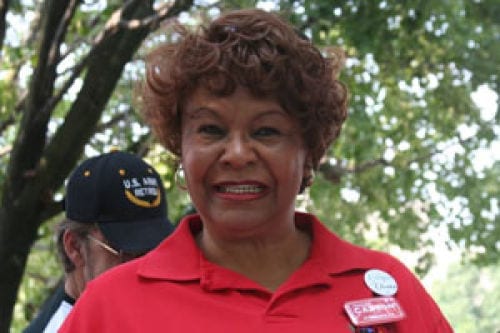
Lewis-Burks encouraged him to keep going, he said. He ultimately won the nomination with 78% of the vote.
Now, as Osili seeks the mayor’s office, the woman who encouraged his first statewide campaign is in the audience as he asks women to help shape his next one.
Lewis-Burks is not an incidental figure in Indianapolis politics. A longtime Democratic organizer, she previously chaired Joe Hogsett’s mayoral campaigns and has publicly backed Osili. Her support links Osili to an experienced political network even as he seeks to distinguish his own vision for the city’s future.
At the tea, he spoke about neighborhood investment, affordable housing, employment and the conditions that determine whether families can build a future in Indianapolis. He described women as among the people who had most influenced his life. His wife, Una, offered a portrait of the person she knows outside the public eye, including his willingness to acknowledge when something is going wrong and the humility to “course correct.”
That phrase carries particular weight for a candidate who has spent years in public office and is now asking voters to trust him with the executive power of the mayor’s office.
In written responses to questions from the Indianapolis Recorder, Osili outlined how he would measure progress for women and Black residents. His proposals include women in senior leadership positions and on boards and commissions, more opportunities for women-owned businesses to receive city contracts, a public dashboard showing government performance and a baseline for measuring Black economic mobility within his first 100 days as mayor.
The promises offer a way to evaluate his campaign. They also leave questions about what the measures will require, what information the city can produce and how residents will know whether the administration has succeeded.
The specifications
Osili said, “I already have an incredible team of women that help guide me through the decisions and actions I must be prepared to take on, including my campaign co-chairs, Tammy Butler Robinson and Amy Conrad Warner.”
Women would play a substantial role in his administration, helping shape policy, set priorities and make budget decisions. He pledged to measure women’s representation in senior leadership and appointments to boards and commissions, including the decision-making authority those positions carry.
That last measure matters. Representation may be counted by examining who holds a title. Authority looks at who controls resources, influences decisions and determines priorities.
For women-owned businesses, Osili said, his administration would track access to financing, business survival and growth, and city contracts awarded and paid to those businesses. He also pledged to examine women’s earnings, homeownership and housing stability, using available information about business ownership and home equity to better understand whether women are building wealth.
These are proposed measures, not guarantees of outcomes. The difference between a contract being awarded and a business being paid, for example, is consequential to a company’s ability to make payroll and remain in business. Tracking both would offer a more useful picture than counting awards alone.
Osili also promised a public dashboard so residents could track the administration’s priorities and results.
For Black economic mobility, he said he would direct his administration to publish a baseline within his first 100 days and establish a timetable for annual targets in consultation with residents and community partners. Those targets would address earnings and employment, homeownership and housing stability, business ownership and growth, access to capital, city contracting and neighborhood investment.
The commitments are specific enough to give residents a starting point for accountability. But Osili also included qualifications.
His written answers say the administration would use “reliable, available data” and share comparisons across communities “where that information allows,” while protecting individual privacy. Where information is missing, he said, the city would identify the gaps and establish a plan to address them.

City government cannot responsibly report outcomes it cannot measure reliably, and privacy protections matter when data concern individual residents. But the public will need to know which measures can be reported immediately, which require new data collection and which may remain unavailable.
A dashboard can make government more transparent. It cannot, by itself, make government more equitable. That requires a public baseline, clear targets, identified officials responsible for results, budget decisions tied to those targets and an explanation when the numbers fall short.
For many women and Black residents, the question is not whether they will be represented in the process. It is whether the process will change how public resources are distributed and whether the resulting benefits can be documented.
The shadow of a public meeting
Osili’s promises to listen and course correct also carry a recent history.
On June 9, 2025, while serving as City-County Council president, Osili ordered sheriff’s deputies to remove Lauren Roberts from a council meeting after she continued speaking beyond the two-minute public-comment limit. Roberts was attempting to discuss her experience working for Thomas Cook, former chief of staff to Mayor Joe Hogsett, whom she accused of sexual harassment.
Roberts had come to speak about her experience and concerns surrounding the council’s investigation into the Hogsett administration’s handling of allegations involving Cook. Osili told her time had expired and ordered her removal after she refused to stop speaking.
Two days later, Osili expressed regret. He said he should have called a recess, created space for calm and shown greater sensitivity in an emotionally charged moment. “In that, I failed Ms. Roberts, my fellow councilors, and those who attended the meeting that evening,” he said in a statement to Mirror Indy.
The episode does not, on its own, determine how Osili would govern as mayor. It does, however, provide a concrete test of the language used at the tea.
Some questioned whether Osili decision prioritized rules over listening to a woman’s testimony.
Osili’s apology acknowledged that he could have handled the encounter differently. The remaining question is what changed afterward, and what procedures he would put in place as mayor to protect public participation while maintaining order at public meetings.
The campaign should have an opportunity to address that record directly. Osili should be asked what he learned from the Roberts encounter, whether he changed any council practices after the apology and how his proposed approach to listening would work when a resident challenges his administration or its allies.
Those questions are part of determining what those promises mean when they become difficult to honor.
Back to the room
At the tea, Osili returned to the women who had influenced his life. He spoke of his mother, his sisters and the mentors who encouraged him to serve. Then he named Lewis-Burks, recalling that she had supported him when others doubted his first run for statewide office.

Her presence connected the story of his political beginnings to the campaign he is building now. But political support is not an agreement that ends when a candidate wins. It can create an expectation that the people who helped open the door will continue asking what happens after the candidate walks through it.
Lewis-Burks’ support may help Osili build relationships and credibility among voters. The broader group of women at the tea represents a different kind of resource: people with their own priorities, experiences and expectations for the city.
Osili is an architect by profession. At the gathering, he used that background to describe a city that residents could build together.
“Within my first 100 days, I will direct my administration to publish a baseline [report] using available data and a timetable for achieving annual targets with residents and community partners,” he said. “Those targets will address earnings and employment, homeownership and housing stability, business ownership and growth, access to capital, city contracting, and neighborhood investment.”
The women in that room have heard what he says he will build. They can ask whether women hold positions with real authority, whether women-owned businesses receive and are paid for city contracts, whether Black economic mobility improves and whether the city makes the evidence public.
Contact Health and Environmental Reporter LaTasha Boyd Jones at tashaj@indyrecorder.com or follow her on social media @iamtashajones.

Tasha Jones is a poet, writer, researcher, and educator whose work explores language as a tool for liberation and resistance. She hosts In the Beginning: The Spoken Word Podcast, the #1 spoken word podcast on Apple and Spotify. Tasha is also the Poems & Parables Literary Journal editor and is currently writing Pyramids. Plantations. Projects. Penitentiaries. You can follow her on social media: @iamtashajones, @itbspokenwordpod, and @poemsandparables.