
In selecting Mojtaba Khamenei as its new Supreme Leader, Iran sent a strong message to the United States. Khamenei is the second-eldest son of Ayatollah Ali Khamenei, who the U.S. and Israel killed at the start of their war against Iran. That message is, in the vernacular, a “one-finger salute” to Iran’s two primary enemies.
Arguably, however, Iran’s leaders sent an even stronger message to their nation. That message is, “Don’t expect change.” This is quite a statement at a time when Iran’s old guard (in this case, the Revolutionary Guard) is literally fighting an existential battle. As Black folks might say, Iran’s leadership is “standing ten toes down.”
Iran’s ruling council is an 88-member group of clerics known as the Assembly of Experts. This group is comprised primarily of elderly men. In fact, there is a joke that the average age of the Experts is “dead.” While we don’t know how many members supported Khamenei, the Experts selected him as just the third Supreme Leader in Iran’s history.
At age 56, Khamenei is 10 years older than the Islamic Republic itself. In short, he is a relatively young man who is leading an even younger Republic that exists in a very old nation. (Iran, or Persia, as a unified nation has a history that goes back roughly 2,600 years.)
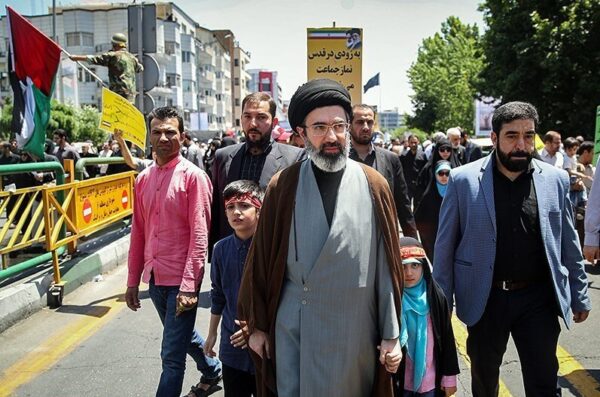
Given that his father was selected as Iran’s second Supreme Leader when the younger Khamenei was around age 20, the new leader is accustomed to power and privilege. Crucially, Khamenei spent years cultivating a strong relationship with the Revolutionary Guard. That work paid off, assuming that he survives the war.
Officially known as the Islamic Revolutionary Guard Corp (IRGC), this paramilitary group is perhaps more powerful than the Assembly of Experts. Or, more accurately, the Assembly of Experts sustains its power with the approval of the IRGC.
How is Khamenei likely to rule? Politically, he is generally viewed as being more hardline than even his father was. For example, the younger Khamenei is said to be more favorably disposed to Iran developing a nuclear weapons program than was his father, who issued a religious edict, known as a fatwa, against such weapons.
Further, one wonders how personal tragedy might affect Khamenei’s decisions. In addition to his father, he is also believed to have lost his mother, his wife and at least one of his three children in attacks during this war. Khamenei may have lost more relatives, but it is difficult to verify whether that is the case.
Will a sense of personal revenge cause Khamenei to make strategic errors, or even irrational decisions? For their part, the U.S. and Israel are diligently seeking the highly enriched uranium that Iran is said to have — material that Iran could use to make nuclear bombs. Obviously, that would be disastrous for all involved.
To be sure, it is widely assumed that Khamenei will not wield quite as much power as his father did for 37 years. Still, as long as he has the confidence of the IRGC, he will be far more than nominally in charge, assuming (again) that the regime is somehow able to survive the war.
Predictably, President Donald Trump reacted to the news of Khamenei’s ascension as one would expect. He was dismissive, calling Khamenei a “lightweight” and insisting that he (i.e., Trump) should have a hand in selecting Iran’s leader. Trump also suggested that Khamenei’s reign would depend on him. Trump and Israeli Prime Minister Benjamin Netanyahu have even intimated that killing Khamenei is under consideration, though not a foregone conclusion.
Internationally speaking, Khamenei’s rise is receiving mixed reactions. Though Khamenei has never officially held political office, several of Iran’s neighbors are supportive of him, at least publicly. That includes Oman and Iran’s longtime foe, Iraq. Naturally, western governments are less enthusiastic.
Not surprisingly, Russia — which is a longtime Iranian ally — welcomed the news. President Vladimir Putin offered a strong personal endorsement. China, which is also an Iranian ally, was much less effusive, but offered its support of the process. Guo Jiakun, who is a Foreign Ministry spokesperson, referenced the importance of Iran’s sovereignty. Guo also stated, “China opposes interference in other countries’ internal affairs…”
Iranians are said to be deeply divided over Khamenei’s selection. His father was a very polarizing figure who brutally repressed his own people. His son could conceivably be even worse. Unless a great deal is going on behind the scenes, the U.S. and Israel just might win the war — only to lose the peace.
At home, most Americans would be surprised to learn that Iranians are, relatively speaking, pro-American in their outlook — at least as compared to most Muslim countries in the region. Still, nationalism has a way of resurging when outsiders pose a threat to a country. A Middle Eastern proverb perhaps applies here: “I against my brother; I and my brother against my cousin; I and my brother and my cousin against the world.”
The next few weeks should reveal a great deal about where all this is headed.
Contact community leader Larry Smith at larry@leaf-llc.com.