

A nation’s oldest contradiction
“Loving you is like a battle, and we both end up with scars.”
Lauryn Hill was singing about love; she could have been singing about America.
For nearly 250 years, this country has promised freedom while asking Black women to prove they deserve it. It has celebrated our labor while questioning our leadership. It has borrowed our brilliance while withholding the full protection of its democracy. Loving America has often required Black women to believe in a country that has struggled to believe in them.
Frederick Douglass understood this contradiction long before Lauryn Hill gave it a melody.
In 1852, Frederick Douglass stood before a white abolitionist audience in Rochester, New York, and asked them why he had been invited to celebrate a freedom he did not possess.
“This Fourth of July is yours, not mine,” Douglass told them. “You may rejoice; I must mourn.”
It remains the most precise indictment ever delivered against American self-congratulation — not a rejection of the nation’s ideals, but a demand that the nation be held to them. Douglass did not ask his audience to abandon liberty as a value. He asked them to notice that they were celebrating it over the bodies of people it did not cover.
Nearly half a century later, Rudyard Kipling offered a philosophical reply to the very contradiction Douglass exposed. “The White Man’s Burden,” written in 1899 to encourage American imperial expansion in the Philippines, did not deny the hierarchy Douglass exposed. It justified it.Kipling’s poem recast domination as duty. Hierarchy became a virtue. If Douglass argued that America had failed its own ideals, Kipling suggested those ideals were never intended to reach everyone equally.
These two texts, read together, are the argument and its rebuttal.Douglass exposes the contradiction and identifies the hypocrisy, naming the gap between principle and practice. Kipling rationalizes the contradiction by revealing that the gap is not a flaw in the system — it is the system working as intended, dressed in the language of stewardship. Between them, you have the entire architecture of American racial hierarchy: the wound and the alibi.
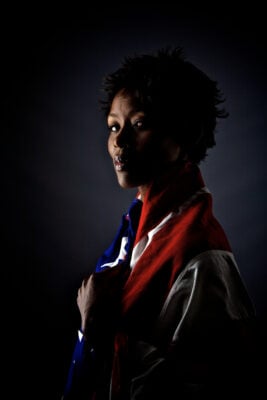
It is worth acknowledging how openly the poem says this, because what followed in American life — Jim Crow, redlining, convict leasing, the slow legal throttling of Black political power — required exactly that philosophic scaffolding. Hierarchy needed a story that made it sound honorable, and the poet, Kipling, wrote that narrative down.
But there is a third voice that our national story too often leaves out.
The Black woman.
In 1892, Anna Julia Cooper wrote, “Only the BLACK WOMAN can say ‘when and where I enter… there the whole Negro race enters with me.'” More than a century later, the data suggests she understood something America still struggles to accept. Black women enroll in college at higher rates than any other demographic group when measured by both race and gender — and within the Black community, they earn nearly two-thirds of all degrees at every level. This is not a footnote to the history above; it is the answer Douglass was waiting for and the refutation Kipling never anticipated.
Kipling’s burden required its subjects to “need rescue.” Black women’s response, generation after generation, has been to become the most credentialed people in the room without anyone’s permission, often without resources, often while the very government bestowing degrees withheld the protections that should have accompanied them. That is not assimilation into the colonizer’s terms. That is refusal — proof that the contradiction Douglass named was never a problem of Black capacity. It was always a problem of American will.
When affirmative action became politically toxic, and the 2023 Supreme Court ruling in Students for Fair Admissions v. Harvard dismantled it, public resentment rarely settled on the demographic that benefited most from employment-based affirmative action. Instead, Black women often became the face of undeserved opportunity. When diversity initiatives came under attack, Black women were frequently among those whose qualifications were questioned, whose leadership was scrutinized, and whose presence was treated as evidence of lowered standards rather than earned excellence.
That pattern is not accidental. When the nation needs someone to blame for its own discomfort with change, it reaches, with striking consistency, for those who symbolize that change.
Especially Black women.
This Fourth of July, fireworks will once again illuminate the sky. Politicians will invoke freedom. Families will gather beneath flags that promise liberty and justice for all.
Douglass would almost certainly ask the same question he asked in 1852: Who is included in that “all”?
Black women have spent generations answering with their lives rather than their words. They have refused the hierarchy Kipling justified and insisted that freedom is not measured by who grants it, but by who continues to build it despite every attempt to deny it.
Perhaps that is what America still owes Black women — not gratitude, not symbolism, not another speech — but a democracy expansive enough to match the freedom they have been imagining all along.
Lauryn Hill was right. Loving America has often been a battle. The scars are easy to see.
The question, 250 years later, is whether the country is finally ready to stop mistaking the people who keep believing in freedom for the people who have never earned it.
Tasha Jones is an award-winning journalist, poet, and cultural critic who explores language, liberation, identity, fashion, beauty, and Blackness.

LaTASHA BOYD JONES
Tasha Jones is a poet, writer, researcher, and educator whose work explores language as a tool for liberation and resistance. She hosts In the Beginning: The Spoken Word Podcast, the #1 spoken word podcast on Apple and Spotify. Tasha is also the Poems & Parables Literary Journal editor and is currently writing Pyramids. Plantations. Projects. Penitentiaries. You can follow her on social media: @iamtashajones, @itbspokenwordpod, and @poemsandparables.







That’s deeeeeeep! Love it!