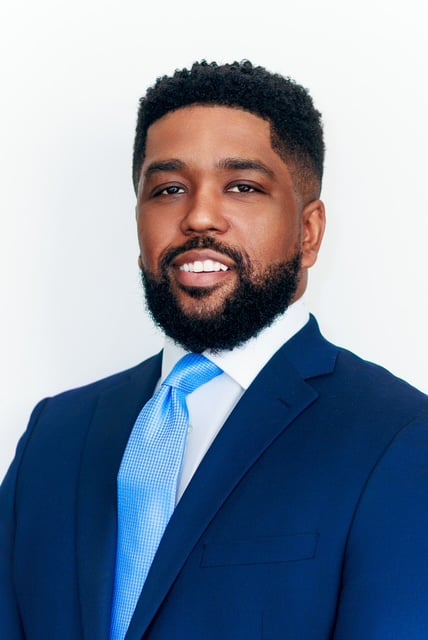
I hear people talk about “two Americas” on a consistent cadence, from superficial items like seasoning foods or pop culture references to more complex items like systemic issues. Years ago, I found myself having one of those moments of my own with a mentor of mine. At the time, we had spent months traveling Indiana, meeting with people from various identities, ideologies, and life experiences. It was an education on people that I’m grateful for, not for some specific goal, but for the reaffirmation that people want access to opportunity and safety for themselves and their loved ones.
I can’t recall the specific catalyst for the conversation, but I shared some of my direct and indirect life experiences, from breaking up house party fights to attending funerals of friends who were lost to gun violence. As I look back on those funerals, I realize they were teaching lessons no young person should have to learn. There is something profoundly unsettling about becoming familiar with grief before you’ve fully come to understand life. By the time I reached adulthood, attending funerals for peers had become less shocking than it should have been.
“…’be safe’ served as both a salutation and a warning.”
At a certain point in the conversation, I mentioned that growing up my parents, extended family and friends had always ended conversations with “be safe” as a goodbye. While there may have been other phrases inserted, “be safe” served as both a salutation and a warning. A warning not for any reason other than what I imagine to be historical context, shaped by generations whose relationship with safety was often different from the one experienced by many of their fellow Americans.
Floored is the only word that could appropriately articulate his response.
Two men, both with ties to Indiana in a multitude of ways. Me, a 30-year-old Black man who had seen Indianapolis grow and change. Him, a white man from southern Indiana who was thoughtful, curious, and far from unfamiliar with conversations about race. Yet the idea that “be safe” could carry the weight of both a farewell and a warning had never occurred to him.
“I’ve never had the thought to tell my sons that when they leave the house,” I remember him saying.
The comment was neither defensive nor dismissive. It was matter-of-fact, almost as though he was discovering something about my experience in real time. What struck me was not that he had never said the words. It was that the possibility had never occurred to him. If anything, there was genuine surprise. For him, “be safe” was not a phrase loaded with meaning. It was not a ritual, a warning, or a lesson passed from one generation to the next. For me, “be safe” had become woven into the fabric of everyday life; for him, it had never needed to be. In that moment, I found myself wondering how many of our assumptions about the world are shaped not by what we believe, but by what we’ve never had to consider.
Some people experience violence as a headline. Others experience it as an accumulated series of names, faces, funerals and warnings.
As I got older, I began to realize I fell into the latter category. Local news reports of violence rarely felt distant. More often than not, I knew someone in the story, knew a member of their family, or knew someone who did. The degrees of separation were often far fewer than they should have been.
It wasn’t that funerals became commonplace. It was that certain parts of them became familiar. The Black suit hanging in the second closet in preparation. The receiving line. The quiet conversation before the service begins. I would tell myself I’d hold it together. Then, somewhere between the opening prayer and the phrase, “on behalf of the family, thank you all for being here today…,” a single tear would betray the lie. For a moment, all the routines and coping mechanisms would fall away, and I’d be forced to confront the reality that none of this should feel familiar.
“…violence should never be viewed through the lens of ‘those people’ or ‘that neighborhood’ or ‘that side of town.'”
If there is any lesson in all of this, it is that violence should never be viewed through the lens of “those people” or “that neighborhood” or “that side of town.” The reality is that none of us can or should carry the emotional weight of every tragedy every day. We have jobs to do, families to care for and lives to live.
But there is a difference between protecting ourselves from the weight of every headline and convincing ourselves that the people in those headlines are somehow different from us. Every time a life is cut short by violence, another family is introduced to a reality they never expected to know firsthand.
Maybe the real divide isn’t between two Americas at all. Maybe it’s between the experiences we carry and the ones we never have to consider. The conversation with my mentor reminded me that understanding doesn’t always begin with agreement. Sometimes it begins with surprise.
Sometimes it begins with realizing that what feels ordinary to you is unimaginable to someone else. The challenge is learning to see what others carry before tragedy asks us to carry it ourselves.
Greg Stowers, the Vice President of Local Government Affairs at the Indy Chamber, is a lifelong Indianapolis resident committed to building stronger communities through service, connection, and opportunity.