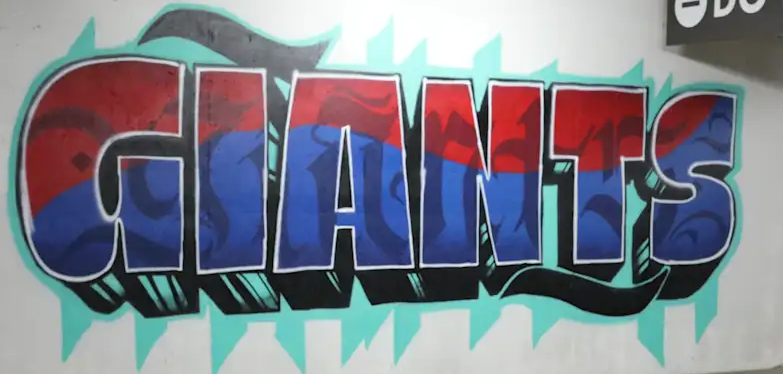
“The sky is not the limit; it’s the view.”
—Swizz Beatz
A shifting perspective opened at the Indianapolis Museum of Art at Newfields with Giants: Art from the Dean Collection of Swizz Beatz and Alicia Keys, bringing 134 works by prominent Black diasporic artists to Indianapolis through Feb. 28, 2027.
The Indianapolis presentation includes 19 additional objects following its previous showing at the High Museum of Art in Atlanta.
“Indianapolis put the artist to the forefront,” Kasseem Dean, known as Swizz Beatz, said of Belinda Tate, the Melvin & Bren Simon director of the Indianapolis Museum of Art, and the coordination of the exhibition’s curation.
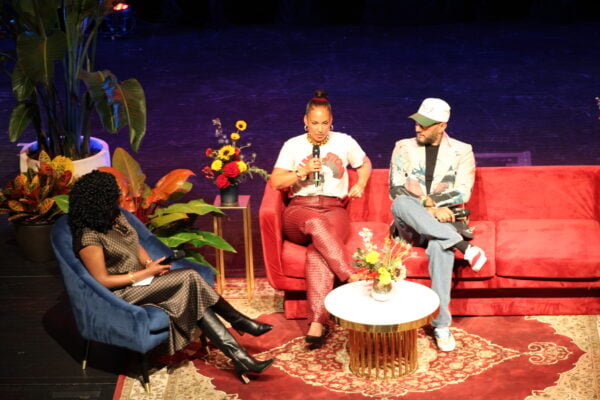
The exhibition, which opened Sept. 19, is the latest stop on a global tour of works from the Dean Collection, which includes paintings, photographs and sculptures by artists such as Gordon Parks, Amy Sherald, Nick Cave, Mickalene Thomas, Ernie Barnes, Barkley L. Hendricks, Deborah Roberts, Kehinde Wiley, Derrick Adams, Jamel Shabazz, Arthur Jafa, Meleko Mokgosi and Kwame Brathwaite, among others.
The Indianapolis presentation is organized into five thematic chapters — “Becoming Giants,” “On the Shoulders of Giants,” “Giant Conversations: Celebrating Blackness,” “Giant Conversations: Critiquing Society,” and “Giant Presence” — and occupies the fourth floor of the Indianapolis Museum of Art.
Becoming giants
“We believe institutions like Newfields should be places where people can see themselves,” said LeMonte Booker, president and CEO of Newfields.
The “GIANTS” exhibition opens that door.
The title draws on the idea of “GIANTS” as cultural icons — artists whose works are both monumental in scale and in impact.
The collectors describe the collection through a philosophy that “greatness develops over time. It grows with curiosity, collaboration, risk-taking, and trust in one’s creative potential. Growing with intention, lifting others as you rise and recognizing that creative community is essential to human flourishing.”
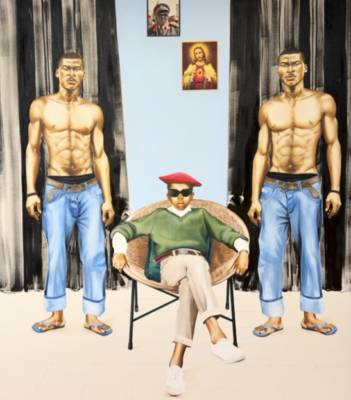
That idea of becoming is present in the exhibition’s opening work, Ebony G. Patterson’s “they were just hanging out you know… talking about…when they grow up…” (2016).
Patterson draws viewers in through beauty and play before asking them to confront the adultification of Black children.
Kehinde Wiley’s portraits of the Deans center the collectors as royalty, adding layers of culture, fashion, style and perspective.
For Dean, however, the exhibition is also about what changes when the same collection enters a different institution.
“Every iteration is different, but this is the first time I have seen certain parts,” Dean said at the opening reception, specifically naming Meleko Mokgosi’s monumental series “Bread, Butter, and Power” (2018).
Dean described seeing images within the artwork that he had not noticed previously, joking referencing “the Indiana lights” before adding, “Indianapolis is the best [iteration thus far].”
On the shoulders of giants
Kwame Brathwaite Jr. carried that idea of putting the artist at the forefront into his conversation with the Indianapolis Recorder.
For Brathwaite Jr., the idea is also about how an artist’s work is presented. “This [pointing toward the gallery], you get to experience the work in its entirety, in its fullness,” Brathwaite Jr. told the Recorder.
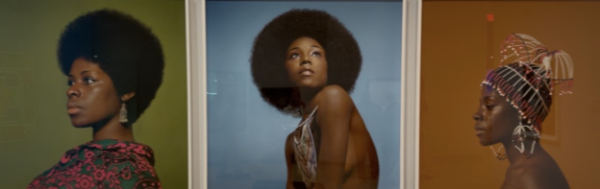
His father, legendary photographer Kwame Brathwaite, created the photographs represented in the exhibition, including images of Brathwaite Jr.’s mother, Sikolo Brathwaite. He said he was honored to have both parents represented. The Brathwaite photographs also include known and admired model and singer Radiah Frye.
“The photographs have traveled with GIANTS, but their placement changes with each iteration of the exhibition … It’s really interesting to see how each iteration is different,” Brathwaite Jr. said. “I also love it, you know, where they place each piece — it is different each time.”
Kwame Brathwaite, Ernie Barnes, Esther Mahlangu, Sanlé Sory, Malick Sidibé, Barkley L. Hendricks, Jean-Michel Basquiat, Jamel Shabazz and Gordon Parks form what the exhibition describes as a “vital lineage” rooted in representation and social change in “On the Shoulders of GIANTS.”
The artists in the section, according to the gallery text, have made a lasting impact on the world.
Giant conversations: Celebrating Blackness
“It is essential for artists to make work that celebrates Black culture,” Derrick Adams said.
For Gordon Parks, celebrating Black culture meant recording what it endured and what it overcame. The selections premiered are from the collection of Kasseem Dean and Alicia Keys Dean, who hold the largest private collection of works by Parks.
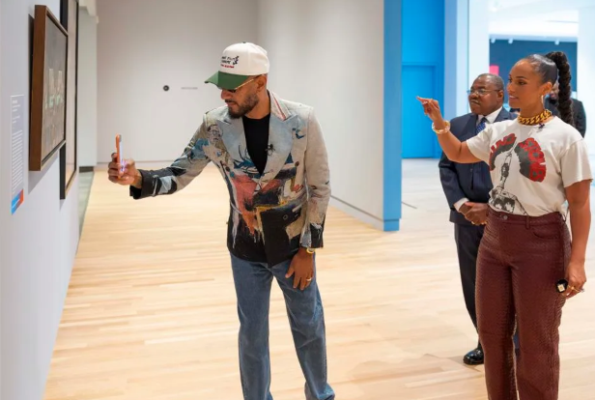
Parks’ portraiture and street photography appear across from Jamel Shabazz’s photographs, drawing their work into a conversation across generations. Parks’ photographs document grit and resilience, while Shabazz’s images capture young people experiencing the streets and subway cars of New York with a sense of movement and joy.
That grit and resilience run through each Parks photograph on view. A segregated water fountain marks the everyday indignity of Jim Crow. In American Gothic, Washington, D.C. (1942), Ella Watson, a government cleaning woman, stands with a broom and mop before an American flag. Parks restaged Grant Wood’s “American Gothic” painting to show the labor behind the American image.
From those single moments, Parks’ camera widens to the crowds of the 1963 March on Washington, where thousands gathered for jobs and freedom. Then it narrows again on Muhammad Ali, a boxing champion Parks came to know while covering him for Life magazine.
Read together, the photographs move from segregation to protest to triumph. That arc lays the ground Shabazz’s young New Yorkers would later cross with movement and joy.
That joy has a lineage. Brathwaite’s photographs helped popularize “Black is Beautiful” in the 1960s, and his son, Kwame Brathwaite Jr., brings that same insistence to the question of who decides what counts as art.
“Fine art is art that comes from the heart,” he said.
Brathwaite Jr. added, “I don’t accept the gatekeepers,” while distinguishing between gatekeeping and the role of curators.
“Curators are there to elevate the conversation, not to gatekeep,” he said.
Giant conversations: Critiquing society
That idea of conversation continues in “Giant Conversations,” where Nick Cave’s Soundsuit greets visitors before they encounter Mokgosi’s 32-panel series “Bread, Butter, and Power” (2018).
The scale of Mokgosi’s work changes the physical experience of the gallery, while the work’s historical and political references expand the conversation beyond the individual pieces. The connectivity and separation of the panels mirror humanity’s shared experiences while emphasizing individuation.
For Dean, that was part of what made the Indianapolis presentation distinct.
His reaction to seeing the work in this setting illustrates one of the central characteristics of a traveling exhibition: “The collection remains the same, but its meaning can shift with the space, arrangement and audience,” said Dean.
“Bread, Butter, and Power” is the work that stopped Dean at the opening reception, revealing images he had not noticed in earlier iterations.
Giant presence
The exhibition closes with Arthur Jafa’s nearly eight-foot-tall “Big Wheel” (2018), wrapped in chains and described by the museum as evoking the exploitation of both the Black body and the African continent through mining.
The paintings by Titus Kaphar and Nina Chanel Abney’s “Catfish” (2017) use scale and visual language to emphasize themes that resonate across history.
Together, the five sections move visitors through recognizing lineage while becoming, dialogue and presence — from artists who established visual languages for Black representation to contemporary artists continuing to challenge how Black life, history and identity are seen.
And that brings the exhibition back to the view from which it began.
The Dean Collection arrives at Newfields as a traveling collection, but the Indianapolis iteration is not simply a repeat of what audiences saw elsewhere.
Nineteen additional objects have entered the exhibition. Works have been rearranged. Artists are placed into new conversations. And, according to Dean and Brathwaite Jr., the experience of seeing the collection changes with each institution.
The sky, in Dean’s words, is not the limit.
It is the view.
Contact Health and Environmental Reporter LaTasha Boyd Jones at tashaj@indyrecorder.com or follow her on social media @iamtashajones.
Editor’s note — Oct. 8, 2026: After this story was published, Newfields announced that Belinda Tate, Melvin & Bren Simon Director of the Indianapolis Museum of Art, will leave her position effective Oct. 9. Tate’s leadership and role in bringing GIANTS: Art from the Dean Collection of Swizz Beatz and Alicia Keys to Indianapolis are discussed in this conversation. The Indianapolis Recorder has requested additional comment from Tate and Newfields regarding her departure.

Tasha Jones is a poet, writer, researcher, and educator whose work explores language as a tool for liberation and resistance. She hosts In the Beginning: The Spoken Word Podcast, the #1 spoken word podcast on Apple and Spotify. Tasha is also the Poems & Parables Literary Journal editor and is currently writing Pyramids. Plantations. Projects. Penitentiaries. You can follow her on social media: @iamtashajones, @itbspokenwordpod, and @poemsandparables.