
Indiana University Health invited news outlets on Oct. 22, to tour its 44-acre downtown medical campus, a major hospital development spanning about eight city blocks, from 12th to 16th streets and from Interstate 65 to Capitol Avenue West. The 2.5-million-square-foot hospital is expected to open in December 2027.
The campus will house four clinical institutes focused on cardiovascular care, neuroscience, cancer care, and clinical innovation through the Tobias-Lechleiter Institute for Clinical Innovation.
The walkthrough provided an overview of the facility’s infrastructure, sustainability initiatives, inpatient room design, technological capabilities, medical education and research facilities, and cancer care services. Hospital representatives described how consolidating services and redesigning clinical spaces are intended to improve the experiences of patients, families and health care workers.
Key observations
Campus infrastructure and environmental sustainability
During the first stop, Erin Pattee, vice president of project planning and operations and Jim Mladucky, vice president of design and construction, discussed the campus’s infrastructure and sustainability initiatives.
Representatives discussed the relocation of power lines underground and the replacement of former parking areas with green space intended to be accessible to neighboring communities. They highlighted energy efficiency, stormwater management, native plantings, and plans to plant about 1,000 trees.
Patient-centered design and hospital operations
The room walkthrough focused on the design of patient rooms, adaptable care environments, family spaces, and clinical workstations intended to support patient care and staff workflows.
Hospital representatives Amanda Noth-Matchett, chief nursing officer for Methodist and University hospitals and Christi Cornelius, director of project planning and operations, discussed the role of clinicians in developing room designs. Representatives said clinical team members contributed to the planning process and that simulations were used to evaluate room layouts before construction.
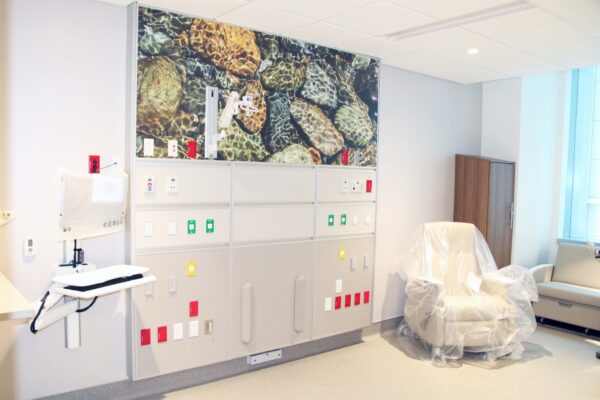
The rooms incorporate Indiana landscape artwork, designated areas for patients and families, and clinical workspaces. The hospital’s design also allows inpatient rooms to accommodate intensive care needs when necessary.
Technology integrated into the rooms is intended to support communication between patients and care teams, including electronic medical record displays and remote nursing capabilities.
During the discussion of hospital operations, Noth-Matchett said IU Health maintains downtime procedures and contingency measures intended to sustain patient care when technology becomes unavailable.
Medical education and research
The Indiana University School of Medicine’s 11-story Medical Education and Research Building, which opened in June 2025, sits adjacent to the IU Health Neuroscience Center.
Asked how medical education and research will serve Indianapolis’ diverse population, particularly whether clinical studies adequately represent patients from different racial and ethnic backgrounds, Katie McGill, vice president of clinical operations, pointed to IU Health’s collaboration with the School of Medicine and research focused on specific patient populations.
McGill cited research into triple-negative breast cancer (TNBC), a subtype that disproportionately affects Black women, as an example of efforts to develop more specialized approaches to treatment.
A 2025 study published in the journal of racial and ethnic health disparities, “TNBC accounts for 40-50% of breast cancers in young Black women. Black women have an increased risk of death due to TNBC than white women; whether age contributes to worse outcomes in the setting of a high–risk tumor subtype is unclear.”
“So, we do have a number of trials that are specific to diverse populations,” McGill said, describing research focused on minority patients with TNBC. She explained that treatment responses can differ across patient populations, making aimed approaches important.
The discussion also raised questions about transparency in clinical research. Asked whether demographic data from the research would be made publicly available, McGill said publication and reporting fall under the School of Medicine’s research protocols. She indicated that IU Health does not own that research.
Cancer care and health equity
The final stop focused on the cancer center’s approach to coordinating oncology services, reducing unnecessary movement between departments, and helping patients navigate complex treatment plans.
McGill and Liz Linden, chief operating officer of Methodist and University Hospitals, described a centralized model in which patients can access multiple services and consult with specialists who coordinate their care. Oncology nurse navigators are expected to help patients prepare questions, understand medical explanations, and navigate appointments and treatment.
The discussion also addressed the physical environment of cancer care, including wall colors, lighting, and the use of natural light. Linden described design choices intended to create a calming environment for patients.
Health equity and language access were also topics. Representatives also discussed interpretation services for patients who speak languages other than English, including technology that supports communication when an interpreter for a less common language is not immediately available.
For patients and families working through a cancer diagnosis, McGill said that support begins with oncology nurse navigators, practitioners who “can convey your questions and the doctors’ responses in understandable terms.”
This reporting is made possible by a grant from the Indianapolis African-American Quality of Life Initiative, empowering our community with essential health insights. https://iaaqli.org/
Contact Health and Environmental Reporter LaTasha Boyd Jones at tashaj@indyrecorder.com or follow her on social media @iamtashajones.

Tasha Jones is a poet, writer, researcher, and educator whose work explores language as a tool for liberation and resistance. She hosts In the Beginning: The Spoken Word Podcast, the #1 spoken word podcast on Apple and Spotify. Tasha is also the Poems & Parables Literary Journal editor and is currently writing Pyramids. Plantations. Projects. Penitentiaries. You can follow her on social media: @iamtashajones, @itbspokenwordpod, and @poemsandparables.