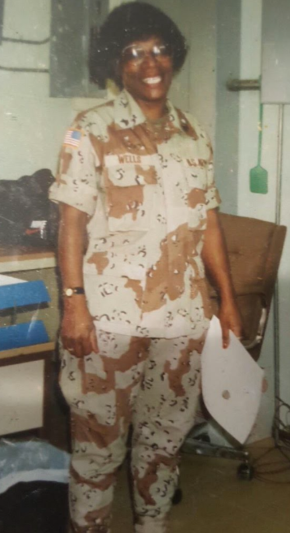
Gulf War veteran and 33-year breast cancer survivor remembers the choice she made

When Sgt. Annie Faye Jackson Wells learned she had breast cancer in 1993, she made a decision about her treatment while still in the exam room.
At a cancer center on Indianapolis’ north side, she listened as a group of doctors, some of them students, she believes, discussed the size of her tumor. She remembers interrupting.
“You can just take the whole breast,” she recalled saying. “I’ll be sure you got it all.”
More than three decades later, Wells, now 76, has not changed her mind.
“This breast is not that important to me,” she said. “My life was more important.”
Wells had a mastectomy at Community East Hospital. After the mastectomy, Wells recalled, doctors told her that the tumor’s size meant she would not need chemotherapy or radiation. She has never had either.
An Army Reserve veteran who served in Saudi Arabia during the Gulf War, Wells is now a 33-year breast cancer survivor. As Breast Cancer Awareness Month continues and Veterans Day approaches on Nov. 11, her story spans both.
A sister’s warning
Before her own diagnosis, Wells felt a lump in her sister’s breast.
Her sister, Bettie Jean Jackson Bolden, had mentioned a lump but had never seen a doctor. One day, Wells placed her hand against her sister’s chest, expecting it to rest flat.
“My hand stayed in the air,” she said. “I broke out in a cold sweat.”
She urged Bolden to get care. Her sister went through chemotherapy and lost her hair as treatment continued. Bolden died of cancer in 1999.
Bolden’s lump is what prompted Wells to get checked herself. Her own cancer was found early.
“I owe it all to Bettie,” she said. “I went the next day.”
Black women are 38% more likely to die from breast cancer than white women, even though they are slightly less likely to be diagnosed with it, according to the American Cancer Society.
Wells said she never learned why her sister waited and that she never asked.
New ground
Asked how her upbringing shaped her response to cancer, Wells talked about the cotton fields.
She was one of 13 children born to Ruth Owens Jackson, whom she called MaDea, and Hardy D. Jackson, a Korean War veteran. In the 1950s, in and around Brownsville, Tennessee, she picked cotton alongside her grandmother, whom she called Mama, starting when she was about 5 or 6.
Cotton was the foundation of the economy in Haywood County, where Brownsville is the county seat, according to the Tennessee Encyclopedia.
She remembers the long cotton bags, how Mama’s bag was weighed before everyone climbed back onto the truck, and the snakes in the field the family called “new ground.”
The family moved to Indianapolis when she was about 9 or 10.
“I think that was just how I was made,” she said. “It was not gonna be an issue. I definitely wasn’t gonna let it get me down.”
Be all you can be
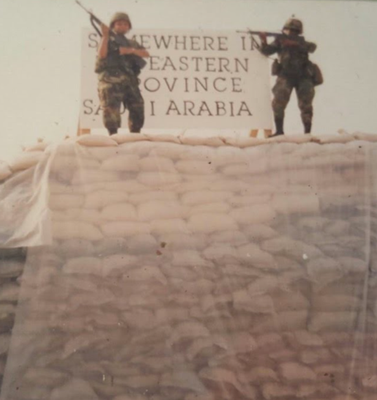
In 1977, at 27, Wells joined the Army Reserve.
Because she already knew how to type, she entered through a program for recruits with civilian-acquired skills and completed an abbreviated basic training in Alabama. She liked the marching and the singing, she said, but not the physical training. She came home so worn out that she fell asleep at her own welcome-home gathering.
Her first unit was the 451st. She later transferred to the 21st Theater Army Area Command, which supported training exercises in Germany.
“I was trying to be all I could be,” she said, recalling the Army’s recruiting slogan.
When the Gulf War began, she said, her commanding general told military leaders he had a unit from Indianapolis that could “get the job done.” Her unit was sent to Saudi Arabia to run logistics.
The unit came home after six months. Wells stayed three more. Her activation ran from Dec. 4, 1990, to Sept. 30, 1991, and she left the military when she returned.
What survival asks
Asked what carried her through her diagnosis, Wells said it came from within.
Her account is not a prescription for how every woman should approach breast cancer treatment. Each diagnosis and treatment plan is different, and lumpectomy and mastectomy can both be appropriate options depending on the case.
Asked what she wanted others to understand about her survival, Wells returned to the words she said in 1993.
“My life was more important.”
Contact Health and Environmental Reporter LaTasha Boyd Jones at tashaj@indyrecorder.com or follow her on social media @iamtashajones.
Tasha Jones is a poet, writer, researcher, and educator whose work explores language as a tool for liberation and resistance. She hosts In the Beginning: The Spoken Word Podcast, the #1 spoken word podcast on Apple and Spotify. Tasha is also the Poems & Parables Literary Journal editor and is currently writing Pyramids. Plantations. Projects. Penitentiaries. You can follow her on social media: @iamtashajones, @itbspokenwordpod, and @poemsandparables.