By LaTASHA BOYD JONES
@tashaj@indyrecorder.com
When disaster comes to an American city, the first questions are not usually philosophical. They are practical: “Are we safe?” “Can we connect or communicate?” “How do we survive?” The litany of questions roaming the mind sorts itself — what must happen now, what can wait. Survival is always, always, always now. But one question outlasts that sorting; the one no single person can answer alone: “Do we need help?” After viewing the devastation on the news and across social media, America knew the answer: help was warranted, not just needed.
That help question is particularly complicated in Gary, Indiana. A majority-Black city, Gary has spent decades being described through decline even as its residents, institutions, and elected officials continue trying to construct a different future. And Black Americans know all too well what it takes to survive in America — what it costs, and who is expected to pay it. So, amid devastation, the familiar slogan gets tested: whose America does “America First” aim to help — or better yet, save?
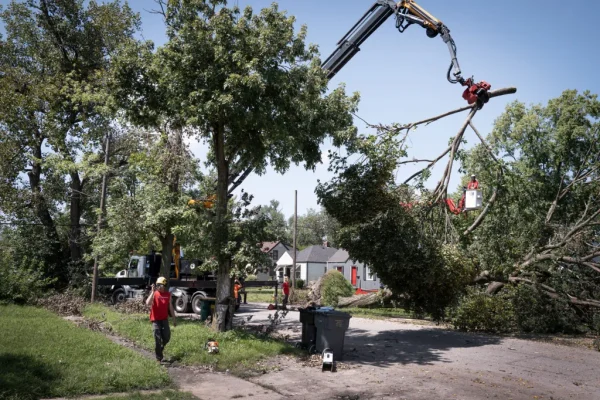
If America is first, what does that mean at the level of a single household in the dark? Who is bringing food when the refrigerators stop working? Who is opening a shelter when the electricity is gone? Who is fixing the part of a house that stands between a restored electrical grid and a family sitting in the dark? Who is clearing the streets when the trees have fallen across the roads?
On Aug. 11, severe weather moved across Northwest Indiana with straight-line winds, tornadoes, heavy rain and flooding — a system that officials preliminarily characterized as a derecho. Some areas received six to nine inches of rain. Winds in Gary reached speeds that Mayor Eddie Melton said were clocked as high as 99 miles per hour.
By Aug. 12, Gary had declared a local disaster emergency and begun responding. That chronology is easy to lose when the story is told backward from the eventual federal declaration. Gary did not spend days deciding whether it had experienced a disaster. Mayor Melton declared the local emergency within 24 hours, while he was still personally driving streets he could not get down, assessing damage that did not require much assessing. Governor Mike Braun followed Mayor Melton’s actions and declared Indiana a statewide disaster emergency Aug. 13.
Then the community did what communities often do when formal systems have not yet reached the person standing in front of them.
People called. They donated. They opened churches. They opened shelters. They distributed food and supplies.
Melton put it plainly on The Harambe Show: “We were immediately feeding people, hot meals, all in the street, in shelters, and taking them to senior buildings.” By Aug. 17, before most of the federal machinery had moved, Gary was already handing out physical aid — thousands of tarps, oxygen refills, food, and charging stations. The YWCA became a shelter and a charging location and somehow held its power; dozens of churches stepped up; the Northwest Indiana food bank and others helped replenish what was vanishing from households. Mayor Melton called it all hands on deck.
One of the first calls came from someone who knew something about Gary. Glenn Robinson, the former NBA player, texted the mayor to ask what he could do, sent an initial contribution and then another $100,000, announced Aug. 19. Hard Rock Casino announced another $100,000 the next day. Gary ultimately raised close to $1 million — money Mayor Melton said he wanted to circulate back through the local economy, not just spend down.
So, the question was never whether Gary needed government. It did. The question is what happened while the government was moving.
And here the calendar tells the real story, because a disaster declaration, an application, and money in a family’s bank account are three different things, arriving on three different dates.
The federal clock ran like this. On Aug. 15, President Trump approved an Emergency Declaration for Indiana. In plain terms, that money could clear the streets, haul the fallen trees, and pay the crews — but it could not put a dollar in a resident’s hand. The streets were funded before the people were. On Aug. 20, Gov. Mike Braun formally requested a Major Disaster Declaration. On Aug. 24, Mayor Melton and Sen. Jim Banks spoke directly with the president; Gary’s own release says Mayor Melton told Trump the city needed immediate access to FEMA resources. On Aug. 25, the major declaration was approved. On Aug. 26, FEMA Individual Assistance became available to eligible Lake County residents. On Aug. 28, intake centers opened so residents could begin to apply. By Aug. 30, people were still being directed to start applications, check their status, and gather information.
Read that sequence slowly. The declaration was not the application. The application was not the money. So, the honest question is not when Washington acted, but when help actually reached a resident — and for the family that fed its children on Aug. 12, that answer lived weeks away, inside a process that had not yet opened its doors.
The state now reports $5.1 million in FEMA Individual Assistance paid out or allocated statewide, with 600 households approved. Those are statewide figures, and “paid out or allocated” is not the same as money already in Gary residents’ accounts.
On a single day, Aug. 24, several two America’s answered at once. Sen. Banks toured damaged areas and met residents at a city shelter. Mayor Melton and Sen. Banks got the president on the phone. And the food critic Keith Lee, who days earlier had said he was driving to Gary, Indiana, arrived and ran a relief distribution with the Salvation Army and local partners. A mayor asking Washington for help; a senator carrying the request; a shelter full of residents; a social media figure with a platform; athletes writing checks; churches organizing gift cards; neighbors helping neighbors. None of it was outside the American response. It was the American response.
This is where the gap stops being a statistic. A neighborhood can be 90% powered, and a family can still be sitting in the dark. Of the roughly 301,000 customers knocked offline, about three-quarters had power back by mid-month — and restoration of the grid still did not mean restoration of the home.
Mayor Melton said roughly 400 residents had applied for help repairing damaged “weatherheads,” the equipment on a house that can keep electricity out even after it returns to the block. If power comes back to your neighborhood but not your house, he explained, the weatherhead is the homeowner’s problem. Some of the donated money was paying for exactly that — keeping a family’s lights on because they could not afford the part that public restoration had left on their side of the line.
When Pastor Tony Guthrie, a Central Indiana church leader, offered to send help from Indianapolis, Melton suggested the churches work through networks already connected to people in Gary, and that gift cards could immediately buy groceries and cleaning supplies. The city itself took no donations directly; it stood up a charitable fund through the Legacy Foundation. “Keeping it very local,” Melton said, had proved successful.
That phrase does more than it appears to. Local here does not mean isolated. It means knowledge — knowing which church can reach which block, who lost a refrigerator, whose power returned but whose weatherhead did not. It is an infrastructure, even if we do not always call it one, and it existed before the federal government finished its next step.
On the Harambe show, that instinct has a name. It’s up to us to save us — a line Thomas Griffin returns to often — and in the storm it looked like neighbors who volunteered while their own houses had no power.
But the phrase needs care, because it carries a danger alongside its power. Read as self-determination, it names something true: Black communities have repeatedly built systems of survival when larger institutions did not arrive in time. Read as permission for government to withdraw, it becomes an alibi. A community should not have to prove its resilience to deserve infrastructure that works. It should not have to raise private money to repair what public systems are responsible for maintaining. It should not have to choose between feeding residents tonight and waiting for reimbursement.
Mayor Melton made that point about NIPSCO. He asked for 60 to 90 days without disconnections, bill credits for the outage period, payment plans and waived fees — and he argued the grid should be built to withstand the winds that now arrive more often, not repaired on the residents’ bill after it breaks. That is not a request for charity. It is a question of responsibility.
And it points past Gary. If the country is entering an era in which extreme weather routinely overwhelms local infrastructure, the question is no longer whether communities will show up for themselves. They will. The question is what determines how fast help moves from a government or institution to the person who needs it — the funding mechanism, the legal authority, the damage assessment, the political relationship, the infrastructure already in place, or all of them at once. Gary adds a variable those conversations often miss — community capacity. When formal systems move slowly, community systems can move immediately. But that capacity should never become an excuse to underinvest in the public kind.
Gary should not have to choose. It can have churches that feed people and a federal system that moves efficiently. It can have neighbors helping neighbors and infrastructure built for 100-mile-per-hour winds. It can have philanthropists writing checks and utilities held accountable for what they maintain. It can have residents who know how to save themselves and a government that does not make them prove it.
That may be the real question hidden inside “America First.” Not whether Washington came — it did. Not whether Indiana responded — it did. Not whether Gary responded — it certainly did. The harder question is whether all three can learn to move at the same speed when the next storm arrives.
Because Gary has already shown what a community does when it refuses to wait. It feeds its people. It opens its churches. It finds its donors, its neighbors, its own money, its own networks. It keeps the lights on wherever it can.
And then, when it has done everything, it can; it still asks its government to do its part.
Gary showed up for Gary. The question now is whether America can learn to show up with it.
Contact Health and Environmental Reporter LaTasha Boyd Jones at tashaj@indyrecorder.com.

Tasha Jones is a poet, writer, researcher, and educator whose work explores language as a tool for liberation and resistance. She hosts In the Beginning: The Spoken Word Podcast, the #1 spoken word podcast on Apple and Spotify. Tasha is also the Poems & Parables Literary Journal editor and is currently writing Pyramids. Plantations. Projects. Penitentiaries. You can follow her on social media: @iamtashajones, @itbspokenwordpod, and @poemsandparables.