COMMENTARY
By LATASHA BOYD JONES
In a town where basketball is a religion, a gem in the gym runs the length of the court, counting down 5-4-3-2-1, taking her shot and imagining the crowd going wild.
That is the dream of almost every childhood athlete.
Kelsey Mitchell is living it.
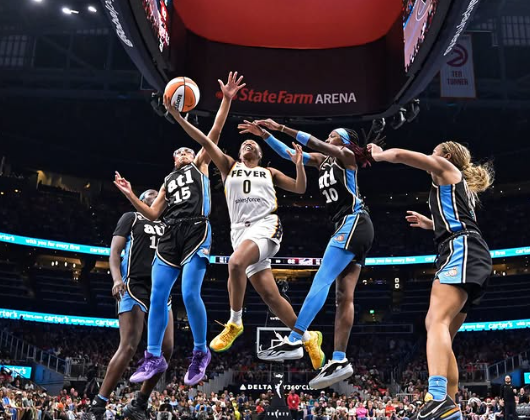
On Aug. 28 in Indianapolis, the veteran Fever guard walked into the third quarter, needing only a handful of points to make WNBA history.
Then she did.
Mitchell became the first guard in WNBA history — and only the second player — to score 1,000 points in a single regular season. She did it with four games remaining, and she did not stop at 1,000.
Mitchell finished with 34 points in Indiana’s 111-91 victory over the Connecticut Sun, bringing her season total to 1,001 and extending her streak of 20-point games to 24. During that same third quarter, she recorded her 911th career assist, moving past Briann January and into second place on the Indiana Fever’s all-time assists list.
January now sits on the Fever bench as an assistant coach. Mitchell passed her in the franchise record book while continuing to do what she has done for nine seasons: move, shoot, score, and play the game she loves.
One thousand points in a single season is not an ordinary accomplishment. It requires volume, durability, and extraordinary consistency. A’ja Wilson was the first player in WNBA history to reach the mark in 2024. Mitchell became the first guard.
The distinction matters.

Wilson is 6-foot-4. Mitchell is 5-foot-8.
Wilson has built her dominance through power, length, and the ability to score from virtually anywhere on the floor. Mitchell has built hers through movement, separation, shooting, misdirection and repetition.
Different bodies. Different positions. Different forms of dominance. But the same number.
One thousand.
Yet the 1,000-point mark is not the only evidence of what is happening in Indianapolis. Mitchell became the first Indiana Fever player to win Eastern Conference Player of the Month in consecutive months. Her July and August honors also made her just the 13th player in WNBA history to accomplish the feat.
Only two other Fever players have won the award multiple times: Tamika Catchings and Caitlin Clark.
The company matters.
Catchings is the franchise’s standard-bearer, a Hall of Famer whose name is woven into the tapestry of the Indiana Fever and the WNBA. Clark is the generational phenomenon whose arrival helped transform the attention surrounding women’s basketball. And now Mitchell has carved out a piece of the franchise record book that belongs to her alone.
August numbers were unparalleled.
Mitchell averaged 28.9 points per game, the highest monthly scoring average for a player over a full month in WNBA history, while shooting 55.6 percent from the field and 53.4 percent from three-point range. She scored at least 20 points in all 11 games she played that month.
This is no longer a hot streak. This is sustained production. And her colleagues did not need the numbers to tell them what Mitchell could do.
Olivia Miles, the Minnesota Lynx rookie who had the task of guarding Mitchell, was almost incredulous when describing her.
“Kelsey Mitchell is legit one of the best basketball players I think I have ever seen,” Miles told ESPN in 2026. “Her ability to move you and catch you off guard so quickly, and her misdirection, is insane. It’s hard not to be a fan.”
Later, Miles described defending Mitchell as her “low-key” welcome-to-the-WNBA moment.
Raven Johnson, the Indiana Fever rookie, offered a similar assessment after guarding Mitchell in practice.
“It is hard to guard her; you can’t guard her from the three, she has a quick first step… Kelsey Mitchell. I have never guarded anybody like her, ever! She is a dog!” Johnson said on the Post Moves podcast.
Angel Reese watched Mitchell score a game-high 28 points for Team Cooper at the WNBA All-Star Game. Her scouting report was only four words:
“That girl, bucket getter.”
The players know. The coaches know. The opponents know. The record book knows. But if a journalist asked Mitchell about any of this, she would say,
“For me, it’s less about the accolade and more about the journey and process,” as WRTV told in 2026.
Although her response is revealing, one wonders if that is why Mitchell’s contributions to the game are consistently underreported.
How can a player this productive remain so easy to overlook? Is it culture? Race? Age? Position? The peculiar economics of attention in a league that is growing faster than its stars can be marketed? Or is it simply that some forms of greatness are easier to keep quiet than others?
Mitchell’s numbers are no longer muted. The first guard in WNBA history to score 1,000 points in a season cannot be shushed. Twenty-point games cannot be hidden. Back-to-back Player of the Month awards cannot be explained as a good night, a hot hand, or the benefit of playing alongside Caitlin Clark.
The recognition in part is coming from inside the league, month after month, while productivity continues to accumulate.
Natasha Howard called Mitchell “1 of 1.” Aliyah Boston called her “a freak of nature.” Becky Hammon has described Mitchell as one of the most difficult guards in the league to cover. Clark has called her “incredibly underrated.”
The players know. The coaches know. But the marketplace of attention has its own statistics.
Who gets the commercials? Who gets the signature campaigns? Whose jersey becomes a cultural artifact? Whose highlights circulate long after the final buzzer? Who gets turned into a slogan, a shoe, a doll, a collectible, a billboard?
What does it say about the way we see women athletes when a 30-year-old, 5-foot-8 guard can become only the second player in league history to score 1,000 points in a season — while becoming a back-to-back Player of the Month — and still somehow have to introduce herself to an audience that has been watching her for nine years?
Perhaps the problem is not that Mitchell has been invisible. Perhaps we have been looking for her in the wrong places. We look for stars in youth, novelty and spectacle. We look for them in height and power, in viral moments and marketability. We look for the player who arrives and announces herself.
Mitchell’s story is different.
For nine seasons, she has continued to exceed whatever expectations were placed on her without needing to become louder than the game itself. She became an All-Star. Then an All-WNBA player. She returned season after season and built a game that could withstand changing teammates, changing coaches, changing expectations, and changing eras of the league.
Now the record book has caught up with what the players already knew.
Kelsey Mitchell is verifiably your favorite player’s favorite player.
Somewhere, perhaps, another girl is counting down:
5-4-3-2-1. She takes the shot. This time, the crowd is real.
And maybe that is the part of Kelsey Mitchell’s story worth remembering:
She never needed to become someone else’s idea of a star.
She just kept becoming Kelsey Mitchell.
Better with time.
Follow Health and Environmental Reporter LaTasha Boyd Jones on social media @iamtashajones.

Tasha Jones is a poet, writer, researcher, and educator whose work explores language as a tool for liberation and resistance. She hosts In the Beginning: The Spoken Word Podcast, the #1 spoken word podcast on Apple and Spotify. Tasha is also the Poems & Parables Literary Journal editor and is currently writing Pyramids. Plantations. Projects. Penitentiaries. You can follow her on social media: @iamtashajones, @itbspokenwordpod, and @poemsandparables.