
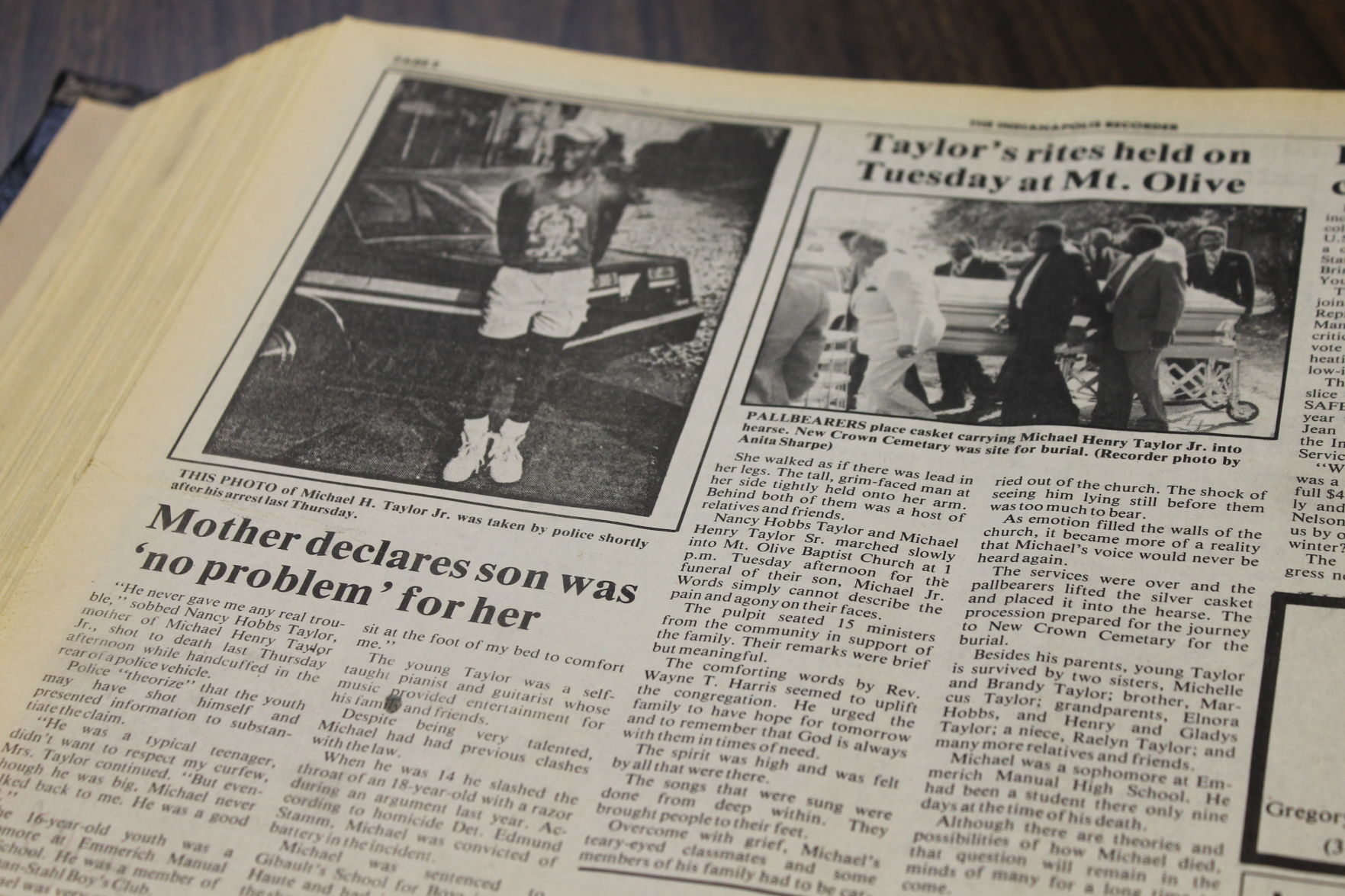
Indianapolis has a long history of major tensions between law enforcement officers and African Americans, especially boys and young men. For example, anyone who is in their fifties or older will recall the case of Michael Taylor in 1987. Taylor, who at 16 years old was just a year younger than I was, died while handcuffed in the back of a police car. The official report says that he had hidden a gun in his shoe, which accidentally discharged and killed him.
That tragedy became one of dozens of stories that I heard about from relatives and family friends as I was coming of age. Those stories left an indelible mark on my psyche as I grew from boyhood to manhood. Still, I did not appreciate how much my fears could multiply until I fathered a son.
Having “the talk” about dealing with police is just the start. For example, I will never forget Christmas shopping for my then seven year-old son in December 2014, roughly one month after Cleveland police officer Timothy Loehmann murdered 12 year-old Tamir Rice. Rice had been playing with a toy gun that someone had mistaken for an actual weapon. In reflecting on that incident, I stood in the aisle of the store, uncontrollably crying after realizing that I could not risk buying my son even a Nerf gun.
The following summer my son and I were in a grocery store buying food for a family cookout in a heavily African American area of town. As young boys often do, he was running up and down the aisles when I noticed three police officers enter the store. Clearly, they were looking for someone.
I immediately told my son to stop running and to stand next to me. My voice was stern, which caused him to tear up. He asked me what he had done wrong. I told him to wait until we were outside. Once we left, I told him that he had, in fact, done nothing wrong. I then explained, as gingerly as I could, why I had stopped him from running.
These and other memories came to me when recently I watched a viral video of a Black teenaged male driver being stopped by an Indianapolis Metropolitan Police Department (IMPD) officer following an anti-ICE protest. Reportedly, the officer initiated the traffic stop because someone indicated that they saw one of the young man’s passengers enter the vehicle with a gun.
The officer, in an expletive-laden rant, threatened to kill the young driver even though he clearly was cooperating. The officer has since been placed on administrative leave pending an investigation. Whatever the ultimate outcome, this is not a good look for IMPD. Still, I am grateful that all the young men survived the encounter.
Importantly, our new Police Chief, Tanya Terry, does not have the authority to fire the officer. However, during public comments she said the following: “The words used in that incident were unacceptable. That language does not reflect the values of this department, or the professionalism we expect from our officers.” To be clear, the problem is not the expletive; the problem is the threat to kill the young man.
Not surprisingly, African Americans are extremely upset about the incident. That includes the young man’s mother, who has been very vocal in defending her son. Like many others, I will continue to monitor the situation.
“To be crystal clear, African Americans are not anti-police; we are anti-police brutality.”
To be crystal clear, African Americans are not anti-police; we are anti-police brutality. Tragically, not everyone understands that simple distinction. Several of my family members and friends are, or have been, law enforcement officers. Although I can never fully appreciate what they go through daily, I have a pretty good understanding of the lives that they lead.
I’m fully aware of the immense stress that they face. I’m also familiar with the troubling statistics on suicide among law enforcement officers. But we need to know that, according to the Law Enforcement Officers Killed and Assaulted program (LEOKA), more white men kill or assault police officers than do Black men. LEOKA is an FBI initiative that collects data on officers killed or assaulted, intentionally or accidentally, while on duty.
Yet, according to the Bureau of Justice Statistics, which is maintained by the U.S. Department of Justice, African Americans are more than three times as likely as white Americans to experience the threat or use of force during encounters with police — even though we are not more likely to act aggressively toward police.
One of the challenges is what is frequently termed “unconscious bias.” In particular, white officers often have had little exposure to African Americans prior to entering law enforcement. Further, white nationalist groups have openly spoken about actively infiltrating law enforcement. Both those facts endanger Black lives.
I understand that the majority of police officers are men and women who simply want to return home safely after their shift is over. Likewise, the vast majority of Black folks simply want to survive our encounters with police. We cannot simply wish either of those realities into being. All of us, police officers and civilians, must actively work toward that end.
Contact community leader Larry Smith at larry@leaf-llc.com.