
Remember playing tug-of-war in middle school? In my experience, when it came time to “choose up sides,” if left to their own devices the physically stronger and more athletic kids often banded together. Watching in horror, the weaker and less athletic kids would scramble to recruit some of their heavier classmates to try to even the odds. Victory was often unpredictable.
Our three branches of government are playing a version of that game. For example, in the wake of multiple scandals involving Justices Clarence Thomas and Samuel Alito — not to mention the revelations about Chief Justice John Roberts that surfaced just this week — the Supreme Court that is vigorously defending itself from a Congress that has suggested it needs oversight.
At the same time, the Supreme Court of the United States (SCOTUS) seemingly bends to nearly all of President Trump’s legal whims, often ruling in his favor via the so-called “shadow docket.” These cases typically sidestep the normal process of weighty oral arguments and public briefings. Instead, they are rushed through (by SCOTUS standards) and often lack detailed written explanations or even signed decisions.
Results of fights between Congress and the Supreme Court’s can be highly destructive (as in the Dred Scott decision), but are normal in the sense that battles over “checks and balances” have existed since the founding of the Republic. For example, the famous (or infamous) Marbury v. Madison decision served to establish the Supreme Court as a co-equal branch of government — which, by definition, placed certain limits on the other two branches.
Still, there is the very troubling issue of the lack of any external mechanism by which to force rules of ethics on the Supreme Court, which is the only judicial body that has the power to exempt itself from such rules. The only failsafe is the potential impeachment and conviction of justices, which has happened just once in our history.
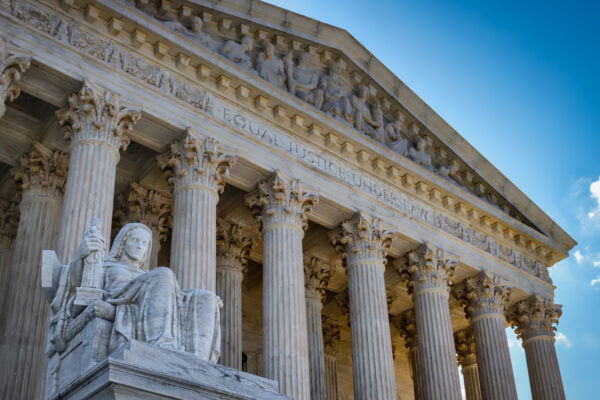
Thus, even though congressional power is enshrined in the first article of the Constitution, it often plays second fiddle to SCOTUS. And if the Congress – the people’s branch – is secondary, so are the people.
Potentially even more troubling is the situation regarding the Supreme Court and President Trump. SCOTUS already gave him what amounts to a “Get Out of Jail Free” card, ruling:
“Under our constitutional structure of separated powers, the nature of Presidential power entitles a former President to absolute immunity from criminal prosecution for actions within his conclusive and preclusive constitutional authority.”
Trump has given new meaning to the phrase “Imperial President,” having taken many actions about which scores of legal scholars have expressed great concern. Of course, the court that ruled on his immunity from criminal prosecution resulting from official actions is the very court that would ascertain whether any given act was “official.” I highly doubt that Mr. Trump is concerned about that hypothetical.
Defenders of Trump will point to other extraordinary presidential acts in our history, such as Abraham Lincoln suspending habeas corpus during the Civil War. But Lincoln took that action during the greatest crisis in the nation’s history (other than the Revolutionary War, which led to the reification of the completely outrageous idea of a Constitutional Republic).
Today, the extraordinary powers that have traditionally been in the purview of presidents might be tested to their limit. For example, Trump publicly stated that, when it comes to waging war, his authority is virtually unlimited. In January, he gave an eyebrow-raising interview with The New York Times. (I know. The vast majority of his interviews are extremely mundane.)
Trump was asked whether there were any limits on his power as Commander-in-Chief. Even for a man who says nearly 100% of whatever comes to his mind (irrespective of how it might be received), his “my own morality” response was stunning. He even said, “It’s the only thing that can stop me.” This comes from a man who has access to weapons that could annihilate the global population.
To use another childhood game analogy, if the current government were a rock/paper/scissors contest, Congress would merely be a staple — a collating tool that serves a minor purpose. Given its abject abdication of its responsibilities, combined with the obsequious assent of the Supreme Court, the principle of separation of powers that is embedded in our Constitution has been rendered all but obsolete.
This is not a partisan issue, at least not for me. Despite the game analogies, this isn’t about the color of one’s proverbial jersey. It is about the absolute necessity of undoing the harm that is being done before it is irreparable.
Contact community leader Larry Smith at larry@leaf-llc.com.
This column has been edited to reflect the columnist’s updates.