Gov. Mike Braun announced that Indiana will end race- and sex-based contracting considerations and replace them with a “merit-based approach that gives every Hoosier business a fair opportunity to compete” on July 15.
“Our Constitution mandates equal protection under the law, because a system where the government picks winners and losers on the basis of race or sex can never be fair. Indiana has replaced divisive, politically-charged programs with a focus on Merit, Excellence, and Innovation: a level playing field where every single Hoosier has the chance to get ahead with hard work,” Braun said.
According to a statement, Braun will soon announce the Indiana Small Business Program, a new small-business initiative to help more Indiana businesses compete for state contracts.
“This blatantly illegal program singles out some Hoosiers for disfavored treatment purely because of their sex or the color of their skin, and it insults other Hoosiers by suggesting they cannot compete on a fair playing field. The program is both un-American and unconstitutional,” Attorney General Todd Rokita said in a statement.
In August of last year, the Indiana Department of Administration asked the Attorney General to review the legality of the Governor’s Commission on Supplier Diversity, the Minority and Women’s Business Enterprises (M/WBE) program, and related race- and sex-based contracting goals.
According to Rokita, race- and sex-based contracting preferences in the Minority and Women’s Business Enterprises (M/WBE) components of Indiana’s Diversity Business Enterprises (DBE) Program are “unconstitutional under the Equal Protection Clause of the Fourteenth Amendment”.
State Rep. Robin Shackleford (D-Indianapolis), a former M/WBE subcontractor, released the following statement in response:
“For seven years, I worked for a certified M/WBE. Many times, the only reason we got a subcontract was because of the goals in this program. But those goals only got us in the room. We still had to earn every dollar on cost, quality and performance, just like any other business competing for the work.”
Shackleford went on to describe how this decision will diminish the support local minority and women-owned businesses have received.
“That’s the distinction this decision ignores: This program was never about guaranteed results. It was about guaranteed opportunity. Calling it ‘un-American,’ as AG Rokita did, gets it backward. The un-American part is pretending a playing field is level when entire categories of qualified businesses have historically been shut out of the room before they ever got the chance to compete. Ending these goals doesn’t erase that history, it just removes one of the few tools that addressed it. If Gov. Braun truly wants a merit-based system, he owes minority- and women-owned businesses something more than a slogan in return: a real, structured path to compete, not just a theoretical one.”
Community leaders demand accountability
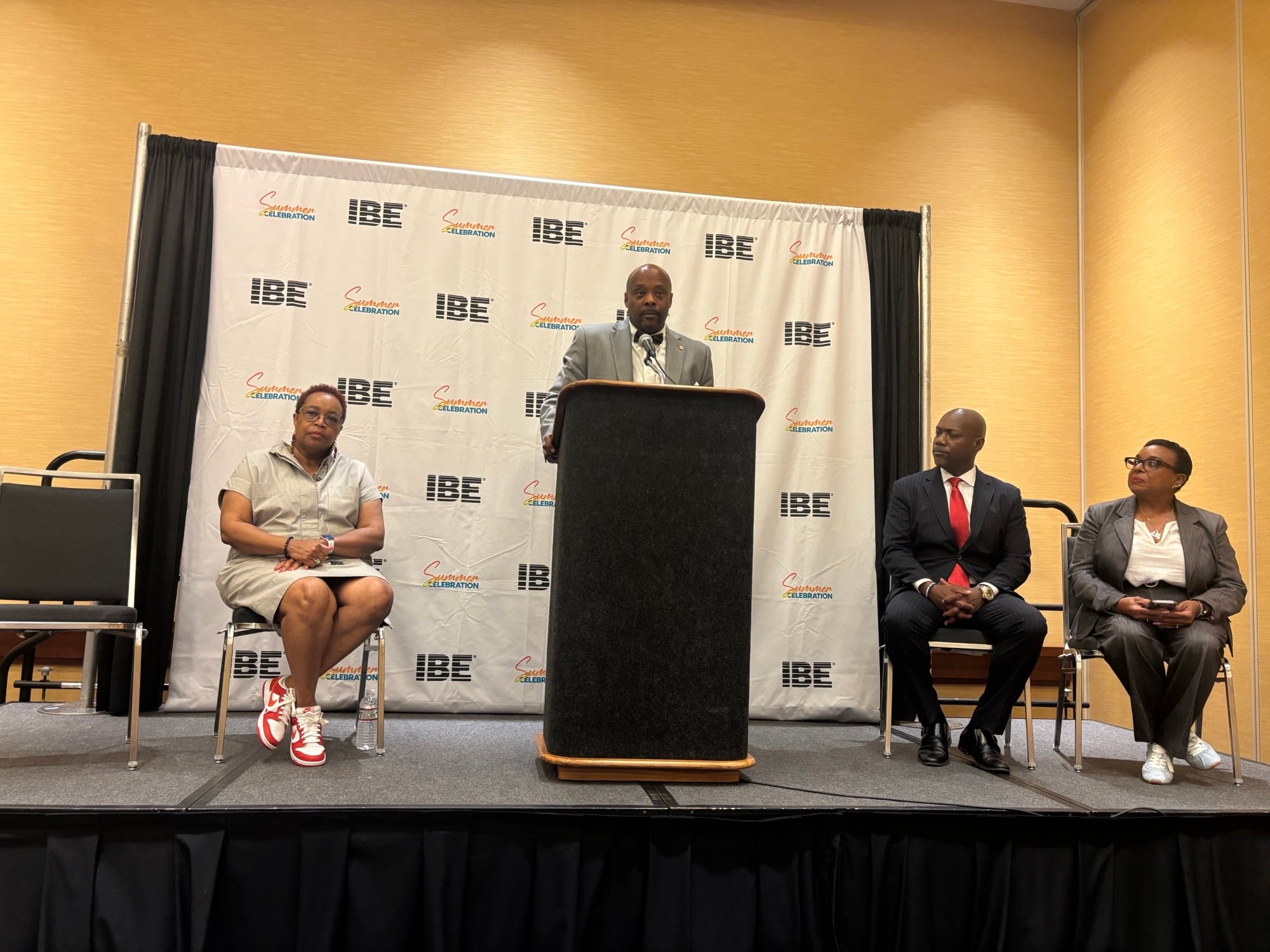
Alice Watson, president and CEO of Indiana Black Expo (IBE) said Braun’s decision to eliminate the W/MBE was “very surprising to all of us here,” during a July 15 press conference held in response during IBE’s Summer Celebration.
“We are celebrating 55 years of Summer Celebration, 56 years of Indiana Black Expo. We just had a celebration with our business conferences, so this is really very bittersweet to have to take this podium at a time when we are highlighting Black businesses and Black excellence,” Watson said. “Indiana Black Expo has more than five decades helping Black businesses build capacity, create jobs, and strengthen Indiana’s economy. That condition will not change. If the standard is merit, then our goal is to ensure Black-owned businesses are among the most prepared, competitive and successful businesses in the state.”
However, Watson said that IBE will also carefully monitor the impact these policy changes may have on minority and women business owners while continuing to advocate for fairness, transparency and economic opportunity for all qualified Indiana businesses.
Indiana Black Expo’s mission has always been about economic empowerment, and Watson said that mission “does not change because state policy changes.”
“Our businesses will continue to be the most prepared businesses and also operate in a spirit of excellence — something that they know how to do and what to do because they’ve had these challenges for past existence of Indiana Black Expo,” Watson added.
Larry Smith, CEO of Fathers and Families, was also present during the press conference, speaking on behalf of the African American Coalition of Indianapolis, calling for Braun to offer Hoosier business owners some clarity by outlining the new parameters for which business contracts will be awarded going forward.
Smith addressed Braun’s point about merit, excellence and innovation — or MEI — and said that when “there are no objective measurable, empirically based standards, then any subjective standard will do,” citing Plessy v. Ferguson and Brown v. Board of Education.
“We want to ensure that there are measurable, objective standards for MEI, so we can hold everybody accountable, so we can measure everybody by the same standards,” Smith said. “No one up here, no one who is represented here, is afraid of merit or excellence or innovation. … We simply want to know what the rules are.”
Tony Mason, president and CEO of the Indianapolis Urban League, called language such as MEI “a dog whistle that’s opening the door for national politics to creep into what we do here in Indiana,” and said that isn’t representative of what Hoosier values stand for.
“For over 60 years, we have been helping to support not only people throughout this community of all backgrounds and races, but businesses as well,” Mason said. “I think we find ourselves clearly at a crossroads, not just crossroads of America, but in this moment where we would have a sitting governor — we also have Todd Rokita and others — who would have the audacity to say that Black, minority and women-owned businesses are anything less than what other businesses are is beyond unfair and unreasonable.”
Mason also echoed Smith’s sentiment and called for Braun to clarify the definition, terms and quantifiable measures for which businesses will be held to. Mason also encouraged local contractors in the community to continue working with minority- and women-owned businesses, while warning women business owners, particularly white women, that this should come as a red flag.
“It’s no secret that, despite all the resources, dollars and supports that have gone into numerous training initiatives and programs here for entrepreneurs and small businesses, we can’t sit here and pretend as though, for some reason, white businesses are struggling because contracts and overwhelming number of contract opportunities are going to Black minority women-owned businesses,” Mason said. “Secondly, if we’re not careful, we will create opportunities where thriving businesses and entrepreneurs might consider relocation.”
Denise Herd, co-chair of the Government Affairs Committee for the National Association of Women Business Owners (NAWBO), spoke on behalf of the organization, reading an official statement that addressed the practical implications for women-owned businesses in the state of Indiana. NAWBO Indianapolis “respects the attorney general’s role in interpreting the law and recognizes that constitutional questions surrounding programs are matters for the courts and policymakers,” but moving forward, the organization’s focus remains on the “practical implications” for the state’s economy and women-owned businesses.
“Programs supporting women-owned businesses were established to address long-standing disparities in access to contracting opportunities and to expand participation in competitive marketplaces where historical barriers existed,” Herd said. “Their purpose has always been to strengthen competition and show all businesses have the opportunity to compete, not to exclude others. Our greatest concern is what happens next. Women-owned businesses have consistently demonstrated that they can compete and succeed on merit, the issue has never been about capability. It has been about access to opportunity. As Indiana transitions away from the MWBE program, we believe the state has a responsibility to ensure qualified women-owned businesses do not lose meaningful access to public contracting opportunities as an unintended consequence of this policy change.”
Members of the Indy Black Chamber of Commerce (IBCC) as well as Rep. Vanessa Summers (D-Indianapolis) and Rep. Greg Porter (D-Indianapolis) also attended the press conference on July 15, standing in solidarity with IBE, the Indianapolis Urban League and the African American Coalition of Indianapolis and all the minority and women business owners that would be affected by Braun’s decision.
“This decision does not create a level playing field, but it removes one of the few tools that helped level it in the first place,” the IBCC said in a statement. “Black-owned and women-owned businesses in Indiana continue to face documented disparities in access to capital, contracting opportunities, and economic resources. Eliminating this program does not erase those disparities; it simply removes one of the mechanisms designed to help address them.”
Impact on local business owners
For local minority and women entrepreneurs operating across Central Indiana, the state’s sudden elimination of Minority and Women’s Business Enterprises (M/WBE) contracting goals represents far more than a policy shift — it undermines years of hard-earned professional vetting.
Camille Walker, an Indianapolis resident and founder of Lamira Wellness and Lamira AI — an artificial intelligence ethics integration firm — described the state’s rollback as disappointing, though not entirely unexpected given the political climate.
“Not surprised, given the current administration,” Walker told the Indianapolis Recorder. “Kind of knew that this was going to happen … I’m disappointed that they allowed for it to happen.”
Walker’s path to certification was directly tied to major civic investments in Indianapolis. Almost exactly one year prior, Walker was selected as part of a cohort of women business owners who were supported in the lead-up to the 2025 WNBA All-Star Weekend in Indianapolis. The initiative, backed by Pacers Sports & Entertainment (PS&E) and the Indiana Fever, sponsored 21 women-owned enterprises through a rigorous vetting process to secure city and state M/WBE credentials.
For Walker, the value of the M/WBE certification was never about receiving preferential hand-outs or skipping to the front of the line for contracts. Instead, it served as an essential third-party verification of operational excellence and financial legitimacy.
“It doesn’t automatically guarantee you that you’ll get contracts,” Walker said. “It’s just a stamp of approval. It’s just simply saying that the city, the state, whoever supports my business and is a good business to do business with.”
Walker emphasized that earning the credential required navigating an exhausting administrative audit of her firm’s inner workings. Applicants were required to submit extensive tax documentation, historical financial records, corporate references and evidence of previous contract execution.
Under the state’s new framework, M/WBE designations are slated to be replaced by a general small-business certification based solely on annual revenue thresholds, rather than on structural identity or rigorous operational audits.
“When I applied for this program, it was very intense — they go through every single aspect of your business financials, what contracts you’ve done previously … references, resources,” Walker said. “Having that taken away and now saying this is solely based on how much income your business has brought in is very frustrating. It’s like all that hard work that I did to get the certification, and now it was just for nothing.”
Beyond administrative recognition, some minority business owners note that the M/WBE seal opened crucial networking doors with regional institutions, including the Indy Chamber of Commerce and local technology forums.
“Walking in these rooms and saying, ‘hey, the city of Indianapolis or the state of Indiana has certified my business to be a good person to do business with,’ that automatically increases my credibility,” Walker said.
The decision to disband M/WBE protections while retaining certification frameworks for veteran-owned enterprises has drawn sharp criticism from local business advocates, who view the selective elimination as deeply telling. Advocates point out that systemic biases against women and Black entrepreneurs persist across both public procurement and private capital access.
Furthermore, some business owners question the timing of the state’s policy shift, which effectively nullifies the significant private-sector capital and mentorship that corporate partners like Pacers Sports & Entertainment poured into minority enterprises just 12 months ago.
“The Pacers and the Fever (PS&E) put all this money and effort into it just last year to get all of these businesses certified together,” Walker said. “And here we are, a year later … it’s useless.”
While established business owners like Walker have built diversified networks to weather the policy change, she expressed grave concern for the next generation of minority entrepreneurs attempting to gain a foothold in Indiana’s economy without formal institutional backing.
“Selfishly, I feel like it’s not going to necessarily affect my business because I know how I operate and I’ve already put things in place to support myself,” Walker said. “However, I do understand how for the majority of us, it is a frustrating thing that now puts us in a situation: Where do we go from here?”
At the time of this reporting, the IDOA Division of Supplier Diversity website was not active. For more information visit events.in.gov/gov.
Contact Staff Writer Malik Simon at 317-762-7847.
Contact Arts & Culture Reporter Chloe McGowan at 317-762-7848.
Contact Multi-Media & Senior Sports Reporter Noral Parham at 317-762-7846.

Chloe McGowan is the Arts & Culture Reporter for the Indianapolis Recorder Newspaper. Originally from Columbus, OH, Chloe has a bachelor's in journalism from The Ohio State University. She is a former IndyStar Pulliam Fellow, and has previously worked for Indy Maven, The Lantern, and CityScene Media Group. In her free time, Chloe enjoys live theatre, reading, baking and keeping her plants alive.

Malik Simon is a Staff Writer for the Indianapolis Recorder Newspaper. Originally from Memphis, TN, he graduated from Mississippi Valley State University with a Bachelor of Arts in General Studies concentrating on journalism. Before joining the Recorder, he wrote for the Devil’s Gazette newspaper at MVSU and served as a freelance content and video editor. He seeks to use media to help communities flourish through literacy and factual reporting.

Noral Parham is the multimedia and senior sports reporter for the Indianapolis Recorder, one of the oldest Black publications in the country. Before joining the Recorder, Parham served as the community advocate at the MLK Center in Indianapolis and as a senior copywriter for an e-commerce and marketing firm in Denver. He is also a business owner.