Far too often for many Black parents and caregivers, in a nation still riddled with inequities, school choice is a matter of picking between two less-than-desirable options.
In a recent personal essay in New York Times Magazine, “In Fighting for Every Black Child, Did I Betray My Own?,” Pulitzer Prize winning journalist Nikole Hannah-Jones, shared her experience navigating school choice for her only child. She and her husband Faraji chose to send their daughter Najya to an under-performing public school in their New York neighborhood. While her family could afford to send their daughter to a more affluent, or even a private school, Hannah-Jones chose her values, standing in solidarity with under-resourced families, over personal comfort.
She and her husband chose to stick with a challenging academic environment while trying to improve the experience for all school’s students. Faraji Hannah-Jones joined the PTA. They rang the alarm when issues arose. They advocated for policy and academic changes. Their efforts may have even helped a little, but ultimately, their daughter’s educational foundation suffered in an environment where students didn’t receive homework, assignments were left ungraded, and proficiency assessments almost didn’t happen at all.
In the end Hannah-Jones expressed regret over her decision. And their daughter eventually chose a better-resourced public school to attend.
But these are not simply personal choice issues; they are policy issues based on decisions that happened years or decades ago.
While the Brown v. Board of Education decision was pivotal in the desegregation of schools, it did not solve all the educational hurdles Black families would face. Hannah-Jones’ daughter faced discrimination and “casual” racist remarks at the more affluent, less diverse school, presenting another set of challenges.
” … do we believe Black students deserve a good education … “
Thus, it is not simply a tale of two choices. It’s a tale of many choices. Or maybe not. Perhaps it’s just one choice — do we believe Black students deserve a good education where their identity is affirmed and they are prepared for the future that awaits them?
If we do believe that, then how do we get there?
Let me begin by saying that I applaud the school leaders, educators, school board members and advocates who still are determined to fight the good fight. Many do exist and they deserve our acknowledgment and support. This is no small feat.
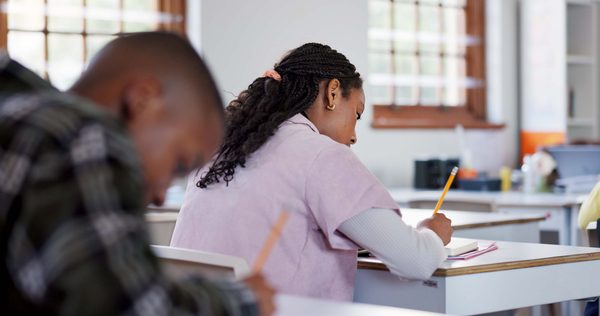
It’s frustrating to watch one generation after another not receive the educational training they need. We do our part as parents or advocates, but it feels like it’s never enough. Further, the saddest part is the students and families often don’t know what they are missing.
Some may not know that teaching to master the subject matter is expected in higher-performing schools and literacy proficiency is a given, not because the students are smarter.
I have observed some Black families reject the idea of academic rigidity because it feels too similar to oppression. Sitting quietly in a room where you can’t fully express yourself and you’re told to repeat a task again, and again, until you do it exactly as instructed may feel oppressive. In other circumstances, however, it’s considered the high-level preparation.
Michael Jordan probably took more shots in practice than he could count so he wouldn’t miss the shot when it mattered. The same principle holds true for education. Practice matters. Preparation matters.
In our current educational landscape, some educational institutions are designed to guarantee their students will become your next judge, senator, surgeon, developer or architect.
Meanwhile, other students are essentially being supervised from 8 to 3. These students get the message to stay quiet, not cause too much trouble and the school will keep passing them until they graduate. They can learn a little, but not much.
This leads us to question our assumptions about intellect. I strongly believe intelligence does not have a ZIP code or a tax bracket, but some other people must believe that some areas are filled with smart kids, and some aren’t. Some people, even educators, must believe that some schools and neighborhoods are filled with not-so-smart kids, leading to lowered expectations overall. As the saying goes, children will rise or fall according to our expectations.
I’m not sure how we can celebrate a reading or math proficiency level that is less than 20% of that school’s population. It may be an improvement or a step in the right direction, but as Hannah-Jones shared in her essay, her child does not get a do-over for her formative educational years, nor do the thousands of students going through schools that have yet to figure out how to teach them.
For those of us who want to see all students succeed, and care deeply for the ones who look like us or come from our neighborhoods, school choice remains a tough decision.
“Schools that lack resources are not able to support our students … but they will not gain those resources if we all abandon ship.”
Schools that lack resources are not able to support our students in the way we hope, but they will not gain those resources if we all abandon ship. We don’t want to abandon other students at lower-performing schools where our presence and resources may help, but we also don’t want our own children to suffer academically when we know better options exist.
We ask ourselves, what responsibility do we have beyond our households, especially for other Black students? As challenging as it may be, we know that historically little has changed in this country without significant, sacrificial and collective effort. Therefore, we know as a community we must do more.
Hannah-Jones said it well in her essay:
“As long as we continue to rescue our own children from the failing schools where we allow other people’s children to languish simply because those children have been born Black and poor in a nation of racism and riches, there is no absolution here. Not for me. Not for you. Not for any of us.”
Contact Editor-in-Chief Camike Jones at camikej@indyrecorder.com or 317-762-7850.

Camike Jones is the Editor-in-Chief of the Indianapolis Recorder. Born and raised in Indianapolis, Jones has a lifelong commitment to advocacy and telling stories that represent the community.