Black school leaders are far more likely than their white peers to hold doctorates. It’s often to counter bias and prove their qualifications, experts say.
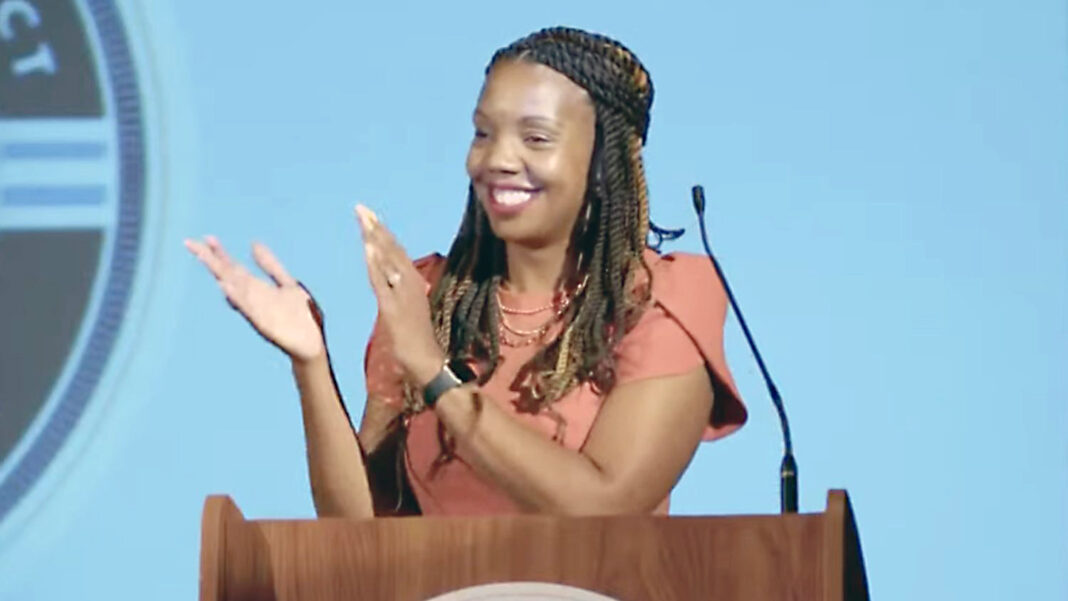
Aleeisa Johnson had her sights set on earning her doctorate the moment she applied to be the Indianapolis Public Schools superintendent in 2018.
As the first Black woman to lead Indiana’s largest school district, Johnson, who had only a master’s degree at the time, felt she needed the extra credential to support her qualifications for the role because she’s not a white man.
Johnson earned her Ed.D. in educational leadership and administration from Oakland City University in June 2021.
“When people think about leadership, oftentimes, from an unconscious or conscious bias, they are thinking about sort of male-affiliated, male-associated characteristics or leadership,” says Johnson, who earned her doctorate in educational leadership and administration from Oakland City University in June 2021.
The degree, she says, gave her “just an additional sort of point” to support her qualifications, and “pierce some of those unconscious or conscious biases that people have in their minds about who is qualified, deserving, [and] of best position to be a superintendent.
And the data, Johnson says, “shows us [that person] is usually not a woman, and it’s usually not a Black woman.”
Why many Black superintendents have doctorates
When it comes to K-12, public school leadership, a higher share of Black superintendents hold doctorates than their white counterparts. Data from the School Superintendents Association show that about 80% of Black superintendents have an advanced degree, nearly double the percentage of their white peers.
But experts say the racial gap between school superintendents called “doctor” and those who are not highlights the extra pressure Black educators — who are vastly underrepresented in grade-school education — face to prove their qualifications for leadership roles in schools.
Sonja Santelises, CEO of Baltimore City Public Schools, says that for Black educators, having a doctorate can help offset any racial biases that may hinder them when it comes time to hire new school leaders.
“I know a number of white male superintendents who don’t feel any pressure to get a doctorate,” she says. “They just feel like ‘Hey, I go in and if I can do the work, they give me the job.’ I see that frequently. I don’t think it’s a burden they carry, frankly, in the same way.”
By contrast, “with a number of aspiring Black female superintendents, they almost feel like it’s a necessity for them” just to be considered a viable candidate, she says.
Why are doctorates so important to school boards?
Many school districts, especially those in competitive areas, require superintendents to hold a doctorate. To school boards who hire school leaders, a candidate with a doctorate in education signals that the candidate has studied school operations, has conducted research that pertains to the role they aspire to hold, and is more likely to have school leadership experience.
Yet even though more Black educators hold a doctoral degree compared to all teachers, the vast majority of school superintendents are white men.
M. Ann Levett, the former superintendent of the Savannah Chatham County Public Schools in Georgia, says implicit biases among school board members can influence who they select as their district’s leader. Most school boards are predominantly white.
“Sometimes people want the familiar,” she says. “They want what they believe works best for their community, and sometimes they do not see a minority person who is indeed qualified as the right fit.”
Levett, who was a board member for two charter schools in New Haven, Connecticut, says that school boards need to be aware of their implicit biases when considering candidates for superintendent.
“If I’m looking at a person to come and perform a service for me and work for me, if I think, ‘I’m never going to have anyone who’s going to do that job outside of a person who looks like me,’” she says, “then I am indeed depriving myself of an opportunity to find someone who may be able to perform that job better.”