
June marks the beginning of summer, the month of Juneteenth celebrations and the month fathers are honored and celebrated.
After hibernating all winter, many people are ready to enjoy warm weather, family reunions, days in the park, beaches and good summer fun! All of that is often ushered in with the last holiday of spring, Memorial Day. Theme parks open, vacation travelers hit the highways and skyways, and scheduled good times begin!
There are two myths associated with June observances that I want to debunk.
Related: Watch “How to Reclaim Lost Genius,” a TedxTalk by Maxine Bryant, Ph.D.
The first is Juneteenth. Many Black communities pause to celebrate and honor Juneteenth with programs, rituals, dancing, poetry, parades and community gatherings. While Juneteenth should indeed be observed, it is important that we observe it in truth rather than through the myths that often accompany it.
Many of us were taught that the Emancipation Proclamation, signed by President Abraham Lincoln on January 1, 1863, freed all enslaved people in the United States and that enslaved people in Galveston, Texas, were the last to be freed two years later, in June 1865. Both are myths.
In February 1861, seven Southern states — South Carolina, Mississippi, Florida, Alabama, Georgia, Louisiana, and Texas — seceded from the Union to form the Confederate States of America. They created their own constitution, elected Jefferson Davis as president, and established their capital in Montgomery, Alabama. Just two months later, the Civil War erupted in April 1861.
“In truth, the Civil War was largely about slavery — economically, politically, and socially.”
In truth, the Civil War was largely about slavery — economically, politically, and socially. The Southern economy thrived on the labor of enslaved people, and the Confederacy fought to preserve that system. Slavery was their “currency,” and they had more of it than the North. They were not about to give it up without a fight.
When Lincoln issued the Emancipation Proclamation in 1863, it applied only to Confederate states — where he had no control — and excluded the border states that remained loyal to the Union. In short, it did not immediately free anyone.
The Civil War officially ended with the Confederate surrender on April 9, 1865, and with it came the legal end of slavery. On June 19, 1865, Union forces arrived in Galveston, Texas, to enforce emancipation and inform the enslaved people there of their freedom. Contrary to the common myth, they received this news just two months after the war’s end — not two years later. That day — Juneteenth — marks the moment freedom was enforced in Galveston, making it a powerful symbol of delayed and long-awaited liberation.
The second myth centers around Black fathers.
Black men are often portrayed as absent fathers — disconnected from their families. Sadly, too often we as Black women contribute to this myth through our conversations and actions.
The truth is that despite slavery, segregation, economic exclusion and racial terror, Black families demonstrated extraordinary resilience. Before the mid-20th century, most Black children were raised in homes with both parents present. In fact, from 1880 to 1960, the majority of Black children lived in two-parent households. This is documented truth.
The question is not whether Black families — and Black fathers in particular — valued stability, marriage, and community. History clearly shows that they did. The deeper question is: what social, political and economic forces disrupted those patterns?
During the early 1980s, I worked as a case manager with the Marion County Department of Public Welfare. Part of my responsibilities included conducting home visits. If I saw any signs of a man living in the household, I was required to report it as a violation, and that single mother could lose her financial benefits. This system existed to keep men — most of whom were Black — out of the household.
Consider also the criminal justice system. We already know that Black men have been — and continue to be — incarcerated at disproportionately higher rates than their white counterparts. This further disrupts their physical presence in homes and communities.
“Slavery could not destroy the Black family. Jim Crow could not destroy the Black family. Yes modern systems … have profoundly disrupted the physical presence of Black men in their homes…”
Slavery could not destroy the Black family. Jim Crow could not destroy the Black family. Yet modern systems — mass incarceration, economic exclusion, and punitive social policies — have profoundly disrupted the physical presence of Black men in their homes and communities. When fathers are removed through prison walls, unemployment barriers and policies that penalize family unity, the issue is no longer simply personal choice. It becomes structural.
As we observe Father’s Day 2026, I encourage Black communities everywhere to join together to support and uplift Black men who are struggling and fighting against these systems.
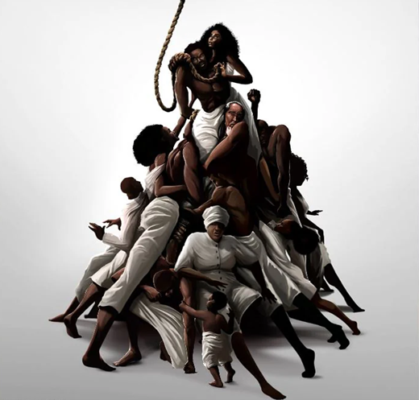
A brilliant artist, Aaron Williams, created a visual piece that paints a powerful picture of the role of the Black community in supporting Black men. It is called “Stronger Together.” Let’s remember that. Let’s do that!
Happy Juneteenth and Happy Father’s Day!
Maxine Bryant, Ph.D., is the founder of GriotSpeaks, author, and an African American culture keeper. Contact her at mlb@drmaxinebryant.com or follow her on Facebook at facebook.com/maxine.bryant.104. Watch her TEDxTalk “How to Reclaim Lost Genius” here.

Maxine Bryant, Ph.D. is the founder of GriotSpeaks, author and African-American culture keeper. Dr. Bryant replaces mythology with truth about Africa and the African Diaspora experience. Learn more about her at www.drmaxinebryant.com and email her at mlb@drmaxinebryant.com.