Christopher Nolan’s “The Odyssey” has been a hot topic of conversation for the last few weeks as moviegoers scramble to find tickets to see the film as it was intended — in 70 mm IMAX.
Thankfully, Hoosiers don’t have to travel far, as White River State Park in Indianapolis is home to one of the few IMAX theaters with a 70mm film capability. Still, tickets are selling out fast, even as new showings are being added well into September, according to Neale Johantgen, theater manager for the IMAX Theater in the Indiana State Museum.
“Here at our theater, we really want to be able to provide the best movie-going experience and the best presentation quality possible, and our quality that we can put forth is never better than when we do something on film,” Johantgen said. “When there’s so few locations, we have people that come over the country to see it here. … It’s a lot of pressure, but it’s also fantastic to be able to share this kind of experience that we really value with as many people as possible.”
Written and directed by Christopher Nolan, “The Odyssey” is based on Homer’s Epic of the same name and adapted from Emily Wilson’s 2017 translation. The story takes place near the end of the ‘Trojan Cycle’, which is a series of epic poems that conveys the causes, events and consequences of the Trojan War — one of the last events of the Age of Heroes in Greek mythology, Bill Beck, assistant professor of classical studies at Indiana University Bloomington, told the Recorder.
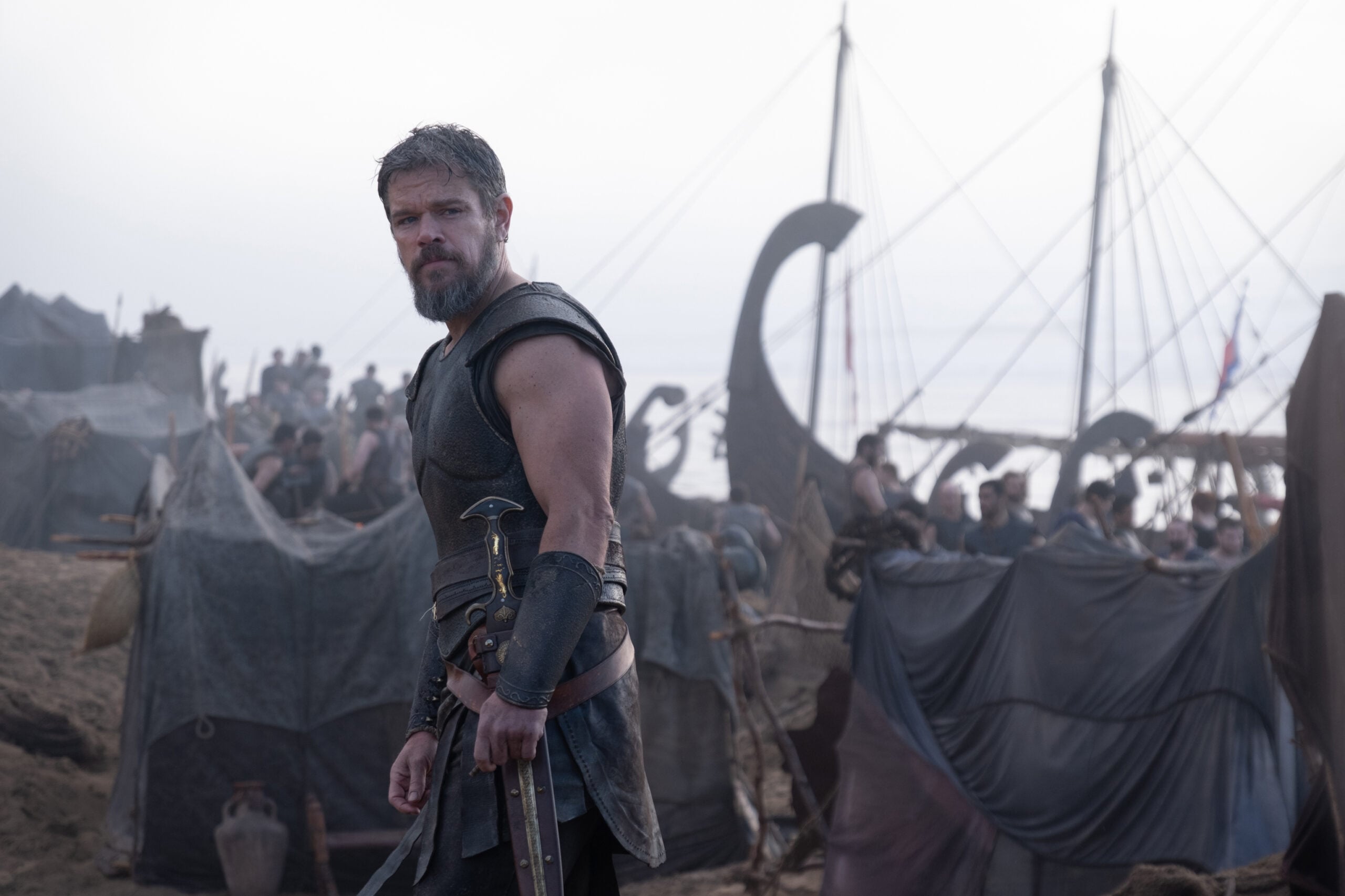
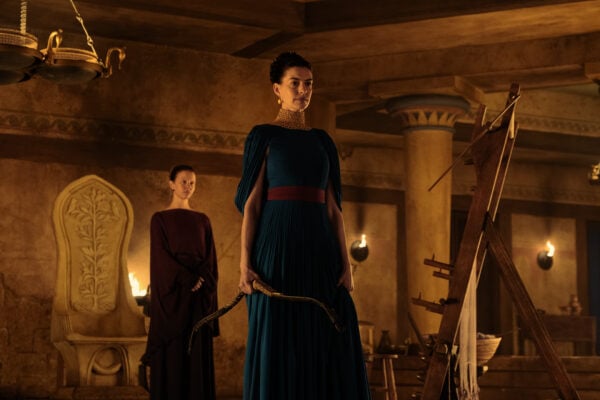
“The Odyssey” follows Odysseus (Matt Damon) on his return to Ithaca and reasserting himself as the master of his household after a 22-year absence following the Trojan War. The film also stars Anne Hathaway as Penelope, Tom Holland as Telemachus, Lupita Nyong’o as Helen of Troy and Zendaya as Athena, and was released in theaters in IMAX 70mm on July 17.
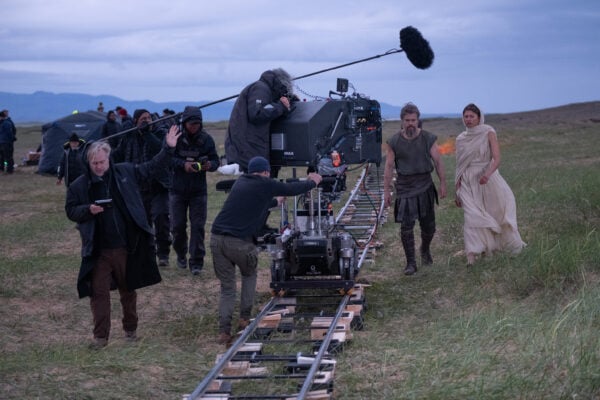
IMAX is short for Image Maximum and is both a movie format and a company that specializes in premium large-format screens and enhanced, loud sound, Johantgen said. Most IMAX theaters specialize in documentary films, which are regularly shot in IMAX, but over the last 10-15 years, more Hollywood movies have incorporated IMAX filming — such as Nolan’s “Interstellar” and “Oppenheimer” and Ryan Coogler’s “Sinners.”
IMAX theaters are still found in multiplexes, though most are at museums — such as the one at White River State Park, which is located inside the Indiana State Museum, despite being a separate entity. When most movie theaters made the switch to digital projection in the 2010s, Johantgen said Indianapolis’ IMAX Theatre at the Indiana State Museum decided to hold on to its 70mm projector, which is why they are one of 25 theaters in North America — and 41 in the world — able to screen “The Odyssey” as in its original format.
“The Odyssey” is the first feature-length film to be shot entirely in IMAX, which Johantgen said means the film will fill up their screen, which is six stories tall and 84 feet wide, for the entirety of the film; people will experience a clearer picture and be more immersed in the image on screen.
The IMAX Theatre at the Indiana State Museum has spring #15 of “The Odyssey,” which Johantgen said is 11 miles long and weighs 600 lbs. There’s also a skilled projectionist in the booth operating the projection system for the entire duration of the film.
‘The impact of this movie. I mean, it’s creating such a buzz. It is really an interesting time to be a Homerist or just a classicist, because it really feels like certainly ancient Greek mythology is entering or really emerging to the surface of pop culture in a way that it hasn’t done,” Beck said. “And so to have a director like Christopher Nolan taking on this material, … brings a lot of excitement for this material. So I’m very thankful for that, and I think we’ll get more students in our classes as a result. So that’s always a good thing for us.”
At IU Bloomington, Beck focuses on ancient Greek and Latin texts, cultures, history and translation, including Virgil’s “Aeneid” and the Homeric poems “Iliad” and “Odyssey.”
Homer’s “Odyssey” was written in the early or mid-7th century BCE — a time of cultural resurgence in the Greek world — and Beck said the text both reflects and is informed by oral storytelling traditions and techniques that have been developed over generations.
Retelling “The Odyssey” in film format makes the story a bit more accessible to modern audiences, but it also loses several nuances — and there is already a lot of discourse about that, Beck said. First and foremost, the moral ambiguity of Odysseus is lost in the film adaptation.
“Odysseus is an incredibly wily trickster character. He cheats, he steals, he lies, and he is absolutely bloodthirsty for revenge, and does not care who is innocent and who is guilty,” Beck said. “The version that Christopher Nolan gets is a very different Odysseus. Matt Damon is just a noble guy who’s trying his best. He makes one mistake or two mistakes in the entire work, and both of them are understandable mistakes. So, we’re really supposed to be rooting for him in an uncomplicated way, whereas in ‘The Odyssey,’ (poem) we’re rooting for Odysseus almost in spite of ourselves.”
Though, Beck also said Nolan is appealing to a very different audience than Homer was in the seventh century B.C., so the film is sending different messages based on what the storyteller believes their audience needs — such as an uncomplicated hero to root for vs a morally ambiguous antihero.
As far as what lessons “The Odyssey” has for modern audiences, Beck said the original poem is interested in three main things: what it means to grow up, the ways society educates their youth and identity. However, Nolan’s adaptation seems to be more interested in asking why people fight wars, who the real good guys are, and if people are their own worst enemies.
While Beck said he enjoyed the film and thought it was fun, entertaining and included a large portion of the original plot — including the travel and wanderings of Odysseus, he also said the film “wasn’t a very successful adaption” of “The Odyssey” as it didn’t get the spirit of the text.
“One of the messages of his (Nolan’s) version of ‘The Odyssey’ is that this war was both sinful and kind of pointless, and that the people who thought they were the good guys turn out to be the bad guys, and I think in Western culture, certainly in America, we’re having a lot of those same ideas,” Beck said. “I think it makes sense that he’s using the Odyssey as a vehicle to express that. So, I think he strips out a lot of what I think is interesting about the original text, but he’s bringing in new ideas that are clearly intended to speak to modern audiences, which, even if some of us will be disappointed with some of the choices he made, I think that he still produced an interesting movie.”
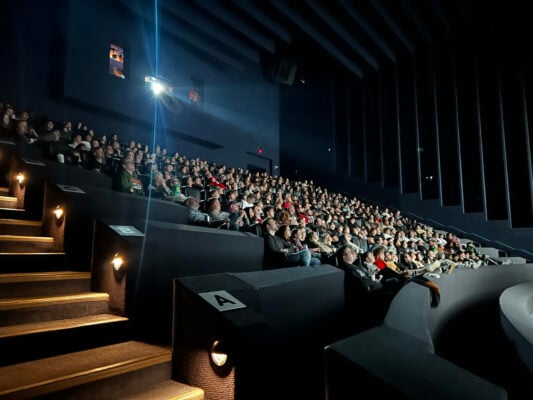
The IMAX Theatre at the Indiana State Museum has a capacity of 338 and typically sees more than 300 people for the opening weekend of any given Hollywood movie. However, “The Odyssey” has sold out nearly every single show since its release, Johantgen said. Most films screen for one to three weeks, but “The Odyssey” has already been extended through Sept. 13, with showings as early as 8 a.m. and as late as 10:30 p.m.
In honor of the occasion, the IMAX Theatre at Indiana State Museum partnered with Sun King Brewery for a Mexican lager and giant piñata horse mascot named Marty, with 8th Day Distillery for a specialty cocktail called “Siren Song,” and five local artists who created movie posters inspired by the original epic. Guests can view the posters along a gallery-style wall to the right of concessions, which are for sale with 100% of the proceeds going back to the artists.
“The Odyssey” is currently showing at IMAX Theatre at the Indiana State Museum, 650 W. Washington St. For more information, ticketing or showtimes, visit imax.com/imax-indiana-state-museum-oo.
Contact Arts & Culture Reporter Chloe McGowan at 317-762-7848. Follow her on X @chloe_mcgowanxx.

Chloe McGowan is the Arts & Culture Reporter for the Indianapolis Recorder Newspaper. Originally from Columbus, OH, Chloe has a bachelor's in journalism from The Ohio State University. She is a former IndyStar Pulliam Fellow, and has previously worked for Indy Maven, The Lantern, and CityScene Media Group. In her free time, Chloe enjoys live theatre, reading, baking and keeping her plants alive.