The Prism Initiative calls Indianapolis to invest in the recruitment, retention and advancement of Black and Brown mental and behavioral health professionals
When we talk about improving mental health in Black and Brown communities, much of the conversation understandably focuses on access to services. We ask whether people can find care, afford care and trust the systems providing it.
There is another question that deserves equal attention: Who will provide the care?
The strength of our mental and behavioral health system ultimately depends on the strength of the workforce behind it. If Indianapolis wants to expand access to culturally responsive mental health services, we must intentionally build, support and retain a workforce capable of providing those services.
That means thinking beyond vacancies and job postings. It means building a pipeline.
It means introducing young people to mental and behavioral health professions. It means helping students navigate undergraduate and graduate education. It means making internships, practicums, supervision and licensure more attainable. It means surrounding early-career clinicians with mentors. And after we recruit talented professionals into the field, it means creating environments where they can grow, lead, build sustainable careers and remain in the profession.
This is particularly important for Black and Brown clinicians.
Research summarized in the development of the Prism Initiative points to interconnected barriers affecting both Black people seeking therapy and Black professionals entering the field. These include stigma, mistrust of health systems, limited representation, the cost of graduate education, unpaid internships and practicums, limited early exposure to mental health careers, insufficient mentorship and professional isolation.
Representation alone will not solve every disparity in mental health care. But representation matters.
The literature supporting Prism’s development indicates that culturally matched care can improve clients’ preferences and perceptions of therapy and that Black clinicians can contribute cultural knowledge and lived understanding important to addressing racism, racial trauma, generational experiences and systemic inequities. Just as importantly, representation can increase trust, provide visible professional role models and help another generation imagine themselves in these careers.
From a workforce problem to an ecosystem solution
This is the work behind The Prism Initiative, an effort of the Center for Praxis focused on strengthening the mental, psychological and behavioral health workforce serving Indianapolis.
Prism starts with a simple premise: We cannot recruit our way out of a retention problem, and we cannot address a workforce shortage without developing the pipeline that feeds the workforce.
The vision, therefore, is not simply to produce more therapists.
It is to create an ecosystem.
Imagine a young person becoming aware that counseling, social work, psychology, marriage and family therapy, behavioral health or another helping profession could be a career. Then imagine that person having access to mentorship, academic support and financial assistance; entering a quality clinical training environment; receiving culturally responsive supervision; successfully reaching licensure; finding employment or developing a practice; receiving continuing education; building relationships with other professionals; advancing into leadership; and eventually becoming the mentor or supervisor for the generation coming behind them.
That is a pipeline that becomes a cycle.
The Prism framework consequently reaches across the professional lifespan: early exposure, education and training, financial and academic support, mentorship, clinical preparation, licensure, career development, business development, clinician wellness, leadership, retention and community impact. The underlying concept calls for partnerships among schools, universities, clinical training sites, hospitals, community organizations, practicing clinicians and funders rather than expecting any one institution to solve the workforce challenge alone.
And there is an important distinction here.
The clinician is not merely the end product of workforce development. The clinician becomes part of the infrastructure for community wellbeing.
One clinician can touch hundreds of lives. One supervisor can develop dozens of clinicians. One healthy practice can employ professionals, train interns and serve families. One university partnership can open a pathway for generations of students. One hospital can create internships, supervision, employment and leadership opportunities. One investment in the workforce can multiply across communities for years.
Four parts of practice. One ecosystem.
Prism also recognizes that strengthening the workforce requires strengthening the work itself.
That is why the initiative brings together four interconnected areas of professional practice: Business Development, Clinical Innovation, Evidence-Based Treatment and Behavioral Intervention.
Business development matters because clinicians and behavioral health organizations cannot serve communities sustainably if their practices and organizations cannot survive.
Clinical innovation creates room to explore emerging therapeutic approaches, neuroscience, somatic interventions, creative therapies and culturally responsive adaptations that recognize heritage, faith, community traditions and experiences such as race-based traumatic stress.
Evidence-based treatment ensures that culturally responsive care remains grounded in research, assessment, treatment planning, measurable outcomes and effective clinical practice.
Behavioral intervention expands the conversation to applied behavioral science, functional behavioral assessment, intervention strategies and contemporary behavioral approaches across clinical, school and community settings.
These should not operate as isolated disciplines.
Every discipline. Every role. Every part of the ecosystem — working together to serve, support and expand.
Indianapolis has an opportunity to build this together.
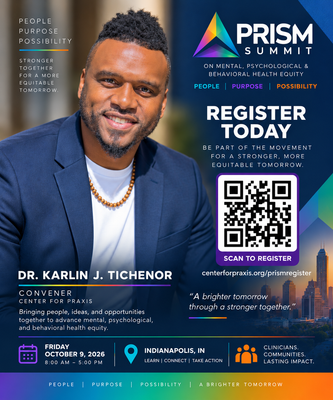
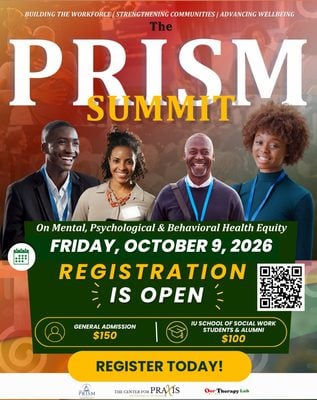
On Friday, Oct. 9, 2026, the Center for Praxis will convene the Prism Summit on Mental, Psychological & Behavioral Health Equity.
Its theme captures the larger ambition: Building the Workforce. Strengthening Communities. Advancing Wellbeing.
The Summit will bring together clinicians, behavioral health professionals, educators, students, researchers, entrepreneurs, health systems, organizational leaders, funders and community partners.
But Oct. 9 should not be viewed simply as another conference.
It is a convening point.
The day creates an opportunity to examine the four areas of practice while also confronting a larger question: What would it take for Indianapolis to intentionally build one of the strongest pipelines and professional ecosystems in the country for Black and Brown mental and behavioral health professionals?
That conversation belongs to all of us.
An invitation to invest — not simply attend
The Prism Initiative is seeking partners who recognize behavioral health workforce development as an investment in community health.
For our health systems and hospitals, the invitation is to consider internships, clinical placements, employment pathways, supervision, leadership development, sponsorship and workforce investment.
For our universities and educational institutions, it is an invitation to strengthen recruitment, preparation, affordability, clinical training and pathways from education to employment.
For foundations, corporations and philanthropic partners, it is an opportunity to invest in scholarships, stipends, licensure support, mentorship, programming, research, professional development and the infrastructure necessary to sustain the work.
For mental and behavioral health organizations and private practices, it is an invitation to become training sites, mentors, supervisors, employers, collaborators and referral partners.
For clinicians, it is an invitation not merely to participate, but to help build the professional community we want the next generation to inherit.
And for Indianapolis, it is an invitation to recognize that mental health equity cannot be separated from workforce development.
The underlying Prism plan envisions measurable goals around recruitment and mentorship, support for pre-licensed clinicians, licensure and career sustainability, greater representation in the workforce, growth of minority-owned clinical practices and ultimately greater access to culturally responsive care. It also explicitly identifies corporate sponsorship from hospitals and other institutional partners as part of the strategy for making that ecosystem sustainable.
The Summit is the beginning, not the destination.
Oct. 9 gives us a place to gather. The greater opportunity is what Indianapolis builds afterward.
- Can we expose more Black and Brown young people to these professions?
- Can we reduce financial barriers between education and licensure?
- Can we create more high-quality practicum and internship opportunities?
- Can we prepare more culturally responsive supervisors?
- Can our hospitals, universities, practices and community organizations share responsibility for developing the workforce?
- Can we reduce professional isolation and burnout so talented clinicians remain in the field?
- Can we help clinicians become business owners, supervisors, researchers, faculty members, executives and community leaders?
- And can we build a system in which the people responsible for helping communities heal are themselves supported, connected and positioned to thrive?
The Prism Initiative believes we can.
But an ecosystem cannot be built by one organization.
We need partners. We need investment. We need engagement. We need expertise. We need institutions willing to open doors. We need clinicians willing to reach backward while moving forward. We need organizations willing to share resources and networks. And we need people willing to imagine what becomes possible when Indianapolis treats the behavioral health workforce as essential community infrastructure.
The invitation for Oct. 9 is therefore bigger than registration.
Attend. Sponsor. Invest. Partner. Share. Mentor. Connect. Open a pathway. Bring your institution to the table.
Because strengthening mental and behavioral health in our community requires strengthening the people who provide it.
One ecosystem. One mission. A stronger workforce and healthier communities.