

By CLARA CALDERWOOD and CORA GIBSON
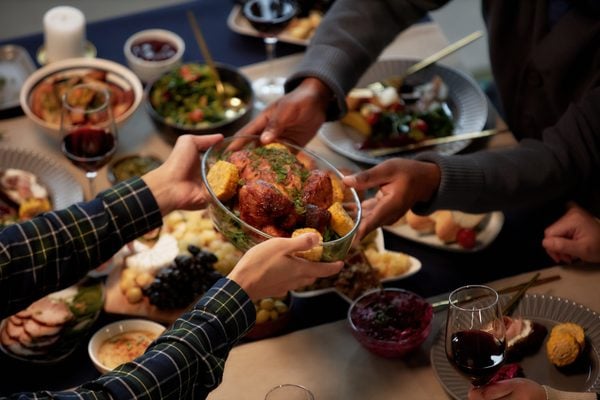
The votes have been counted, the group chats have gone quiet or gone nuclear, and Thanksgiving is here. For many DePauw students, that means a long drive home to a table where at least one person voted differently. Some are already rehearsing arguments. Others are rehearsing ways to avoid them.
That instinct to avoid is not new, and it is measurable. After the 2016 election, economists Keith Chen and Ryne Rohla used anonymized cellphone location data to track Thanksgiving gatherings nationwide. They found that dinners where hosts and guests lived in opposite-party precincts were 30 to 50 minutes shorter than same-party dinners. Nationally, that added up to roughly 34 million hours of cross-party conversation that simply never happened.
A decade later, the pattern appears to persist. A May 2026 Verasight survey found that while most Americans say they don’t mind if people close to them belong to another party, one in five has avoided or stopped talking as much to a family member over politics. About one in nine has ended a relationship entirely. We say we don’t mind. Then we leave dinner early.
When politics strains a family relationship, most people reach for one of two answers. The first is to cut off anyone whose vote you find indefensible. The second is the old rule: never talk politics at the table. Both are understandable. Both end the ethical conversation too early. The harder question is the one neither answers: What do we actually owe the people who voted the other way?
Start with consequences, the lens most of us reach for first. A utilitarian asks which choice produces the most well-being overall. On a single Thursday, walking away looks like the winner: less shouting, less stress, a better meal. But the math changes when you count beyond one dinner. Chen and Rohla warned that skipped conversations may feed a cycle in which people sort themselves into political bubbles and become even less able to talk across them. John Stuart Mill made his version of this argument in 1859: “He who knows only his own side of the case, knows little of that.” In that sense, cutting someone off doesn’t just cost a person; it costs you the best available test of your own convictions.
Then there is intention to consider. Immanuel Kant argued that we must treat every person as an end in themselves, never merely as a means. In political arguments, that principle cuts in two directions. It rules out treating your uncle as an obstacle to defeat or a vote to flip. But it also rules out treating him as someone too fragile or too foolish to reason with. Avoiding every hard subject can look polite while quietly withholding respect. Kant would ask not whether you won the argument, but whether you engaged him as a thinking person.
Care ethics, developed by philosophers like Nel Noddings, pushes further. It holds that relationships themselves create obligations. The grandmother who drove you to every practice did not earn your attention by voting correctly. Care ethicists would say the bond comes first, and disagreement happens within it, not as a test it must pass.
None of this means the obligation is unlimited. Justice and equality draw a line that tolerance alone cannot. Disagreeing over tax policy or tariffs is different from hearing a relative argue that you, or someone you love, deserves fewer rights. When a political view denies a person equal standing, that person isn’t obligated to keep absorbing it in the name of family peace. Respect must run both ways. A relationship where only one person is expected to be patient is not care. It is a cost one person pays alone.
DePauw has made this question, what we owe the people we disagree with, part of its identity. The university belongs to the Intercollegiate Civil Disagreement Partnership, a national consortium of colleges committed to teaching students how to disagree well. That commitment is easy to praise in a seminar room, where the stakes are a participation grade. It gets tested at a kitchen table in Carmel, Ind., or Chicago, where the stakes are a parent, a sibling, or a best friend from high school.
That commitment is also tested here on campus. Many of us spend four years in Greencastle among neighbors whose politics may look very different from those of the places we grew up. How we talk about “them” after an election says a lot about what a liberal arts education is supposed to produce. Some political differences are serious enough to change a relationship, and no one owes endless patience to people who deny their dignity. But most of the people we will sit across from at the end of November are not enemies. Are you willing to stay at the table long enough to find out who they really are?
Cora Gibson and Clara Calderwood are journalists for The DePauw, the student newspaper at DePauw University.
The Indianapolis Recorder Newspaper is a proud supporter of future journalists. As a part of our ongoing mission to provide opportunities to highlight student journalism, the Recorder is partnering with Indiana high schools and colleges to share their work. In November 2026, the Recorder partnered with The DePauw, the student-run newspaper at DePauw University.