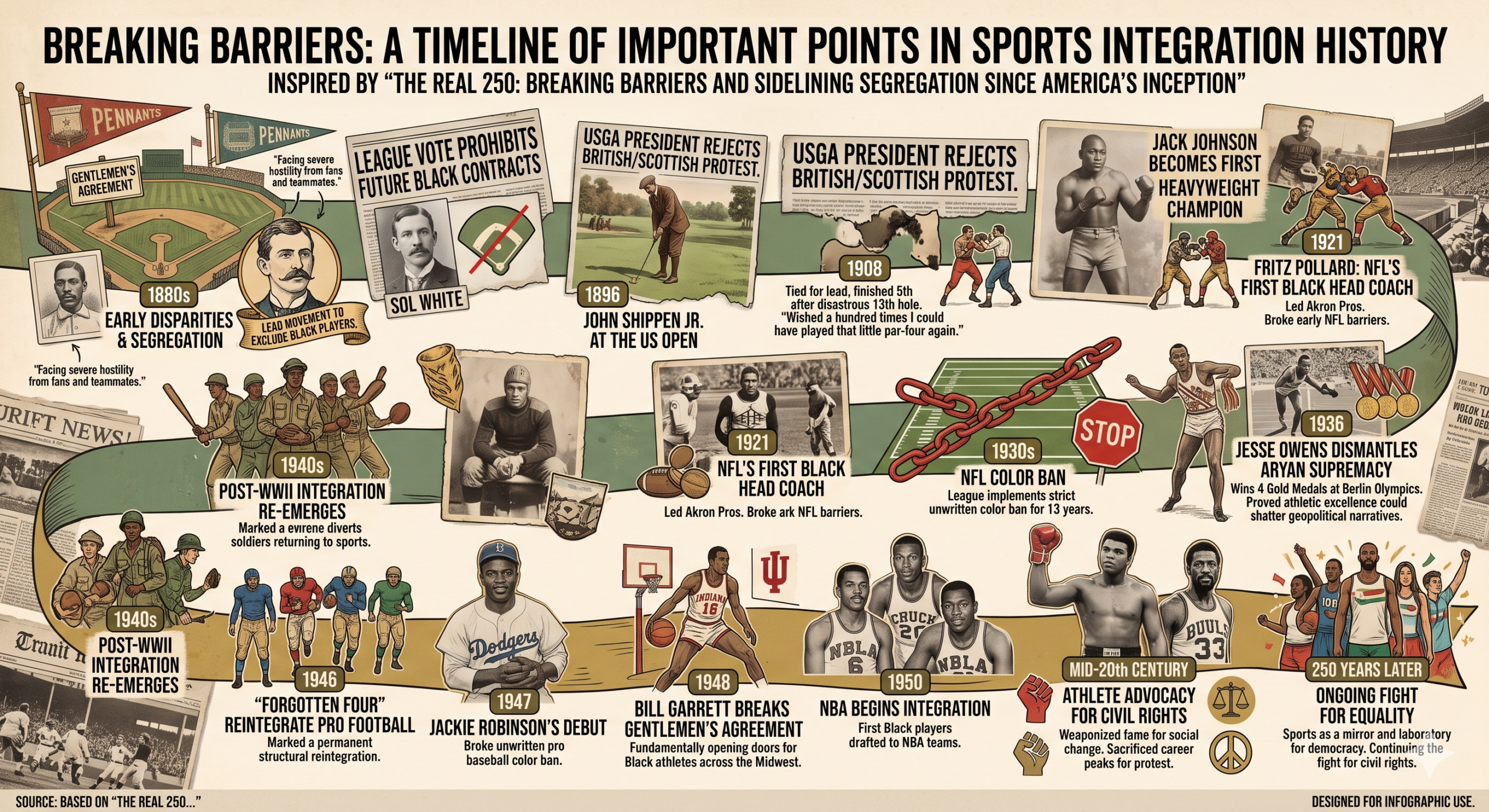
The arena of athletic competition has historically functioned as both a mirror and a laboratory for American democracy. As the United States celebrates its semiquincentennial, examining the trajectory of integration in sports reveals a complex relationship between structural oppression and individual resilience.
By analyzing early pioneers, the socio-political forces in professional leagues, and localized historical developments — particularly in Indiana — one can discern how athletic integration has shaped and continues to shape the broader struggle for civil rights in America. Far from a simple march toward progress, the integration of American sports has been characterized by early breakthroughs, violent retrenchments, tactical compromises, and ongoing structural disparities.
The late nineteenth century was pivotal for modern American sports as organized leagues began to standardize their rules and structures alongside the racial prejudices of the post-Reconstruction South. The sporting world mirrored this emerging segregation, establishing unwritten “gentlemen’s agreements” and formal bans that excluded Black athletes from mainstream competition.
Reviewing ‘America’s favorite pastime’
Long before Jackie Robinson’s 1947 debut, Black and brown athletes competed in early professional baseball, with Moses Fleetwood Walker being the most notable. He signed with the Toledo Blue Stockings of the American Association in 1884. Walker faced severe hostility from fans and even his own teammates. Toledo pitcher Tony Mullane publicly expressed his racial animosity, stating, “[Walker] was the best catcher I ever worked with, but I disliked a Negro.”
Adrian “Cap” Anson, the premier player-manager of the Chicago White Stockings, led the movement to exclude Black players from Major League Baseball. On August 10, 1883, before an exhibition game against Toledo, Anson refused to play if Walker was allowed on the field, declaring: “We’ll play this here game, but won’t play never no more with the n****r in.”
In July 1887, league executives voted to prohibit future contracts for Black players, effectively ending integrated professional baseball for six decades. Hall of Fame infielder Sol White documented this transition in “Sol White’s History of Colored Base Ball,” emphasizing the dangers Black players faced in pursuing opportunities in the sport.
No fair ways on the fairway
The racial politics of the late nineteenth century also affected professional golf, an elite domain historically reserved for white athletes. In 1896, Shinnecock Hills Golf Club hosted the second United States Open, and John Shippen Jr., of African American and Native American descent, entered the tournament alongside Shinnecock Native American Oscar Bunn.
Upon discovering that Black and Native American players were in the mix, British and Scottish professionals threatened to boycott the event. United States Golf Association (USGA) President Theodore Havemeyer firmly rejected the protest, stating that the championship would proceed even if Shippen and Bunn were the only competitors. Shippen performed exceptionally, tying for the lead with a score of 78 after the morning round. However, a disastrous 13th hole due to an unplayable lie in a sandy rut derailed his championship hopes. Shippen finished with a tie for fifth, earning a $10 paycheck (worth approximately $353 today in 2026). Reflecting decades later, Shippen lamented, “You know, I’ve wished a hundred times I could have played that little par-four again.”
As the twentieth century began, organized, segregated professional leagues proliferated alongside the creation of alternative Black-owned sports enterprises. In competitions where Black athletes faced white opponents, the contests carried significant symbolic weight.
Boxing bigotry, racing racism
In boxing, the World Heavyweight Championship stood as the ultimate test of physical dominance. Yet, white champions often drew a “color bar,” refusing to defend their titles against Black challengers. This barrier was challenged on December 26, 1908, when Jack Johnson became the first Black heavyweight champion after defeating Tommy Burns in Sydney, Australia. Johnson’s victory was a seismic shift, causing both celebration and backlash, as it undermined the prevailing racial hierarchies of the time.
This platform of international stage visibility expanded dramatically in 1936 at the Berlin Olympics. Track icon Jesse Owens fundamentally dismantled Adolf Hitler’s propaganda machinery of Aryan supremacy by capturing four gold medals. Owens’ triumph proved that athletic excellence could shatter geopolitical narratives on one of the world’s most visible stages.
Decades later, legendary heavyweight champion Muhammad Ali utilized his athletic fame for civil rights and anti-war protest, famously sacrificing the physical prime of his career by refusing the Vietnam War draft on religious and political grounds.
Football on the ‘Fritz’
In football, the establishment of professional leagues transitioned from sporadic, early integration to an era that systematically marginalized Black players. Fritz Pollard, an All-American from Brown University, broke through these early barriers to become the NFL’s very first Black head coach in 1921 while leading the Akron Pros.
Despite Pollard’s brilliance, the 1930s saw the league implement a strict, unwritten color ban that shut Black players out completely for thirteen years. When African American athletes finally returned to the sport after World War II via the “Forgotten Four” in 1946, it marked a permanent structural reintegration, demonstrating that roster construction based entirely on merit was the key to championship success.
Fast forward to 2003, The Rooney Rule was created. The rule, named after the NFL’s Workplace Diversity Committee Chairman Dan Rooney, mandates that teams must interview at least one minority candidate for head coaching and senior football operations positions. This milestone policy aimed to address the significant underrepresentation of minority coaches and executives within the NFL. By encouraging teams to consider a more expansive pool of candidates, the Rooney Rule has opened doors for minority players to transition into coaching roles, while also signaling a commitment to diversity and inclusion in football.
Over the years, this initiative has contributed to a gradual but notable shift in the coaching landscape, fostering opportunities for formerly marginalized individuals to rise to influential positions within the sport.
Bouncing towards better days
Basketball similarly emerged as a significant avenue for integrating Black athletes. During the 1950s, the NBA faced pressure to include Black players, especially as the sport’s popularity soared. Chuck Cooper became the first Black player drafted by an NBA team in 1950, followed by others like Nat “Sweetwater” Clifton and Earl Lloyd, who broke barriers and paved the way for future generations. In the collegiate ranks, homegrown center Bill Garrett broke the unwritten Big Ten “gentlemen’s agreement” when he took the floor for Indiana University in 1948, fundamentally opening the doors for Black athletes across the Midwest.
A landmark legal battle initiated by Indiana’s own Oscar Robertson in the 1970s significantly altered the landscape of professional sports and benefitted minority athletes. Robertson, along with a coalition of players, filed a lawsuit against the NBA challenging the restrictive rules governing player contracts and trades, notably the reserve clause, which effectively bound players to their teams indefinitely.
The case culminated in a settlement leading to the establishment of free agency in basketball, granting athletes greater autonomy and negotiating power. This shift not only empowered players, including many minorities who had historically been marginalized in contract negotiations, but it also paved the way for a broader movement advocating for athletes’ rights across all sports.
As a result, sports became a more equitable arena where individual talent could dictate career trajectories, fostering a sense of agency and economic freedom that resonated well beyond the court. The implications of this case continue to influence the struggle for equity and representation in all aspects of sports today.
The civil rights movement significantly influenced the sport, with figures like Bill Russell and Kareem Abdul-Jabbar using their platforms to advocate for social change. The NBA’s evolution mirrors broader societal shifts, showcasing both the struggles and triumphs of racial integration within American sports.
The integration of American sports reflects a multifaceted history that intertwines athletic achievement with civil rights struggles. From the codification of segregation during the Gilded Age to the breakthroughs in various sports throughout the twentieth century, these narratives emphasize the ongoing fight for equality and recognition within American society. As new generations of athletes continue to advocate for change, the relationship between sports and social justice remains a vital aspect of the American experience 250 years later.
Contact Multi-Media & Senior Sports Reporter Noral Parham at 317-762-7846. Follow him on X @3Noral. For more, visit indianapolisrecorder.com.

Noral Parham is the multi-media reporter for the Indianapolis Recorder, one of the oldest Black publications in the country. Prior to joining the Recorder, Parham served as the community advocate of the MLK Center in Indianapolis and senior copywriter for an e-commerce and marketing firm in Denver.