America will celebrate 250 years this July 4, but what does that mean for Black Americans?
Anniversaries are a time for reflection — a chance to look back and celebrate milestones and victories while mourning losses and holding on to hope for the future. However, as America stands to face its semiquincentennial on July 4, this anniversary may be conflicting for Black Americans, whose history on this soil is filled with trauma and pain as well as resilience and hope.
“As we look to celebrate this monumental day, looking back, I’m inspired by history,” Kisha Tandy, curator of social history at the Indiana State Museum, told the Recorder. “I am absolutely inspired and encouraged. I love the people who came before you, before us, their resilience, their determination, their willingness to keep moving forward and pressing on toward the goal.”
Despite Indiana only being 209 years old this year, America 250 still offers Hoosiers a unique opportunity to reflect on everything Black Americans have overcome — through art, literature, education, sports, media and politics.
Educational excellence
When it comes to Black history in Indianapolis, some of the most notable institutions include the Madam Walker Legacy Center, Flanner House, Bethel AME Church and Crispus Attucks High School.
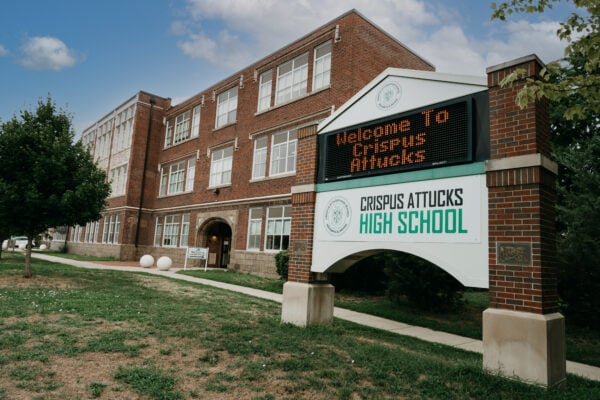
Built in 1927, Crispus Attucks was the only school that Black students in and around Indianapolis could attend up until 1949, but despite the laws, the school remained serving only Black students until around 1971, said Patricia Payne, executive director of the Crispus Attucks Museum and director of the Office of Strategic Educational Excellence at Crispus Attucks High School.
Named for Crispus Attucks, a sailor of African and Native descent widely remembered as the first person to be killed during the Boston Massacre, the Indianapolis high school is one of several schools across the country bearing the name and honoring his legacy.
READ MORE: 250 years healthier
“They (the school board) built this school to fail. They didn’t build anything for us that would be successful; they thought it would fail, but the students here, and the teachers here in particular, took lemons and made lemonade,” Payne said. “We are still going strong, educating students, and the theme of everything was educational excellence, and that remains the theme today.”
Mattias Nolcox, the school’s first principal, held a degree from Harvard University and hired the Black educators with doctorates and master’s degrees who couldn’t get jobs at major universities, Payne said. Russell Lane, a graduate of Howard University Law School, served first as the school’s English teacher, then as principal from 1932 to 1957; and John Morton-Finney, a civil rights activist, lawyer, educator and WWI veteran, came to Crispus Attucks to teach Greek, Latin, German, Spanish and French classes.
“These students were not only culturally prepared, they were definitely academically prepared,” Payne added. “A lot of people associate sports with this school, because Oscar Robertson went here, and it was the first Black school to win a state championship, but they shouldn’t just look at sports, they should look at educational excellence when it comes to this school — because Oscar Robertson would not have been on that basketball floor had his grades not been up.”
Crispus Attucks itself is considered “sacred ground” for the Black community simply because it’s still standing today, Payne said. It’s an integral part of Indiana’s history and Black history. The walls are lined with photos from each graduating class, dating back to 1928.
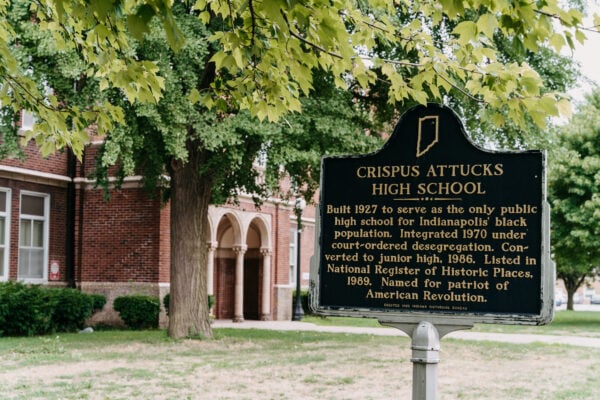
Notable alumni of Crispus Attucks High School include jazz guitarist Wes Montgomery, founder and chair of IU Bloomington’s Jazz studies program, David Baker, former State Rep. Julia Carson, soprano Angela Brown, civil rights activist Willard Ransom, Tuskegee Airman Charles DeBow, and basketball player Oscar Robertson.
The Crispus Attucks Museum was founded in 1998 by Gilbert Taylor to preserve that history. The museum, albeit currently closed due to construction, includes memorabilia, photos and artifacts from the school that Payne said they show each of the students “so they can learn about what they need to live up to.”
Crispus Attucks officially turns 100 next year alongside the Walker Center, but as the country gets ready to celebrate America’s 250th anniversary this year, Payne said she’s reminded of Frederick Douglass’ July 5, 1852 speech, where he said, “The Fourth July is yours, not mine. You may rejoice, I must mourn.”
“It’s going to really be interesting to see how we are portrayed in this whole 250-year celebration, since they’re trying to wipe us out of history as we speak,” Payne said. “They have reason to celebrate. We have reason to mourn, but that’s why the resilience that we have is so very important. We aren’t going to just lay down and die. Our ancestors are just hovering everywhere over us. They had to go through so much, so they are giving us the strength to deal with whatever negativity comes our way, even this, trying to wipe us out of history.”
Hoosier movers and shakers
Tandy said she looks to the past for inspiration and encouragement.
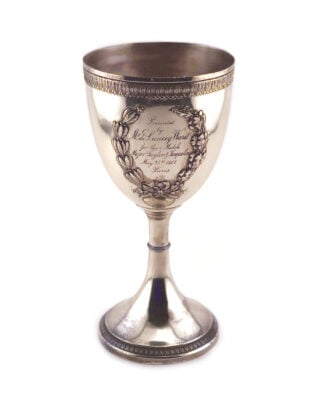
Born in Indianapolis in 1878, Marshall Walter “Major” Taylor was a cyclist and known as the first Black American global sports superstar. The only reason the Indiana State Museum has a significant collection pertaining to Taylor that went on view in 2022 — including nine scrapbooks, photographs, letters, postcards, his mailbag and the trophy from the “Match of the Century” at the Parc des Princes in Paris 1901 — is that he saved it all himself.
“Major Taylor … he kept his story, and then he told his own story, and I love that for him and about him,” Tandy added. “He truly is a story of resilience. He faced so many obstacles, but he overcame them. He did not give up, and he would be a world champion because he did not give up.”
However, it’s the everyday folks, politicians, journalists and educators such as Phyllis Wheatley Waters, who helped “to train young minds across the city,” and Judge Mercer Mance, the first Black Marion County Superior Court Judge, who were the movers and shakers of the city and state, Tandy said.
Waters, whose quadri-colored high-heeled shoes are preserved at the Indiana State Museum, was an educator and the first Black college basketball player at the University of Michigan. Waters earned her master’s degree from Butler University, taught French at Crispus Attucks High School for nearly 40 years, Tandy said.
Beyond that, Waters ran for Indiana State Representative in 1960 and lost, but remained and was active in her community, serving as the first Black vice president of the Indiana State Teachers Association. She was also a board member of the Indianapolis Marion County Public Library, the Marion County Cancer Society and the Children’s Museum.
Receipts of freedom
Company G, 28th Regiment U.S. Colored Infantry was Indiana’s only all-Black Civil War regiment. Led by Captain Charles S. Russel, the regiment organized in Indianapolis from Dec. 24, 1863 to March 31, 1864, before being sent to Washington, D.C. and Alexandria, Virginia, in April 1864.
Very few artifacts from the 28th Regiment exist in the Indiana State Museum’s archives. However, what they do have “really speaks to the idea of freedom and what the 250 means to me,” Tandy said. The piece, which is a Form No. 1(b) for Infantry and Heavy Artillery, was acquired when the museum was assembling the Lincoln exhibit in 2023 and looking at the pursuit of Black freedom.
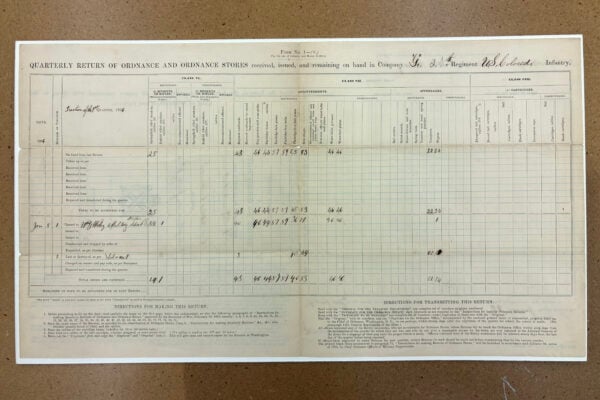
“It gives you the date, it gives what they are receiving, what they are returning, the company that it was, U.S. Colored, and that these were men who were fighting for freedom,” Tandy said. “I think that story is so important to our country’s history — not only our state’s history, our city’s history, but our country’s history.”
The Indianapolis Recorder, the third-oldest surviving Black newspaper in the country, played a vital role in documenting Black life across the state, Tandy said. Founded in 1895 by George P. Stewart and William Porter, the Recorder started as a two-page church bulletin that evolved into a weekly newspaper in 1897.
The Recorder Archives, digitized and housed at Hoosier State Chronicles, date back to January 1899 and include coverage of housing, public health, Civil Rights leaders and voting rights activists. Eunice Trotter, director of the Black Heritage Preservation Program at Indiana Landmarks and former Recorder publisher, helped the Indiana State Museum acquire and preserve two receipts for linograph, signed by Stewart in June 1918.
“I love the details that they give, which we would still do this today, ‘hotel five days, meals going and coming, fare from Springfield to Indiana,’” Tandy said. “This one has been on exhibition recently in our Crossroads Gallery… So just being able to share the story of the Recorder — because it really is a tool that I use on a daily basis to help chronicle Black life in Indianapolis.”
Oil on canvas and hope
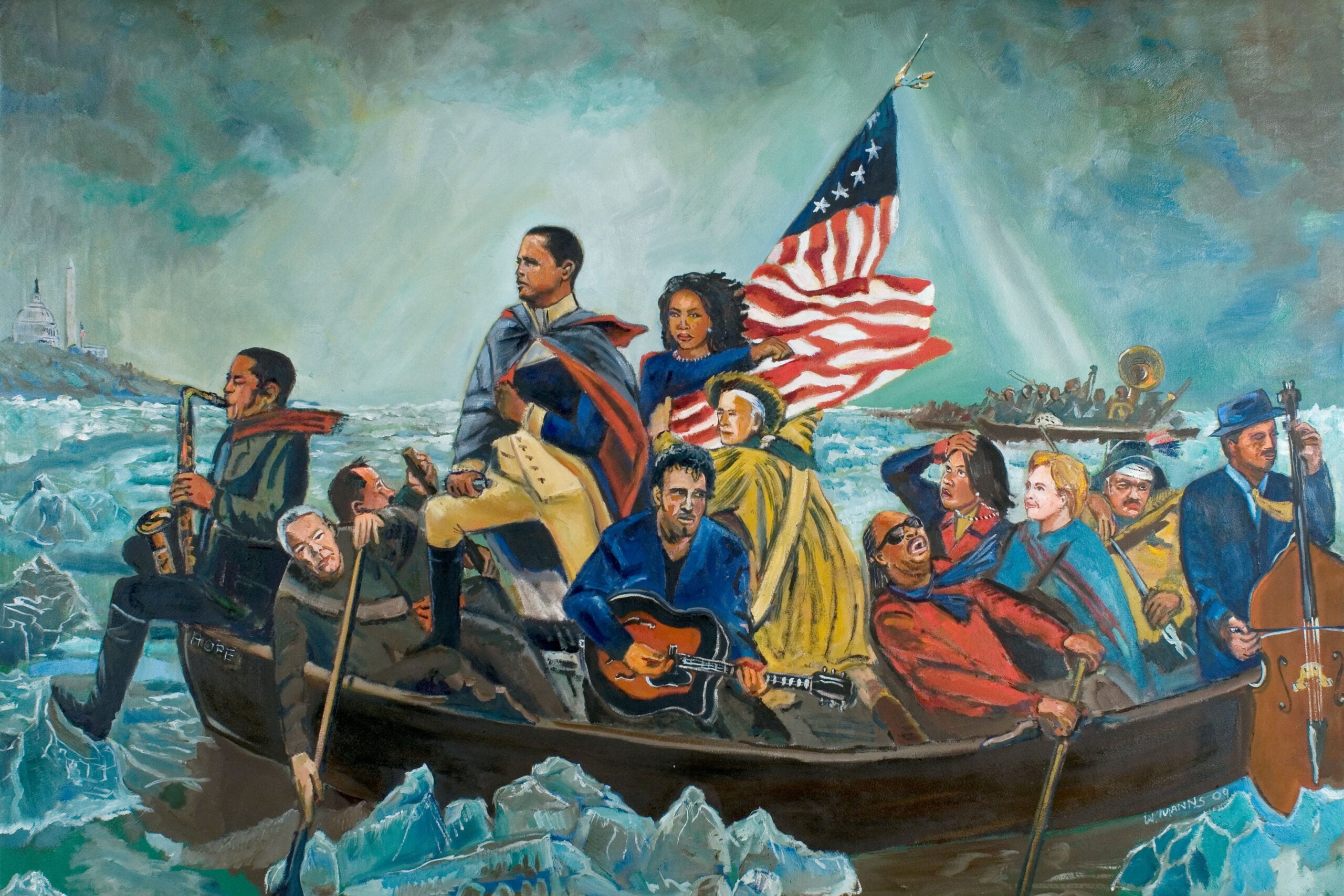
“The Crossing,” created by Black Hoosier artist Wayne Mann in 2008, is part of the Indiana State Museum’s permanent collection and was acquired as part of the “Represent: Celebrating Indiana’s African-American Artists” exhibition in 2012, Tandy said. The exhibition featured a range of works from Black Hoosier artists, including John Wesley Hardrick and Clarke F. “Deacon” Hampton.
The painting, which was inspired by the events leading up to former President Barack Obama’s election, is an appropriation of Emmanual Gottlieb Leutze’s “Washington Crossing the Delaware.”
The painting features Obama replacing George Washington in a boat called Hope, with Michelle Obama behind him, Hilary Clinton, John Coltrane, Ray Brown, Oprah Winfrey, General Colin Powell, David Axelrod, Joe Biden, Bruce Springsteen, Stevie Wonder and Jessie Jackson.
“I think that it’s about legacy … it captures that moment in time, it captures the essence of hope that we were looking for at that time, but then it’s also about the legacy, these are people that you recognize,” Tandy said. “It also tells the way, ways in which we all connect to history and can have an impact on history, and that in different ways we are making a difference.”
Contact Arts & Culture Reporter Chloe McGowan at 317-762-7848. Follow her on X @chloe_mcgowanxx.

Chloe McGowan is the Arts & Culture Reporter for the Indianapolis Recorder Newspaper. Originally from Columbus, OH, Chloe has a bachelor's in journalism from The Ohio State University. She is a former IndyStar Pulliam Fellow, and has previously worked for Indy Maven, The Lantern, and CityScene Media Group. In her free time, Chloe enjoys live theatre, reading, baking and keeping her plants alive.