

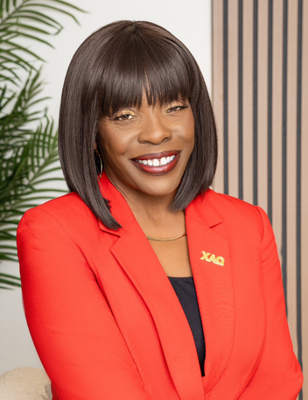
For generations, some of Indiana’s Black history has existed in places that were easy to overlook: a cemetery beneath a cornfield, a one-room schoolhouse converted into a home or antique shop, a church whose roof is leaking, a vacant school deteriorating.
Some stories survived in family memory. Others remained in archives, on faded documents or in handwritten records that take training to read. And some stories were simply waiting for someone to find.
For the past four years, Eunice Trotter has made that search the work. As the founding director of Indiana Landmarks’ Black Heritage Preservation Program (BHPP), Trotter helped build a statewide effort to identify, document and preserve places connected to Black history. The program, established in 2022 with a $5 million Lilly Endowment grant, has grown into a network of preservation projects, community partnerships, oral histories, training programs, grants, interns, scholarships and grassroots organizations.
Now Trotter is leaving the director position, but she is not leaving the work. Indiana Landmarks announced Sept. 23 that André Myers will succeed Trotter as director of the Black Heritage Preservation Program. Trotter will remain with the organization as a consultant through the end of 2026. The program is also moving from one full-time to two full-time positions, expanding the hours of Divine Holmes, previously a part-time historic preservation assistant.
The transition comes at a challenging moment: The program is expanding at the same time its founding director says Indiana is only beginning to understand the amount of Black history still waiting to be found. “We are scratching the surface,” Trotter said.
Project 250, an initiative Trotter developed, is designed to take a deep dive into every county in Indiana to identify 250 significant Black heritage sites that still exist, regardless of their condition. But 250 is not a stopping point. “We’re not stopping just because we’re documenting 250 places,” Trotter said. “We’re not stopping doing the uncovering of this history.”
That distinction may be the most important part of the transition. The question facing the program is not simply who will replace Trotter. It is what happens to a body of work when the person who has spent four years building its relationships, teaching its methods and uncovering its history moves out of the director’s chair while the work itself remains unfinished.
Finding what was missed
Trotter said the most significant confirmation she received through the work was also one of the most consequential. “There is a tremendous amount of history and historic sites that we did not know about,” she said. That discovery changed the scale of the work.
Project 250 is an attempt to create a working list of sites that can become priorities for preservation. Trotter said the places do not have to be pristine or even obviously historic to matter. A cemetery could have corn planted over it. A one-room schoolhouse could now be an antique shop or a home. A building could be “raggedy.” The question is whether the place carries significant Black history and still exists.
When setting priorities, Trotter said, the first criterion is the age of the building, and the next is its significance. How significance is judged, she said, “just depends on who’s making that decision.”
The program’s project record demonstrates how broadly that work has already expanded. BHPP’s statewide work includes historic designation efforts in Indianapolis and Terre Haute; National and State Register projects involving churches, schools, cemeteries and other sites; historical markers; statewide surveys; capital projects; assessments and mapping; walking tours; collaborations; oral history; and capacity-building for grassroots organizations. The work stretches from Indianapolis to Gary, Madison, Terre Haute, Muncie, South Bend, Fort Wayne, Evansville, Vincennes, Lafayette, Jeffersonville, Washington and communities across the state.
Trotter said the program has probably encountered only a fraction of what remains. “There are probably hundreds of places still there out there in the community,” she said.
The urgency, she said, is not abstract. “What we’re dealing with right now is erasure.” By erasure, she said, she means the disappearance of the physical places that carry history. “They’re getting torn down.”
Gary Roosevelt High School is one example she uses. Trotter said the former school is sitting vacant and deteriorating. Its significance is tied to the history of Black education in Indiana. Gary Roosevelt (Gary, 1930), Crispus Attucks (Indianapolis, 1927) and Lincoln (Evansville, 1928) high schools were institutions founded for African American students, “because we couldn’t go to white schools,” Trotter said. The problem is simple,” she said. “You can’t do something about something we don’t know about.”
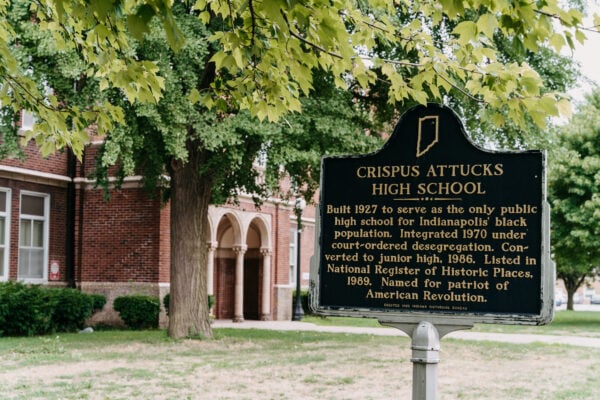
Outside Crispus Attucks High School, this historic marker reads: “Built 1927 to serve as the only public high school for Indianapolis black population. (Photo/Indianapolis Historical Society)
Once a place is identified, however, the work changes. It may mean building community partnerships, documenting the site, finding funding, seeking historic designation, or identifying another use.
IPS School 56 exemplifies that next stage. Trotter said the school was at risk of demolition, so she went to the school board and advocated for the building to remain standing. The board agreed. But saving a building from demolition does not necessarily answer what happens to it next. “So, we saved it from demolition, but what’s next?” she said. That question is at the center of preservation. The answer, she said, typically means finding partners to pursue an adaptive reuse of the building, converting it to a new purpose such as a headquarters or housing.
Preservation is more than a building
The list of BHPP projects makes clear that preservation does not stop with a designation. There are surveys of Sam Plato-designed and built sites, assessments of churches and cultural sites, ArcGIS surveys, proposed walking tours, and a settlement map. There are collaborations with organizations including the Underground Railroad Network, the Greenlawn Community Advisory Group, the Nature Conservancy, Freetown Village, WFYI, the Marion County Bar Association, Conner Prairie Museum, Indy Juneteenth and Freedom Trails.
There is an oral history collection connected to the Indiana State Library, in collaboration with a rural oral history collection through the Center for Rural Engagement. And there is a statewide effort to build capacity. The project list identifies grassroots organizations formed or supported in Knox County and Vincennes, Clarksville, Fort Wayne, Marion, South Bend, Terre Haute, Lafayette, Seymour, Gary and Evansville. For Trotter, that may be as important as any individual building.
She has spent time teaching communities how to do preservation work themselves: how to research a site, how to understand its significance and how to pursue National Register designation. National Register status can create access to recognition, grants, tax credits and other preservation resources, she said. “As many as it takes, as many as it takes,” Trotter said of the people needed to carry the work forward. She has worked with groups in Fort Wayne, South Bend, Vincennes and elsewhere, including traveling to Evansville to help a local group get started.
There are now 12 groups around the state, with a 13th forming, Trotter said. The program nurtures and educates them, and some receive financial resources as well as technical help. When a group forms, she said, the work starts with what she calls the three C’s: control, capacity and credit. Who is in charge, what resources and knowledge the group has, and who gets the credit. In South Bend, a group is working to restore the Westside Recreation Center. In Knox County, a group is looking at Second Baptist Church, an 1870s building.
Teaching people how to find the history
For Trotter, building capacity is about who holds the history. Only 2% of people in the preservation field, including architects, archaeologists, historians and archivists, are Black, she said. She argues that Black communities need the knowledge and capacity to preserve their own histories.
“It needs to be African-American people making the decision about what is most important to African-American history,” she said.
Trotter describes herself as “totally a Garveyite.” “We have to learn how to do it for ourselves,” she said. That self-reliance, she said, applies to private resources: Black philanthropy, Black professional and political leadership, and Black churches need to be on the same page about investing in this history. Public money is a different matter. There, she said, Black communities need their fair share. “We pay taxes,” she said.
The work requires more than passion. It requires a specialized body of knowledge. Trotter said she has had to teach interns — Black and white — how to conduct historical research, including how to read handwritten records. Some historical notes are written in cursive. The detail is easy to overlook, but it illustrates a larger problem: Even when records exist, they are not necessarily accessible without the skills to interpret them.
Trotter describes research as the first step. “You don’t know what you don’t know.” She has seen that firsthand.
While researching Indianapolis history for Freetown Village, before she joined Indiana Landmarks, Trotter said she discovered that Puryear Street, across from the downtown library on Pennsylvania Street, was named for John A. Puryear, one of the first African Americans to serve on the Indianapolis City Council, serving from 1892 to 1897. Puryear had previously been enslaved in North Carolina, Trotter said, and was responsible for changing the names of streets that had been called Mississippi and Tennessee — names associated with slave states — to Capitol and Senate.
Trotter also pointed to Peter McAnnely, Moses Knight and Daniel Strother, three Black Revolutionary War soldiers whose service was not widely known. She participated in a marker dedication organized by the Francis Vigo Chapter of the Daughters of the American Revolution in Vincennes, which commemorated the three men’s lives and military service. McAnnely and Strother served with George Washington when Cornwallis surrendered, while Knight fought at the Battle of Guilford Courthouse.
Trotter said she has heard the same family story more times than she can count: a relative who was chased out of Mississippi or Alabama and never looked back. The research can be uncomfortable because some families lived it and carried those experiences across generations; that does not make the history less important. It makes the preservation of the record more pertinent; the people become the stewards of the work.
Leon Bates is one example. Trotter said Bates researched and filed the application for a marker memorializing John Tucker, who was lynched in downtown Indianapolis.
The places people fought to keep
Some preservation work required more than research. Trotter described advocating for Greenlawn Cemetery in Indianapolis despite opposition from the Keystone Group and its Eleven Park proposal. She described pressure coming from people telling her, essentially, to “go somewhere and shut up and sit down.” Some of that pressure, she said, came from inside the preservation ecosystem itself. She did not sit down. She believes the work demands persistence.
She also did not stand alone. The Greenlawn Community Advisory Group, of which Trotter was a founding member, included Leon Bates and members of the Marion County Historical Society, the Indiana Remembrance Coalition, the Indiana African American Genealogy Group and the Caroline Scott Harrison Chapter of the Daughters of the American Revolution.
Asked what safeguards Indiana Landmarks believes should be in place to protect historic Black cemeteries and human remains when development occurs, Indiana Landmarks’ CEO Brad Ward said the answer is to “empower local people with the knowledge and the tools to be able to safeguard for themselves, but with institutional backing.” He did not identify specific safeguards.
The work, she said, sometimes requires people with access to different parts of the system to move together. That includes institutions. It includes communities. And it includes money.
Building an institution around the work
The Black Heritage Preservation Program began in 2022 with a $5 million grant from Lilly Endowment, which Trotter called “generous support.” Its roots go back further. Ward said Indiana Landmarks’ African American Landmarks Committee began in the 1990s and was active for more than 30 years before the Lilly funding made it possible to formalize that work into a statewide program with dedicated professional staff.
According to Indiana Landmarks, $4 million was placed into an endowment and the remaining $1 million is being used for direct support of Black heritage projects over five years. As of September 2026, the endowment had grown to $5.6 million. Each year, Indiana Landmarks draws about 4.5% from the endowment, roughly $200,000 according to Ward, and leaves the rest to keep growing. Additional funding has come from private donors and the National Trust for Historic Preservation’s African American Cultural Heritage Action Fund.
Trotter said the endowment supports the director’s salary and benefits, scholarships, internships, equipment and operations. That includes two paid internships and four $5,000 scholarships each year. “The program is funded into perpetuity,” Trotter said. The distinction matters. The funding was not simply money to repair a handful of buildings. It created an infrastructure for the work. The program provides grants, training and assistance to regional volunteer groups, paid internships and college scholarships intended to develop future preservation leaders.
The part of the funding with an end date is the $1 million grant fund, which supports nonprofit sites. Ward said about $800,000 has been disbursed, and the program is on track to disburse the rest by March 2027. That fund is what will need additional fundraising.
Trotter also said Indiana Landmarks contributes in-kind resources, including office space and support from its regional staff. The challenge, she said, is making sure the funding and institutional support continue, from wherever they can be found.
The program has also attracted other support. Trotter pointed to $100,000 from the Mellon Foundation for oral history work in Martindale and historic district work. Donors include Robin and Charlitta Winston, Sara Edgerton and Purdue University. The program’s project record shows the result of that investment: a growing collection of physical preservation projects and intellectual infrastructure.
A database for a history scattered everywhere
Another part of Trotter’s work has been collecting oral histories. She said the program’s database contains more than 100 interviews conducted over the past four years. It also contains collections from other sources.
Her goal is bigger than maintaining another database. She wants to bring scattered collections together under one platform rather than having information isolated at different institutions. “One at Purdue, one at Ball State, one at the Harrison Center, you know, one here, one there, one everywhere,” she said. The objective is a single website and platform that can connect those histories.
That effort reflects the same problem Project 250 addresses physically. The history exists. But it is often scattered. Finding it is one task. Connecting it is another. Preserving it is another. Making it available to the public is another.
What happens when the person who built the system leaves?
Trotter’s departure changes the story because she is not simply leaving a job. She is leaving a position from which she built a statewide network while the network is still developing. The director’s chair has already been filled. The work has not been handed off.
Trotter said a successor had been hired, although at the time of the interview she could not publicly name him because he still had another job. Indiana Landmarks has now identified him as André Myers.
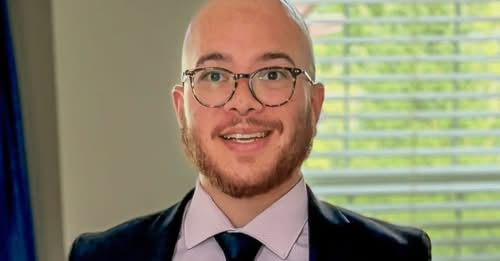
Myers brings more than a decade of experience in urban planning and historic preservation, including preservation roles with the cities of Indianapolis and Covington, Kentucky. He most recently worked for the planning and architecture firm Tunnell Spangler Walsh. He holds a bachelor’s degree in urban planning and development and a master’s degree in historic preservation from Ball State University and previously served as president of Preserve Greater Indy.
Myers first applied for the director position in 2022, the year the program began. Four years later, he was selected to succeed Trotter.
Ward said the organization had begun identifying its needs for the future roughly a year before the current transition. He said Trotter met with the top candidate this summer.
Ward stated the community will have a role in the transition. Community members can be part of onboarding the new director, he said, through listening sessions, open forums, committee work and one-on-one conversations. “We’re not trying to implement any massive overhauls,” Ward said.
Trotter acknowledged that a younger generation of leadership is coming in, with its own priorities. She is 73, and she does not describe herself as finished. “I have more energy than most 33-year-olds,” she said. She plans to remain involved as a consultant and said she will continue working on Project 250 and the oral history project.
Indiana Landmarks’ announcement describes the transition differently: Myers will lead an expanding program, while Trotter will remain available in a consulting role through the end of the year. Ward said the organization is grateful for the foundation she laid and looks forward to continued success under Myers’ leadership. The two accounts describe the same transition from different vantage points.
Trotter’s work is continuing. The institution is changing. And the program is growing. The question is what exactly is being carried forward.
A program larger than one person
Trotter herself resists the idea that the program will end because she is leaving. “Oh, no, that’s not true,” she said when asked whether the program would disappear without her.
She has been preparing for the transition while also making clear that she believes some of the work must continue beyond any individual director. She wants the grant program to remain funded. She intends to continue specific projects. And she has spent years creating community organizations that can work independently.
The project list suggests that the program’s work has already become too broad to be contained in one person’s portfolio. There are capital projects from Madison to Gary to Indianapolis, South Bend, Richmond, Kokomo, Boonville, New Albany, Muncie, Lafayette, Jeffersonville and Peru.
There are walking tours and collaborations. There are oral histories. There are grassroots organizations. There are historic markers. There are surveys. There is Project 250. There are churches, schools, cemeteries, businesses, and cultural institutions. The work has become an ecosystem, and it was built to outlast any one director.
The unfinished work
The official announcement describes Myers’ mandate as building on what came before. “From Fox Lake to New Albany and from Wabash to Madison, Indiana has such a rich and complicated history, and there are still so many stories and places that haven’t received the recognition they deserve,” Myers said. “I’m excited to build on the work of this program and help make sure Black heritage is part of the story we tell about Indiana’s historic places.”
That statement aligns with the central reality Trotter has described. The work is not finished. Project 250 is not intended to close the book on Indiana’s Black historic landscape. It is meant to create a starting list — a way to determine which places require attention and begin the work of preservation. And even as individual places are identified, new ones will continue to emerge.
Someone will hear about the program and say there is an old cemetery over there. Someone will remember a school. Someone will find a name in an archive. Someone will read a handwritten note. Someone will discover a building that no longer looks historic but carries a history that does not exist anywhere else. That is why Trotter insists the uncovering will continue.
The work of preservation begins before a preservationist arrives at a building. It begins with the question of whether anyone knows the building matters. And it continues long after someone establishes that it does.
For Trotter, that means research, advocacy, funding, restoration, adaptive reuse, oral history, community organizing and teaching people how to do the work themselves. For Indiana Landmarks, it now means carrying that work into another phase. And for the communities whose histories are embedded in those places, it means something more fundamental: making sure the knowledge does not disappear simply because the person who helped uncover it is no longer sitting in the director’s office.
Contact Health and Environmental Reporter LaTasha Boyd Jones at tashaj@indyrecorder.com or follow her on social media @iamtashajones.

Tasha Jones is a poet, writer, researcher, and educator whose work explores language as a tool for liberation and resistance. She hosts In the Beginning: The Spoken Word Podcast, the #1 spoken word podcast on Apple and Spotify. Tasha is also the Poems & Parables Literary Journal editor and is currently writing Pyramids. Plantations. Projects. Penitentiaries. You can follow her on social media: @iamtashajones, @itbspokenwordpod, and @poemsandparables.






What an inspiring and important effort to preserve Indiana’s Black history. So many stories and historic places can easily be forgotten, and the work of Eunice Trotter and the Black Heritage Preservation Program is helping ensure these legacies are documented, honored, and passed on to future generations. This is a powerful reminder that preserving history also means preserving the voices, contributions, and communities that shaped the City of Indianapolis.