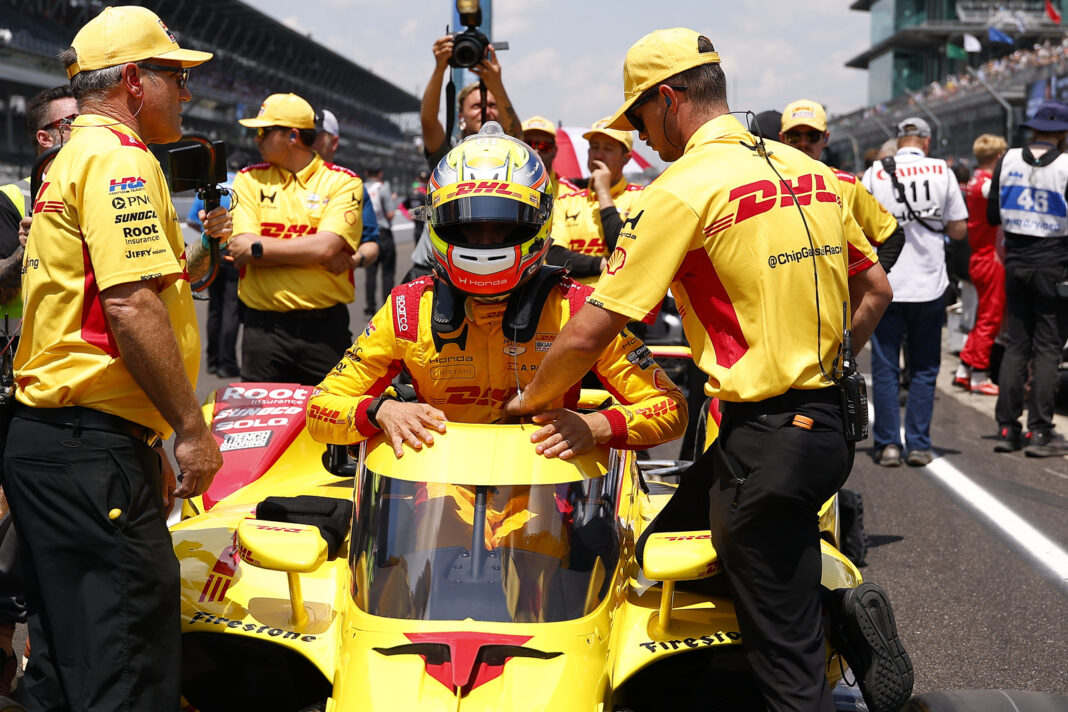
While the checkered flag has dropped and the carbon-fiber debris has been cleared from the asphalt, the true scope of the 110th Running of the Indianapolis 500 on May 24 is best measured not in miles per hour, but in dollars and cents.
The single largest single-day sporting event on earth serves as the foundational anchor for a massive, multi-layered economic engine that completely reshapes Central Indiana every spring.
A landmark evaluation conducted by the Indiana University Public Policy Institute reveals that the annual economic contribution of the Indianapolis Motor Speedway (IMS) has reached an unprecedented $1.058 billion for the State of Indiana.
“The Racing Capital of the World is a marquee hub for economic development that directly benefits Central Indiana and the Hoosier State, triggering innovative activity and providing jobs and income for thousands of families,” IMS President J. Douglas Boles said regarding the study’s findings.
To understand the true scale of this capital injection, economists distinguish between the overall economic contribution and the net economic impact. By conservatively excluding spending by in-state residents — a methodology that prevents the simple recycling of local dollars — the net economic impact is a staggering $972 million in genuinely new capital brought directly into the state’s economic base.
“We wanted an economic impact study that we could feel really comfortable are real dollars that don’t exist in central Indiana or the state unless the Speedway’s here,” Boles said. “This is not about inflating Indianapolis Motor Speedway numbers, but it’s about creating something that we can all believe are accurate numbers and everybody, not just in central Indiana but the state of Indiana, can feel good about.”
The month of May and momentum
The structural core of this financial powerhouse is heavily concentrated within May. The four weeks of practice rounds, qualifications, community activations and the pinnacle race account for $566.4 million in annual economic contribution — representing more than half of the track’s entire yearly output.
This high-density wave of spending relies heavily on out-of-state spectators, who account for roughly 72% of May’s total financial footprint. Visitors from outside Indiana’s borders generate $248.5 million in direct economic impact, while local fans within a 100-mile radius of the track contribute an additional $86 million through localized spending and spin-off activity.
The labor generated by this sports ecosystem are equally profound. IMS operations sustain an estimated 8,440 full-time equivalent (FTE) jobs statewide, injecting $360 million in labor income into the workforce. The hyper-local demands of May alone support 3,783 of those FTE positions, accounting for $155.2 million in seasonal labor compensation.
The remainder of the yearly footprint is supported by secondary events, such as August’s NASCAR and INDYCAR Gallagher Grand Prix weekend, which yields $117.2 million in impact and supports 1,275 jobs. Track rentals, corporate events and non-race activities pull in another $375.1 million.
Historical trajectory: From farmland to financial behemoth
The evolution of the Brickyard from its raw 1909 origins to its current billion-dollar status highlights a transformation from a basic automotive test facility into a globally integrated commercial juggernaut. Originally envisioned by co-founders Carl Graham Fisher, James A. Allison, Frank H. Wheeler, and Arthur C. Newby, the track was built on 328 acres of farmland northwest of downtown Indianapolis to support the state’s booming early automobile manufacturing sector.
Following a dangerous inaugural race program on a crushed stone and tar surface in August 1909, the ownership group famously repaved the 2.5-mile rectangular oval with 3.2 million Culver paving blocks, establishing the legendary “Brickyard” moniker. In 1911, to combat low spectator turnouts at smaller, fragmented events, the founders consolidated their entire racing calendar into a single, high-stakes event on Memorial Day, offering an international prize purse and effectively creating the template for the modern Indianapolis 500.
The financial returns of the race have shifted dramatically over the decades. In 2000, the economic impact of race day was estimated at $336 million. By 2013, a subsequent study by Indiana University tracked an annual economic contribution of $510 million. This prompted “Project 100,” a public-private $92 million modernization facelift ahead of the historic 100th running in 2016. That project funded $30 million in front-straight grandstand renovations and $10 million in upgrades to LED video screens and scoring pylons.
Capital velocity accelerated further in January 2020 when Roger Penske and Penske Entertainment Corp. purchased IMS and the NTT IndyCar Series from Hulman & Co. for an estimated $250 million to $300 million. Penske established an annual enhancement budget of roughly $8 million to power-wash facilities, eliminate crowd bottlenecks at the Georgetown Road gate, install widespread 5G infrastructure, and add 30 new LED displays. According to data reviewed by the Indiana Office of Management and Budget, state-level retail and income tax increments generated by the facility have yielded more than $20.2 million in total incremental taxes since 2013 to support public financing bonds.
Hyper-local realities: Speedway’s micro-economy
At the hyper-local level, the Town of Speedway operates as a unique municipal environment. An “excluded city” within Marion County with its own public school corporation, Speedway boasts exceptionally durable residential real estate demand. However, the Month of May introduces a massive seasonal premium that completely alters the local housing landscape.
Real estate investors heavily target properties within walking distance of the track to tap into a highly lucrative short-term rental (STR) arbitrage. During typical off-season months, a standard three-bedroom home in Speedway commands a modest daily rate of roughly $150 on platforms such as Airbnb and Vrbo. During the Indianapolis 500 weekend, those same properties fetch between $1,000 and $1,500 per night, often with a strict four-night minimum. A single holiday weekend can easily net a homeowner between $4,000 and $6,000 in gross revenue.
Beyond formal real estate underwriting, everyday residents participate in an informal, cash-driven micro-economy known as the “race-weekend yard parking hustle.” Homeowners convert their lawns into temporary parking lots, charging spectators between $20 and $50 per vehicle on race day. These cash transactions can easily generate thousands of dollars in net income over a single weekend for households in centrally located areas. For the brick-and-mortar storefronts lining Speedway’s Main Street — including local anchors like Brozinni Pizzeria, Dawson’s on Main, Mike’s Speedway Lounge, and Founders Grounds Coffee — the Month of May provides the essential working capital required to carry small businesses through the slower winter months.
Suburban lodging spillover and media economics
Because downtown Indianapolis and Speedway hotels hit 100% occupancy during race weekend, out-of-state capital disperses into neighboring counties. Greenwood, situated roughly 30 miles south of the track in Johnson County, functions as the primary suburban lodging buffer. As Greenwood fills, demand cascades further south into Franklin, Bargersville, and secondary markets across Central Indiana. Kenneth Kosky, Executive Director of the Festival Country Indiana Visitor Center, notes that hotel scarcity routinely forces budget-conscious visitors to secure lodging 30 to 45 minutes south of the Speedway.
The true return on investment of the Indianapolis 500 stretches far beyond grandstand hot dog sales. In modern sports marketing, a corporate logo on an IndyCar functions simply as an entry pass into a highly complex business-to-business networking ecosystem. The physical infrastructure of IMS is explicitly engineered to facilitate these high-stakes transactional interactions. During May, the Indiana Economic Development Corporation (IEDC) utilizes the premium corporate hospitality suites on the fourth and fifth floors of the Pagoda control tower to host executives from multinational corporations, cultivating supply chain relocation and direct capital investment in the state.
The 2026 racing season further showcased this commercial and technical vitality. The 2026 season marked a major shift in media economics, with Fox Sports’ inaugural broadcast of the race drawing the largest television audience for the Indy 500 in 17 years. To maximize sponsor retention, Fox utilized a leaner commercial structure, replacing traditional full-screen ad breaks with double-box split-screen advertisements. Broadcast ad units averaged approximately $120,000, translating to a Cost Per Thousand (CPM) of $17. This CPM was roughly 2.5 times more efficient than average broadcast primetime television inventory, underscoring the massive premium brands place on live, unscripted sporting entertainment.
Global Americana: Indy versus the world

To fully comprehend the sheer scale of the Indianapolis 500, it is useful to compare its economic footprint with those of other elite global sporting spectacles. When Indianapolis hosted Super Bowl XLVI in February 2012, it generated $384.1 million in gross spending and a net economic contribution of $295.2 million. While visually spectacular, the Super Bowl was a non-recurring, capital-intensive event. Local sports tourism directors emphasize that the logistical blueprint for hosting the Super Bowl was proven by the city’s historical management of the Indy 500. The physical capacity to handle hundreds of thousands of international visitors on a single day is a permanent, recurring asset of the Indianapolis tourism sector.
By comparison, the Kentucky Derby week generates up to $441 million in local economic activity for Louisville, per the Office of Louisville Tourism. Formula One’s Monaco Grand Prix operates on an entirely different, highly exclusive boutique model, yielding between $90 million and $170 million USD over a compressed four-day period geared toward high-net-worth luxury branding.
The Indianapolis 500, conversely, represents “global Americana” — a mass-spectator sporting event that relies on unprecedented physical stadium capacity to generate massive, volume-driven macroeconomic returns. Through Roger Penske’s modernizing stewardship, IMS’ corporate B2B capabilities and infrastructure have been highly optimized, cementing Indianapolis’ status as the undisputed “Racing Capital of the World.”
Contact multimedia & senior sports reporter Noral Parham at 317-762-7846 or noralp@indyrecorder.com. Follow him on X @3Noral. For more news, visit indianapolisrecorder.com.

Noral Parham is the multi-media reporter for the Indianapolis Recorder, one of the oldest Black publications in the country. Prior to joining the Recorder, Parham served as the community advocate of the MLK Center in Indianapolis and senior copywriter for an e-commerce and marketing firm in Denver.